YouTube Inauthentic Content Policy: Repurpose Safely
What YouTube's inauthentic and reused content rules allow, what gets channels demonetized, and a checklist for repurposing clips without losing money.

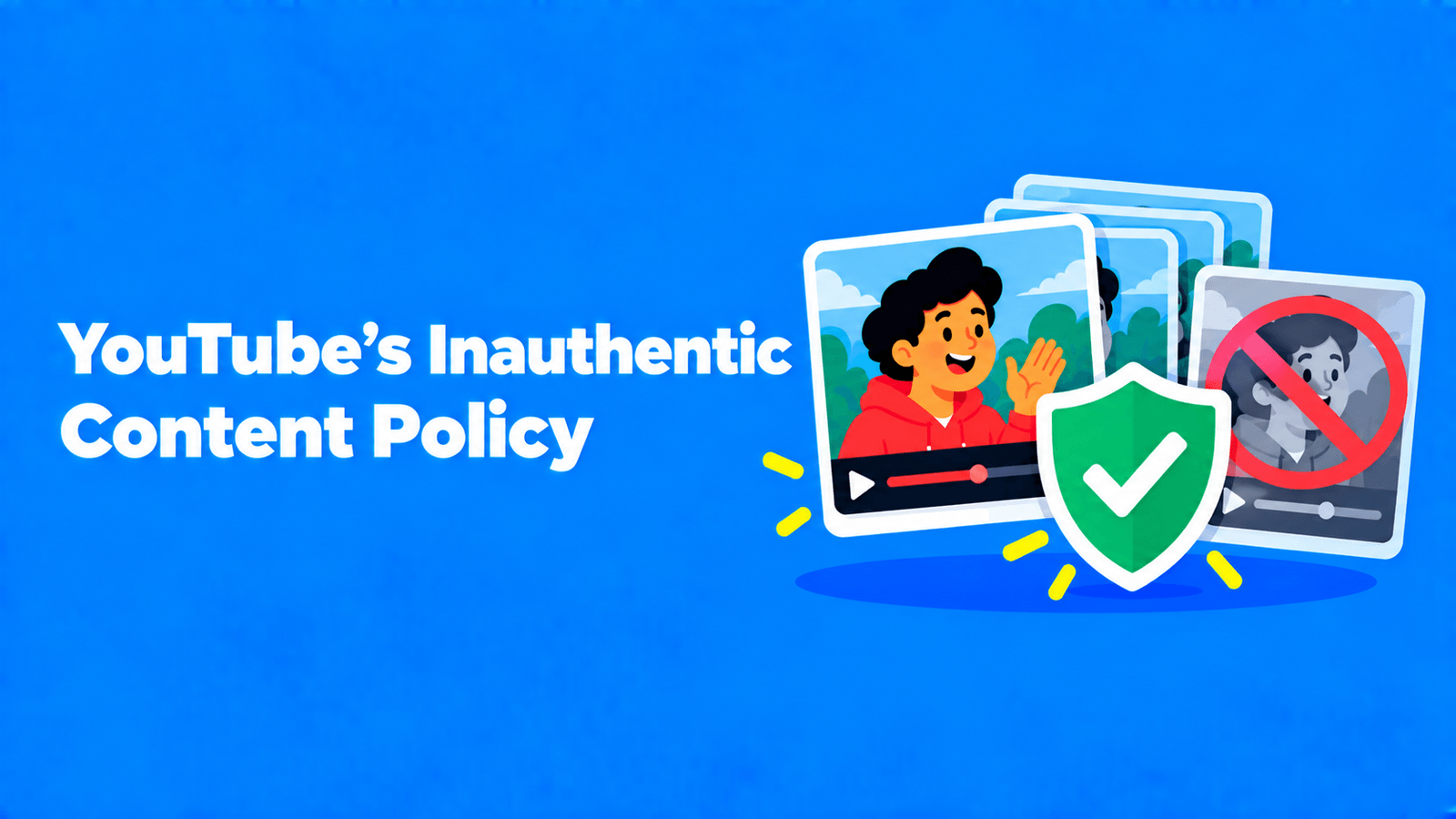
YouTube's inauthentic content policy is a YouTube Partner Program rule against mass-produced and repetitive videos. It was called the "repetitious content" policy until July 15, 2025, when YouTube renamed it and clarified that it covers "content that is repetitive or mass-produced" (YouTube Help). It sits next to the reused content policy, which covers uploading other people's material without adding "significant original commentary, substantive modifications, or educational or entertainment value." You can repurpose videos and keep your earnings. What gets channels demonetized is templated, low-variation uploads and reposting content without changing it in any meaningful way. Both rules are judged at the level of your whole channel, not one video.
What the policy says
YouTube's channel monetization policies list what is and isn't allowed under inauthentic content (YouTube Help).
Allowed:
- "Same intro and outro for your videos, but the bulk of your content is different."
- "Similar content, like a series following a set of characters across episodes or a channel that does product reviews, but in which each video has a distinct storyline, focus, or concept."
Not allowed:
- "Similar or repetitive content with low educational value, commentary, narratives, or minimal variation across videos."
- Videos where characters are put in the same situation over and over with the same outcome.
- Image slideshows, templated storylines or scrolling text with minimal narrative.
- AI-generated content made with generic or unoriginal templates that gives the impression of mass production.
What changed in July 2025
Very little in practice. YouTube called it a "minor update": the rename to "inauthentic content" and a clarification that mass-produced content is included. YouTube, including its creator liaison Rene Ritchie, said the update wasn't aimed at reaction or commentary videos, which "can continue to be monetized" if they add "significant original commentary, modifications, or educational or entertainment value" (Social Media Today).
The new name makes the target plainer: channels that publish near-identical videos at volume.
Inauthentic content vs reused content
| Inauthentic content | Reused content | |
|---|---|---|
| The question | Is this channel mass-producing near-identical videos? | Did this channel add enough to material that isn't originally its own? |
| Typical problem | Templated videos, repeated formats with minimal variation, AI slideshows | Clips, compilations or reposts with little or no change |
| Allowed example | A series with a shared intro but a distinct story in each episode | A reaction video where you comment on the original |
| Not allowed example | The same scenario and outcome over and over | Short videos compiled from other social media sites |
Three lines in the reused content policy matter most if you clip or repurpose (YouTube Help):
- "This policy applies even if you have permission from the original creator."
- "If we cannot clearly tell that you made the content, it may be subject to our reused content policy."
- Allowed: "Edited footage from other creators where you add a storyline and commentary."
Permission from the creator protects you from copyright problems, but not from reused content. If you're a paid clipper, the clips you post on your own channel still need your own editing and commentary to be monetized. See how to make money clipping.
Repurposing: what's safe and what's risky
| What you're doing | Risk | Why |
|---|---|---|
| Cutting Shorts from your own long videos, each with its own hook and edit | Low | It's clearly your content, and each clip stands alone |
| A weekly series with the same intro and format but new topics | Low | The policy explicitly allows a shared intro and outro |
| Reaction or review videos with real commentary | Low | Listed as allowed under reused content |
| Uploading raw highlights from someone else's stream, even with permission | High | Permission doesn't exempt you from reused content |
| Compilations of other people's short videos | High | Named as not allowed |
| Hundreds of AI-voiced slideshows built from one template | High | Templated, mass-produced content is the core of the policy |
| AI personas giving health, legal or financial advice | Not monetized | YouTube says these channels "will not be allowed to monetize" |
The policy text doesn't carve out an exception for clips of your own videos, so treat each repurposed clip as a new video: give it its own hook, its own edit and its own title.
A checklist before you upload repurposed clips
- Would this clip make sense to someone who never saw the original? If not, add context.
- Did you change it? Trim to the point, add captions, add a title card, reframe for vertical, add your commentary or a new structure.
- Is it obviously yours? Your face, voice, name or branding helps YouTube "clearly tell that you made the content."
- Are your uploads varied? If your last 20 videos use the same template with different words dropped in, that's the pattern the policy describes.
- Is the AI doing the creating, or helping you create? Using AI to cut, caption or translate is not the issue. Publishing generic AI output at volume is.
AI clipping tools, including Exemplary AI (our product), speed up steps 2 and 3: they find moments in your long video, reframe them, and add captions you can edit through the transcript. The judgement about what each clip says is still yours. See the YouTube Shorts maker.
For more on turning long videos into Shorts well, read our YouTube Shorts guide and best practices for repurposing video content.
What happens if YouTube flags your channel
Because the policy applies to your channel as a whole, "monetization may be removed from your entire channel" if YouTube finds violations or can't tell that you made the content (YouTube Help). YouTube lists possible outcomes including limited or no ad earnings, monetization being suspended or permanently disabled, and, in exceptional cases, channel termination.
That's why a pattern matters more than one weak video. Because YouTube judges the channel as a whole, a run of low-effort uploads can put all your earnings at risk.
Update: YouTube's July 2026 guidance
In July 2026 YouTube's VP of Trust and Safety, Matt Halprin, explained where YouTube is looking more closely: generic, repetitive content "generally made with templates", emotionally manipulative content, and AI personas talking about finance, legal issues or health care. He stressed that "the wording of YouTube's Inauthentic Content rules hasn't changed", as reported by Social Media Today. The policy text quoted above was checked on YouTube Help in September 2026.
FAQ
What is inauthentic content on YouTube?
Mass-produced or repetitive content with minimal variation between videos, such as templated videos, repeated scenarios or generic AI-generated uploads. It's a YouTube Partner Program policy, so it affects monetization.
Does the inauthentic content policy affect reaction channels?
Not if you add real commentary. YouTube lists "reaction videos where you comment on the original video" as allowed, and said in July 2025 that reaction and commentary content can still be monetized when it adds significant original value.
Can I repost my long videos as Shorts?
Yes. Make each Short work on its own with its own hook, edit and captions, rather than uploading raw slices of the original.
Is AI content demonetized on YouTube?
Not by default. The policy targets AI-generated content made with generic or unoriginal templates that looks mass-produced, and it bars monetization for AI personas presented as experts on sensitive topics like health, law, finance or politics.
Does permission from the original creator make clips safe?
For copyright, it helps. For monetization, no. YouTube says the reused content policy "applies even if you have permission from the original creator."