YouTube Views vs Engaged Views: What Changed in 2026
Since Aug 24, 2026 YouTube counts a view from the first frame. What engaged views are, where to find them, and how to compare and report your numbers now.

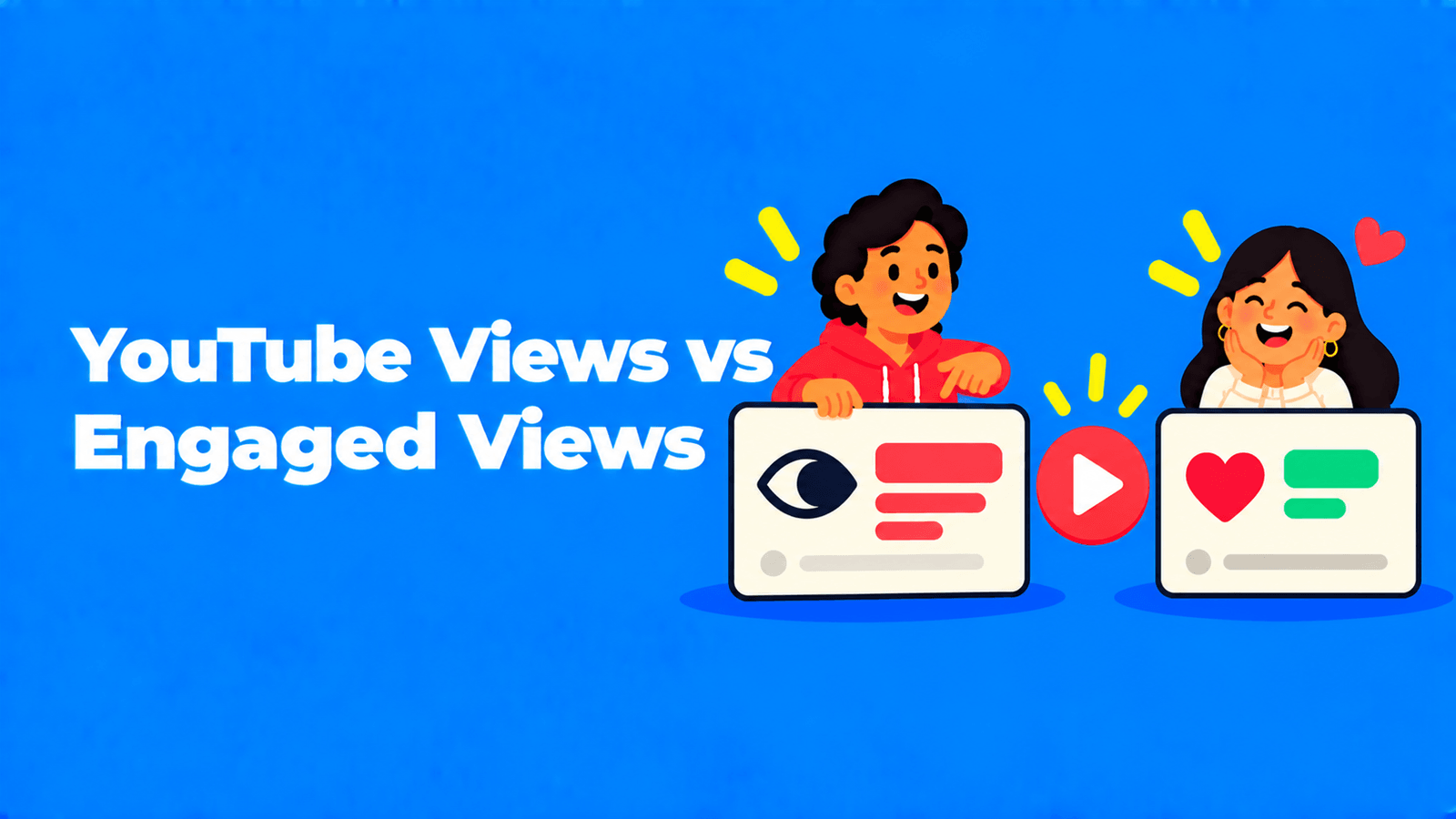
Since August 24, 2026, YouTube counts a view the moment a video starts to play, from the very first frame. That applies to Shorts, long-form videos, podcasts and live streams (YouTube Help Community). The old view count hasn't gone away. It's now called engaged views, and it lives in YouTube Analytics under Advanced Mode. An engaged view means the viewer clicked to watch or kept watching past the initial seconds (YouTube Official Blog). Earnings, YouTube Partner Program (YPP) eligibility and recommendations don't change. What does change is your public view count, which will likely grow faster from August 24, so any before-and-after comparison should use engaged views.
What changed, and when
YouTube made this change in two steps, Shorts first:
| Date | What happened | Source |
|---|---|---|
| March 31, 2025 | Shorts views start counting every time a Short starts to play or replays, with no minimum watch time. The old Shorts count is kept as "engaged views." | YouTube Help Community |
| August 17, 2026 | YouTube announces that all other formats will follow the same standard. | YouTube Help Community |
| August 19, 2026 | YouTube's blog explains the difference between views and engaged views. | YouTube Official Blog |
| August 24, 2026 | The new count starts for all formats, globally. | YouTube Help |
| August 27, 2026 | YouTube confirms the rollout across Shorts, long form, podcasts and live. | YouTube Help Community |
YouTube's reason is consistency. "Historically, we've used multiple view counting systems across different formats," its announcement says, and creators wanted to "eliminate this metric confusion and accurately understand their true exposure."
Because Shorts already switched in 2025, the August 2026 change mostly moves the numbers for long-form videos, podcasts and live streams.
Views vs engaged views
| View | Engaged view | |
|---|---|---|
| When it counts | From the first frame: a Short appearing in the feed, or a long-form video autoplaying on the Home page | When the viewer clicks or taps to watch, or keeps watching past the initial seconds |
| Where you see it | The public view counter, and wherever views appear on YouTube | YouTube Analytics > Advanced Mode |
| Used for earnings | No | Yes: "engaged Shorts views" and "engaged watch hours" |
| Used for YPP eligibility | No | Yes, as "qualified" views and watch hours on public content |
A few cases from YouTube's own explanation (YouTube Official Blog):
- A thumbnail you scroll past without interacting is a thumbnail impression, not a view.
- A thumbnail that starts autoplaying when you hover over it is a view from the first frame. If it keeps playing "for some amount of seconds," it becomes an engaged view.
- A click or tap on a thumbnail counts as both a view and an engaged view.
- A Short in the Shorts feed is a view the moment it starts to play, and an engaged view if it keeps playing for some seconds.
YouTube doesn't publish the exact number of seconds. You'll often see "30 seconds" quoted as the old rule for long-form views, but that figure doesn't come from YouTube, so don't build reports on it.
What didn't change
- Earnings. "Creator earnings will continue to be based on 'Engaged Shorts views' and 'Engaged Watch Hours'" (YouTube Help Community). More public views don't mean more money.
- YPP eligibility. The thresholds are the same: 1,000 subscribers plus either 4,000 qualified watch hours in the last 12 months or 10 million qualified Shorts views in the last 90 days (YouTube Help). Only the names changed: "qualified Shorts views" and "qualified watch hours" replace "valid public Shorts views" and "valid public watch hours." Separate YPP updates start on February 1, 2027; see YouTube Shorts monetization requirements for 2027.
- CTR, average view duration and retention. YouTube says "the vast majority of analytics remain anchored on engaged views," so these are calculated the same way as before (YouTube Official Blog).
- Recommendations. YouTube says there's "no change to recommendations."
How to read your analytics now
1. Don't compare raw views across August 24
Views before August 24, 2026 used the old method for long-form, podcasts and live. Views after it count from the first frame. A jump in views around that date can be the counting change, not a better video. For any trend line that crosses the date, switch to engaged views.
2. Find engaged views in Advanced Mode
- Sign in to YouTube Studio and select Analytics in the left menu.
- Under a report, click Advanced mode (or See more).
- In Metrics, add engaged views to the chart and table. YouTube's help page says you can "add or remove specific metrics to customize your own report" there (YouTube Help).
- Save the report so the comparison is one click next time.
YouTube notes it is gradually rolling out an updated Studio from July 2026, so your Analytics screens may look a little different.
3. Watch the gap between the two numbers
Views minus engaged views is, roughly, the plays that started but didn't hold: autoplays on hover, and Shorts swiped away in the first seconds. The ratio of engaged views to views tells you how often a start becomes a real watch. For Shorts, the Content tab already has a related report, "How viewers engaged," which shows "the percentage of times viewers stayed to watch past the initial seconds of a Short" (YouTube Help).
If that ratio drops on a Short, the first seconds are the problem. That's a hook fix, not a topic fix. Our guide to making Shorts from long videos covers how to pick openings that hold.
4. Judge videos by what YouTube judges them by
The public counter now rewards anything that starts playing, including Home-page autoplay. Retention, average view duration and CTR are still built on engaged views, and YouTube says recommendations haven't changed. Our explainer on audience-content fit and the YouTube algorithm goes deeper on what drives recommendations.
5. Know how ads are counted
If you run ads for your videos, ad views that add to your public view count are counted the moment a video ad starts to play, across Shorts and in-stream ads. Those public views aren't what you pay for: TrueView views are the billable ones. For a skippable in-stream ad, that's a complete watch of an 11 to 30-second ad, at least 30 seconds of a longer one, or an interaction (YouTube Help).
What it means for sponsor reporting
YouTube pitches the new count as a way for creators to "confidently express their true scale and value to brand partners and sponsors" (YouTube Help Community). Bigger numbers help in a pitch, but they also make old benchmarks look worse by comparison. A few habits keep reports honest:
- Report both numbers, labelled. Views (counted from the first frame since August 24, 2026) and engaged views side by side.
- Say which metric a deal is priced on. If a contract pays per view or promises a view guarantee, write down whether that means views or engaged views.
- Benchmark past campaigns on engaged views. A sponsor comparing this quarter with last year's integrations needs the same yardstick on both sides of August 24.
- Add reach metrics. The Content tab also shows unique reach, the estimated number of individual people who saw your content, and Views (Co-viewed), an estimated view count that includes multiple people watching together (YouTube Help).
FAQ
Does YouTube still count a view after 30 seconds?
YouTube never published a fixed number of seconds. Since August 24, 2026, a public view counts from the first frame. An engaged view counts when someone clicks to watch or keeps watching past "the initial seconds," and YouTube doesn't say how many.
Will I earn more now that my views are higher?
No. Earnings are still based on engaged Shorts views and engaged watch hours, which are counted the same way as before.
Does this change affect YPP eligibility?
No. The thresholds are unchanged. They're now called qualified watch hours and qualified Shorts views instead of valid public watch hours and valid public Shorts views.
Why did my long-form views jump in late August 2026?
Most likely the counting change. From August 24, 2026, long-form, podcast and live views count from the first frame, including autoplays. Check engaged views for the same dates to see whether real watching went up too.
Where do I find engaged views?
In YouTube Studio, go to Analytics, open a report in Advanced mode and add engaged views in Metrics.
Do Shorts replays count as views?
Yes. Since March 31, 2025, Shorts views count each time a Short starts to play or replays, with no minimum watch time.