What belongs in an AI agent audit trail?
Build an observable record of who requested an agent action, what was authorized, what ran, and which result was confirmed in the target system.

Sarath Chandran
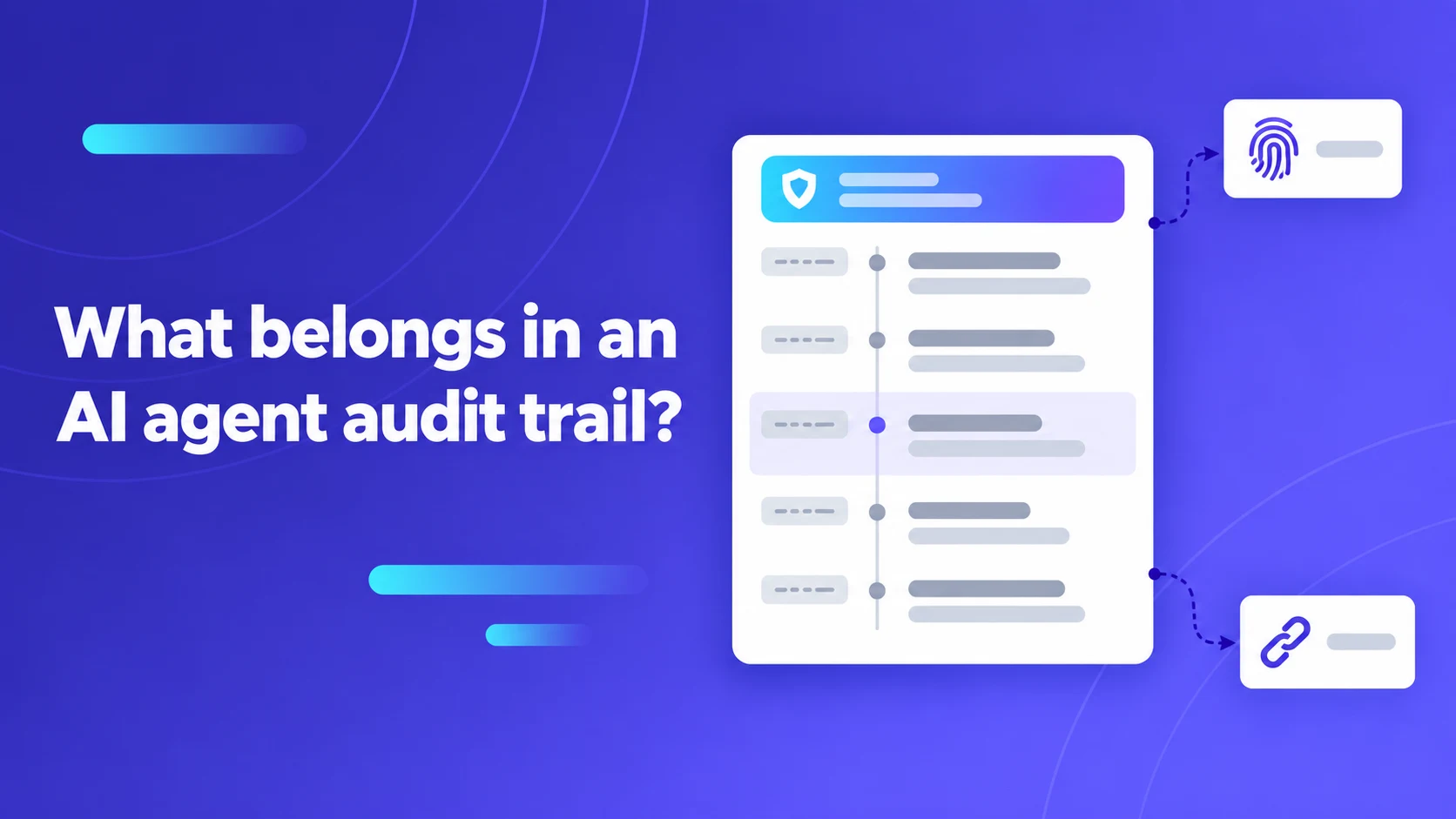
An AI agent audit trail should let an authorized reviewer reconstruct what the agent attempted, under whose authority, against which resource and with what confirmed result. A chat transcript alone rarely answers all of those questions. It records what was said, while a useful action record also connects decisions to execution.
As autonomous AI agents evolve from passive text generation assistants into active enterprise actors capable of modifying ERP ledgers, issuing SQL database updates, altering firewall security policies, and deploying code to production repositories, traditional conversational logging becomes completely obsolete. When an enterprise auditor or security incident response team investigates an unauthorized financial transaction or an unintended database drop, presenting a natural language chat transcript saying "I have updated the vendor payment record per your request" is legally and forensically insufficient. A regulatory audit demands deterministic proof: Which authenticated user authorized the task? What tool parameters were emitted? Which IAM role did the connector assume? What was the upstream source document version? And what exact state change occurred in the destination system of record?
Key Architecture Rule: Decouple conversational chat transcripts from the immutable execution audit trail. Every state-modifying action initiated by an AI agent must generate a cryptographically signed, structured audit span capturing the causal graph: requester identity, grounding evidence, proposed state delta, authorization proof, tool invocation parameters, and destination receipt.
Work backward from a forensic post-incident investigation
To design a defensible audit trail architecture, engineering teams should avoid asking "What telemetry can our agent framework export?" Instead, work backward from the forensic questions a compliance officer or incident response investigator must answer during an emergency review:
- User Intent & Provenance: Who initiated the session, and what exact user prompt triggered the agent's chain of thought?
- Contextual Grounding: Which specific document versions, database rows, or API responses did the agent retrieve as grounding context before deciding to act?
- Proposed Action vs. Executed Action: What payload did the LLM propose, did it require human approval, and did the user approve that exact payload or an altered variant?
- Identity & Delegation: Under whose operational authority did the tool execute—the logged-in end user (delegated token) or a shared service account?
- Target System Mutating Receipt: What transaction ID, HTTP status code, or database commit timestamp was returned by the external system of record?
The table below traces an illustrative synthetic agent workflow: an autonomous agent tasked with updating an enterprise project milestone after analyzing newly uploaded contract amendments. The events below are deliberately synthetic and illustrative; they do not represent customer data or specific platform schemas.
| Sequence event | Retained forensic evidence | Critical auditor verification question |
|---|---|---|
| 1. Request Ingestion | User identity usr_892, Session ID ses_441, Raw prompt. | Who initiated the task, and what scope was requested? |
| 2. Evidentiary Retrieval | Document contract_rev_4.pdf, SHA-256 hash, page 12 coordinates. | What verified source text justified the proposed change? |
| 3. Action Proposal | Proposed JSON payload: { "milestone": "Phase 2", "date": "2026-11-01" }. | What exact system state was the agent attempting to alter? |
| 4. Policy Authorization | Policy engine evaluation decision ALLOW, Role Engineering_Lead. | Was the user and agent tool permitted to execute this action? |
| 5. Human-in-the-Loop Sign-off | Approver mgr_104, Approval Token, Cryptographic signature. | Who verified the action, and which exact payload version was approved? |
| 6. Tool Dispatch | Tool JiraClient.update_issue, Correlation ID tx_99812. | What raw API call crossed the enterprise network boundary? |
| 7. System Confirmation | Destination receipt HTTP 200, Revision v14, Commit hash. | Did the target system successfully apply the mutation? |
This structured chain separates what the agent intended to do from what the external system actually committed. If the tool call times out at Stage 6, the audit log reflects an unresolved state rather than falsely reporting that the project milestone was successfully updated.
Establish a unified correlation thread across distributed spans
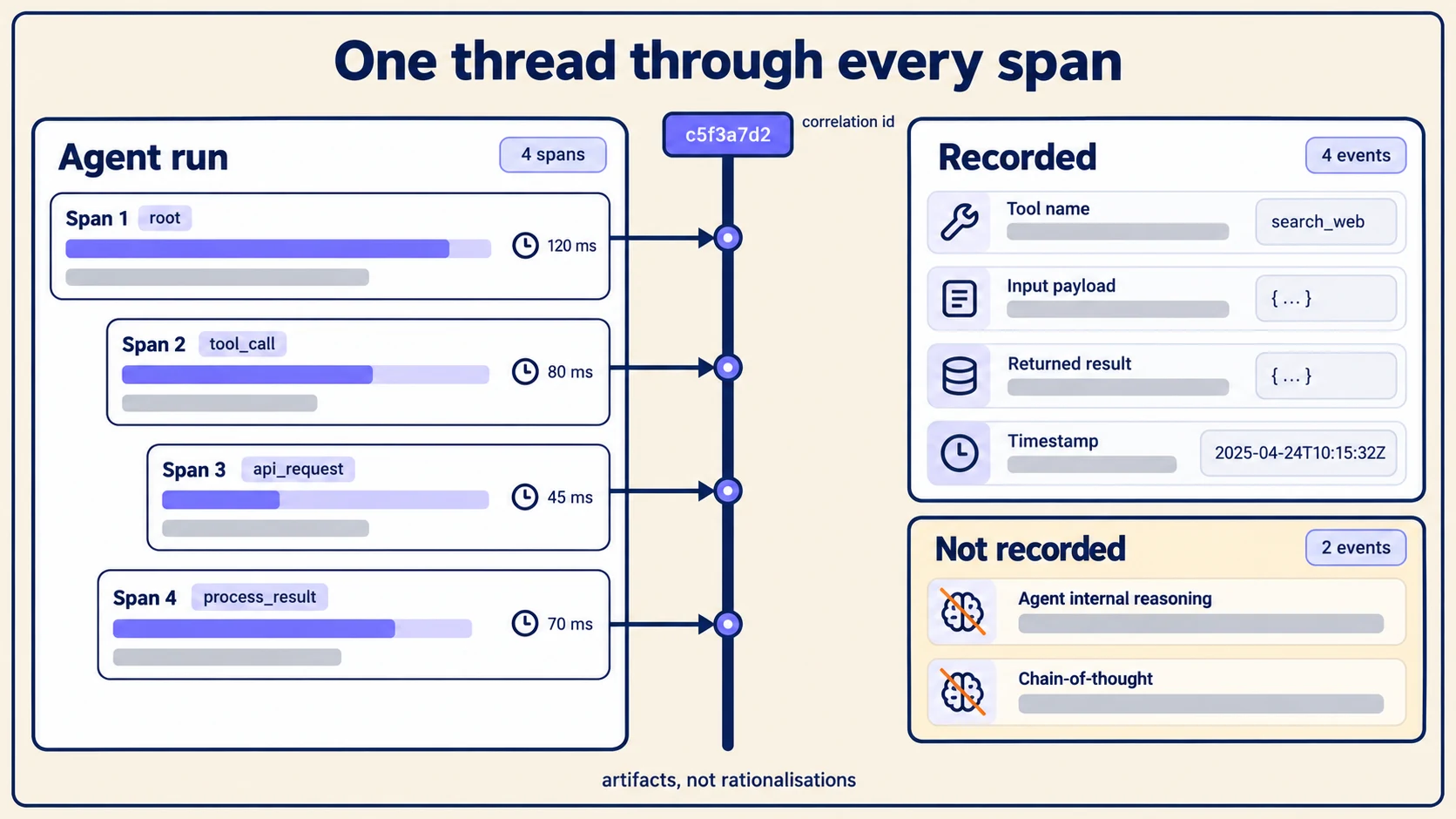
In enterprise agentic architectures, a single user prompt frequently cascades into dozens of asynchronous microservice interactions: vector similarity searches, sub-agent delegations, intermediate code sandbox executions, and third-party API mutations. If log records are scattered across disparate logging silos without a common correlation thread, reconstructing an incident requires days of painful manual log correlation.
Adopt distributed tracing standards based on the OpenTelemetry tracing specification, which links distributed operations via hierarchical trace identifiers:
trace_id(Root Session Context): A globally unique 128-bit identifier that binds the initial user prompt across all downstream calls.span_id(Execution Unit): Unique identifiers assigned to each discrete operational step (e.g., prompt formatting span, vector search span, tool invocation span).parent_span_id(Causal Provenance): Pointers establishing the exact parent-child causal relationships between calling agents and invoked tools.
Do not confuse performance traces with compliance audit records. OpenTelemetry traces are frequently sampled (e.g., retaining only 5% of traces to conserve APM storage), whereas regulatory audit trails require 100% deterministic capture of every state-modifying action.
Retain empirical execution artifacts, not speculative model rationalizations
When asked to explain its actions, an LLM might emit a convincing conversational narrative: "I updated the vendor payment terms because Section 4.2 of the master service agreement specified Net-45." While helpful for human conversation, this natural language explanation is a generative rationalization, not an empirical proof.
To achieve genuine non-repudiation:
- Inspect Verbatim Tool Calls: Anthropic’s engineering guidance on writing tools for agents emphasizes logging the exact, raw tool parameters generated by the model and the verbatim return payloads from the tool execution sandbox.
- Store Cryptographic Digests: If source documents or tool responses are too massive to store inline within log records, record their cryptographic SHA-256 digests and store the raw payload in a write-once-read-many (WORM) compliant object store.
- Capture Negative Denials & Abstentions: Log every authorization denial, format validation failure, and tool timeout as a first-class audit event. If an agent attempted an unauthorized database drop and was intercepted by policy middleware, that blocked attempt is vital security telemetry.
Pro Tip: Always capture both the pre-execution payload and the post-execution response. If an agent calls an external payment API and experiences a network drop before receiving a response, the audit trail must record an UNCONFIRMED_IN_FLIGHT status. Assuming failure when a payment might have been committed on the bank server leads to catastrophic duplicate payments.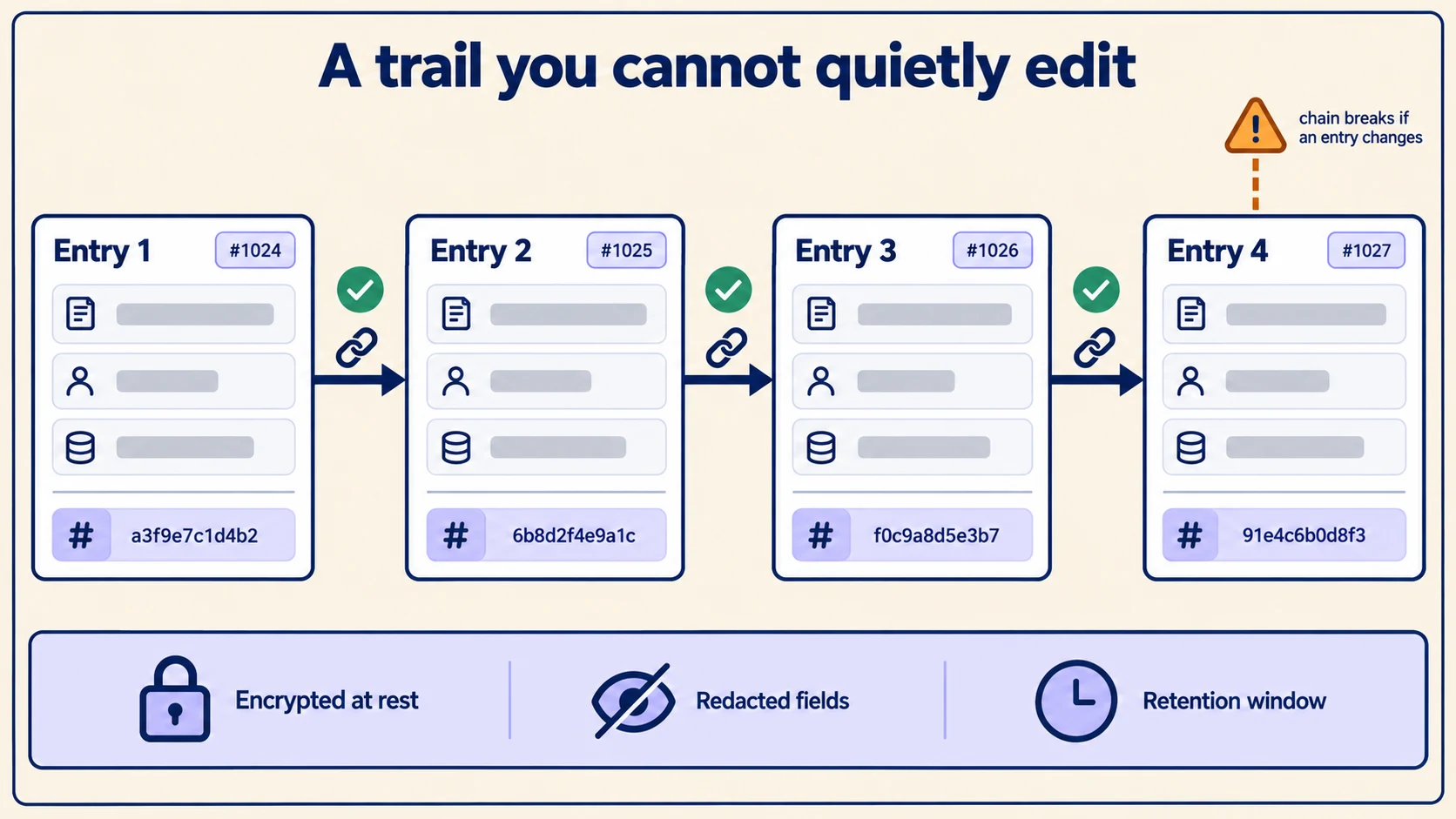
Ensure tamper resistance and protect audit stores from data leakage
An audit store that can be modified or truncated by compromised credentials fails basic regulatory compliance standards under SOC 2, HIPAA, and Sarbanes-Oxley:
- Immutable, Append-Only Storage: Forward audit spans immediately to a dedicated, write-only logging cluster or immutable cloud bucket with Object Lock enabled. Platform administrators and AI service accounts must possess zero permissions to edit, truncate, or overwrite historical audit rows.
- Automated PII Redaction in Audit Spans: While audit logs must capture execution parameters, they should not become an un-monitored reservoir of unencrypted passwords, credit card numbers, or patient medical records. Apply automated token scrubbing at the logging forwarder to mask sensitive secrets before persistence.
- Cryptographic Merkle Trees: For ultra-high-security environments, link audit log entries in sequential cryptographic hash chains (Merkle trees), where altering any historical entry mathematically invalidates all subsequent log signatures.
Execute a forensic reconstruction rehearsal
To verify that your audit architecture functions in practice, conduct an unannounced forensic reconstruction drill with your enterprise security operations and compliance team:
- Provide an internal auditor with a single synthetic database record that was modified by an autonomous agent.
- Instruct the auditor to reconstruct the complete causal chain using exclusively production audit dashboards:
- Identify the user who submitted the request.
- Retrieve the exact document version that informed the agent's decision.
- Inspect the human approval token and the approving manager's identity.
- Verify the exact tool invocation payload and response latency.
- Document any gaps where information is missing, ambiguous, or unverifiable.
Feed audit findings directly into your governance framework to refine human approval boundaries and enforce least-privilege tool permissions.
For complementary evaluation frameworks governing grounded answers and citation verification, consult our enterprise knowledge assistant evaluation guide.
To explore how our platform architecture enforces enterprise auditability, review Exemplary AI Management and schedule an enterprise architecture demo to evaluate live agent audit logging and compliance reconstruction tooling.