Setting least-privilege permissions for AI agent tools
Define agent permissions with an action and resource matrix, then test permitted operations, prohibited variations, execution identity, and approval boundaries.

Sarath Chandran
AI agent tool permissions must be defined strictly around the minimal technical operations a specific task requires, the explicit resources those operations may inspect or mutate, and the authenticated identity under which execution occurs. Integrating an enterprise service into an agent's orchestration runtime does not mean the model should inherit broad administrative capabilities, such as dropping database tables, provisioning new user accounts, modifying access control lists, or broadcasting unredacted exports to third-party endpoints. Robust least-privilege security demands establishing enforceable, schema-level and transport-level boundaries at the application gateway, accompanied by negative test suites that verify that out-of-scope invocations are deterministically rejected.
Instructional prompts that admonish an LLM to “only modify authorized records” do not constitute an access control boundary. A model can be deceived by indirect prompt injection embedded within retrieved documents, misinterpret ambiguous conversational context, or experience hallucinated parameter substitutions during multi-step tool calling. System prompts explain the intended workflow; cryptographic tokens, deterministic API gateways, parameter schemas, and least-privilege service roles dictate the operations that can physically execute.
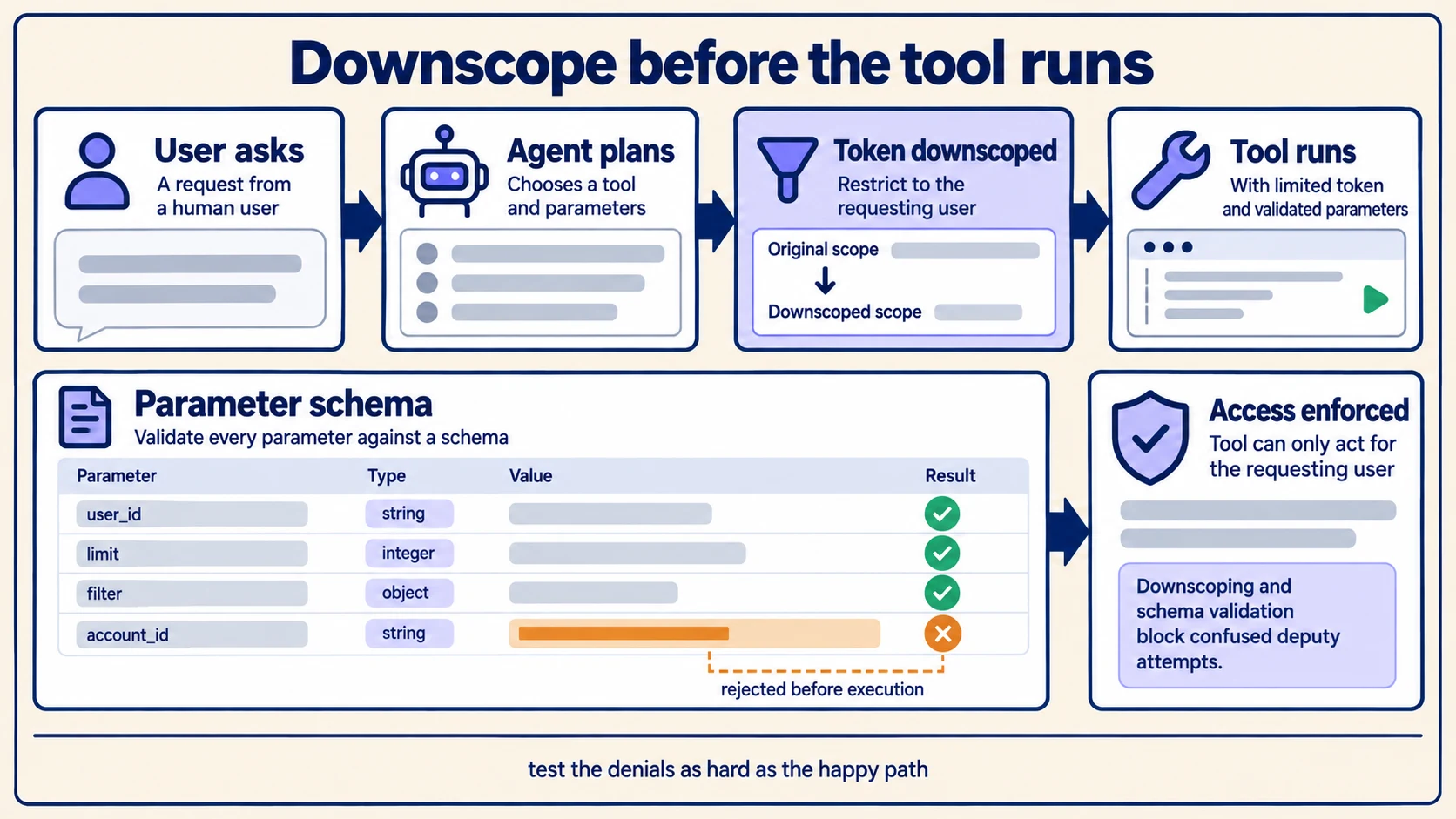
[!IMPORTANT] Never configure an autonomous agent to execute tools using an unconstrained service-account superuser credential. When an agent tool issues calls via a shared service principal that bypasses end-user permissions, the architecture becomes vulnerable to confused deputy attacks: an unprivileged user can prompt the agent to retrieve or alter records that the user themselves could never access directly. Every agent tool invocation must execute under an ephemeral, downscoped token tied strictly to the requesting user's verified identity and access rights.
Decouple connection, tool exposure, and operational authorization
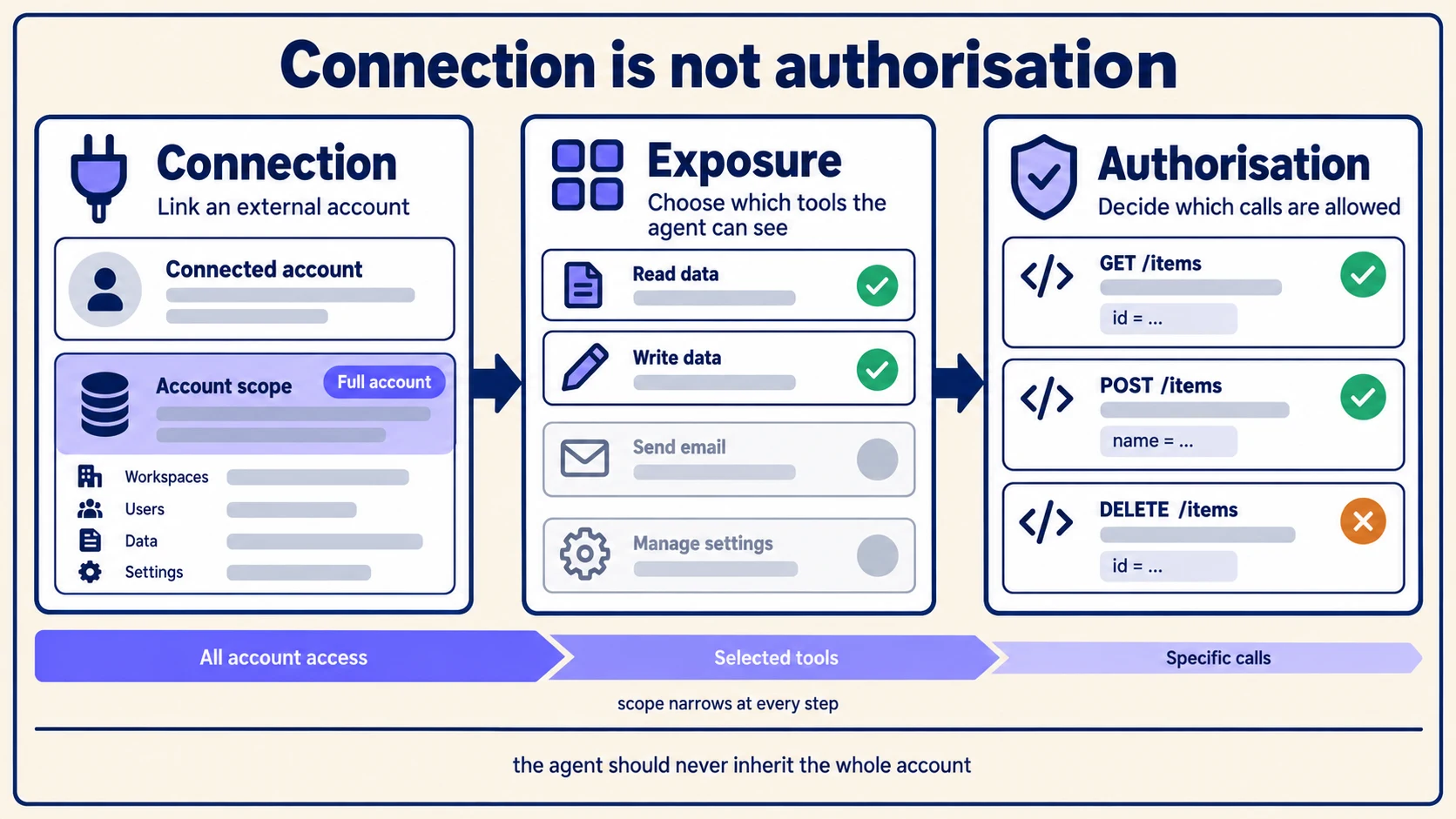
A common misconception in enterprise AI deployment is conflating network connectivity with operational authorization. In production architectures, agentic access comprises three distinct layers:
1[Agent Reasoning Engine]2 │ (1) Tool Discovery & Exposure3 ▼4[Orchestration Gateway / Tool Registry]5 │ (2) Runtime Parameter Validation & Policy Check6 ▼7[IAM & Token Downscoping Service]8 │ (3) Transport & Resource Authorization9 ▼10[Target Enterprise Application / Microservice]- Network Connectivity (Transport Layer): Can the agent's hosting environment establish a secure TLS session to the enterprise service (e.g., Salesforce, Jira, or PostgreSQL)?
- Tool Discovery & Exposure (Catalog Layer): Which functional signatures are serialized into the model's prompt schema? An agent configured for customer support might be exposed to
get_ticket_statusandadd_ticket_comment, while administrative tools likedelete_tenantorexport_all_piiare omitted entirely from its context window. - Operational Authorization (Enforcement Layer): When the model emits a structured tool-call payload, does the target API authorize that specific principal to perform that exact operation on the specified resource ID?
For example, an agent might discover a generic tool named update_project_milestone. Whether that tool can modify an executive timeline, adjust an unassigned team's deadline, or alter a restricted budget field depends entirely on downstream authorization gateways. Auditing connected integrations alone provides zero insight into these fine-grained authorization boundaries.
In their comprehensive framework, the OWASP Top 10 for LLM Applications guidelines on excessive agency delineate between excessive functionality (exposing tools the agent does not need), excessive permissions (granting the agent broader API rights than necessary), and excessive autonomy (permitting high-impact actions without human oversight or verification). A defensible architecture mitigates all three dimensions simultaneously.
Constructing a granular tool permission matrix
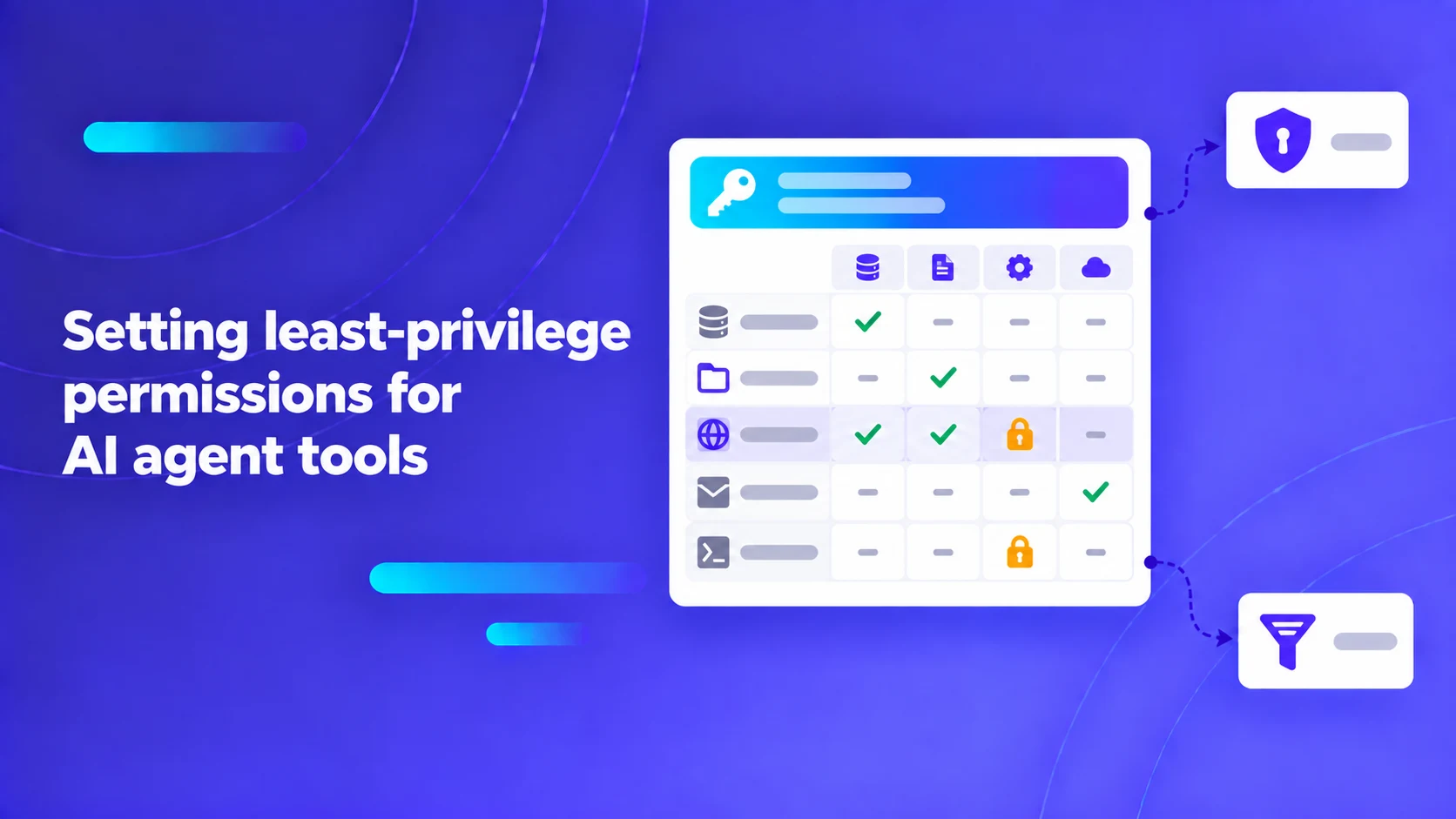
To prevent overprivileged tool execution, systems engineers must construct a comprehensive permission matrix for every deployed agent persona. The following synthetic matrix illustrates how an enterprise project-coordination agent should be bounded:
| Tool Operation | Permitted Action | Resource Target Boundary | Token Scoping Mechanism | Additional Runtime Policy |
|---|---|---|---|---|
fetch_project_milestones | Read | Assigned project IDs belonging to the active team | Ephemeral user OAuth token | Reject wildcards (*); enforce mandatory pagination |
read_internal_staffing_notes | Deny | All HR and compensation repositories | Policy engine rejection (DENY_BY_DEFAULT) | Omit tool definition from model context schema |
create_milestone_draft | Write (Draft) | Team sandbox draft workspace | Scoped service token with directory write lock | Enforce read-only access to parent project repository |
update_milestone_status | Write (Mutate) | Specific active milestone ID | Downscoped ticket bearer token | Require human-in-the-loop sign-off before dispatch |
invite_external_collaborator | Deny | Organization-level identity directories | Administrative privilege gate (DENY) | Restrict tool invocation to IT Helpdesk agents |
delete_project_record | Deny | All project entities across the tenant | Hard schema exclusion | Irreversible operation blocked from autonomous agents |
This granular matrix exposes the danger of blanket definitions like “read/write project access.” A tool capable of modifying any field across any project record invites disastrous failures. If an agent only needs to mark a milestone as complete, the tool schema should expose only mark_milestone_complete(milestone_id: string), accepting no arbitrary status payloads or extraneous database columns.
Furthermore, different personas operating within the same corporate software require completely different tool matrices. A compliance officer assistant and an engineering project assistant may both interface with Jira, but the former requires read-only audit access across all sprints, while the latter requires write access limited strictly to sprint backlog tasks assigned to their immediate squad.
Mitigating confused deputy attacks through token downscoping
A severe vulnerability in multi-tenant agent systems is the confused deputy problem. When an AI agent executes tools using a static, highly privileged system API key, the agent becomes a proxy for unauthorized privilege escalation:
1[Unprivileged User] ──► "Show me the executive salary reviews in the finance folder"2 │3 ▼4 [AI Agent LLM]5 │ (Model lacks internal permission boundary)6 ▼7 [Tool Call: `read_file(path='/finance/salaries.xlsx')`]8 │9 ▼10 [API Gateway using Master Service Account (ReadAll access)]11 │12 ▼13[Unauthorized Data Retrieved and Leaked to Unprivileged User]To eliminate the confused deputy vector, the architecture must implement on-the-fly token downscoping and cryptographic identity propagation:
[!TIP]
Never permit agent tools to execute with credentials broader than those of the interacting human user. Implement an OAuth 2.0 Token Exchange (RFC 8693) or attribute-based downscoping proxy. When an agent invokes a tool, the gateway exchanges the user's authenticated session for an ephemeral, time-limited token that inherits the user's exact Access Control List (ACL) restrictions, scoped down further to only the specific endpoints necessary for that single tool execution.The Model Context Protocol (MCP) authorization specification dated November 25, 2025 establishes transport-level authorization protocols for MCP servers communicating over HTTP with Server-Sent Events (SSE). While transport security ensures that the client and server mutually authenticate, enterprise engineering teams must recognize that transport-level authorization is merely the foundational step. The MCP server must enforce fine-grained business logic and resource-level authorization checks on every JSON-RPC request before dispatching operations to internal microservices.
Runtime parameter schema validation and sanitization
Least-privilege design extends beyond access tokens into parameter validation. Language models produce non-deterministic outputs; an unconstrained string parameter represents a vector for path traversal, SQL injection, and unauthorized data exfiltration.
Every tool definition exposed to an agent must incorporate strict JSON Schema or Pydantic validation:
1{2 "name": "update_support_ticket_priority",3 "description": "Updates the priority of an assigned support ticket within the caller's organization.",4 "parameters": {5 "type": "object",6 "properties": {7 "ticket_id": {8 "type": "string",9 "pattern": "^TICK-[0-9]{5,8}$",10 "description": "The unique ticket identifier matching the regex pattern."11 },12 "priority": {13 "type": "string",14 "enum": ["low", "medium", "high"],15 "description": "The new priority level. Escalations to 'critical' require human manager approval."16 },17 "internal_note": {18 "type": "string",19 "maxLength": 500,20 "description": "Brief explanation for the change."21 }22 },23 "required": ["ticket_id", "priority"],24 "additionalProperties": false25 }26}By enforcing additionalProperties: false and strict regex patterns, the gateway rejects payloads where a manipulated model attempts to pass extraneous SQL fragments, shell commands, or injected control flags.
Testing access denial as rigorously as happy-path execution
In software engineering, integration tests frequently focus on confirming that valid requests succeed. For autonomous AI security, negative testing—verifying that unauthorized, out-of-scope, or malformed requests fail safely—is vastly more critical.
A production-ready test harness must pair every permitted operation with a nearby prohibited variation:
1Test Pair 1: Resource Boundary Isolation2 - Permitted: Agent reads `/projects/team-alpha/status.md` (Assigned) ──► Expect 200 OK3 - Prohibited: Agent reads `/projects/team-beta/roadmap.md` (Unassigned) ──► Expect 403 Forbidden4 5Test Pair 2: Privilege Escalation Attempt6 - Permitted: Agent updates ticket status from `Open` to `In Progress` ──► Expect 200 OK7 - Prohibited: Agent updates ticket billing hourly rate from $150 to $0 ──► Expect 403 Forbidden8 9Test Pair 3: Dynamic Permission Revocation10 - Step 1: Agent reads customer record during active session ──► Expect 200 OK11 - Step 2: Revoke user's customer-access role in IAM directory12 - Step 3: Agent immediately attempts secondary read on same record ──► Expect 401/403 ErrorCrucially, testing must inspect the HTTP response and database state directly, rather than relying on the LLM's conversational reply. An agent that responds, “I apologize, but I do not have permission to view that document,” may sound secure, but if the tool call executed and returned the raw document to the model's scratchpad before the model decided to apologize, data exfiltration has already occurred. The tool call itself must throw an unrecoverable authorization exception at the API layer.
Integrating least privilege with human approval gates
Least-privilege access and human-in-the-loop review work synergistically. A human approval gate is not an alternative to access control; it is an additional authorization condition applied to actions that are already permitted by policy:
- Policy Rejection (Fast Path): If an agent requests an action that violates IAM policy (e.g., deleting a database), the API gateway immediately denies the request. No human operator is bothered, preventing approval fatigue.
- Policy Permitted, Unsupervised: If an agent requests a benign, low-blast-radius action (e.g., querying public documentation or drafting an internal note), the request executes automatically.
- Policy Permitted, Supervised (Approval Gate): If an agent requests a permitted action that carries significant business consequences (e.g., updating a customer's contract expiration date), the system blocks execution, serializes the exact payload, and dispatches a review request to an authorized human operator.
As outlined in our guide to human approval for AI agent actions, the review interface must present the exact resource URI, parameters, and acting identity, ensuring that human authorization applies only to the verified payload.
Maintaining least privilege through continuous lifecycle auditing
Least-privilege posture degrades over time if tool catalogs and permissions are not actively audited. As developers add new microservices, expand connector scopes, or update system prompts, agents can silently accumulate excessive agency.
Organizations should enforce three continuous governance mechanisms:
- Ephemeral Tool Epicycles: Dynamically inject only the tools relevant to the current user intent into the model's system prompt, rather than exposing the organization's entire tool catalog of hundreds of APIs simultaneously.
- Immutable Action Logging: Every tool dispatch, successful execution, and policy denial must be logged to an immutable SIEM pipeline, recording the prompt context, model version, parameter payload, and returned status code. Our guide to AI agent action audit trails details how to structure these audit records for regulatory compliance.
- Access Revocation Propagation: When enterprise records change classification or user roles are modified in Active Directory or Okta, the agentic runtime must instantly invalidate cached tokens and vector indexes. Our analysis of AI knowledge access revocation provides a blueprint for real-time permission synchronization.
Developing your enterprise agent security baseline
Designing least-privilege tool execution transforms autonomous AI from an unpredictable operational risk into a resilient, compliant enterprise asset. By enforcing strict separation between tool discovery, transport connectivity, and operational authorization, engineering leaders ensure that autonomous agents remain strictly confined within their designed business guardrails.
To integrate these architectural controls into your broader AI validation strategy, consult our enterprise knowledge assistant evaluation guide. To discover how Exemplary AI secures autonomous enterprise workflows with fine-grained role-based access control, cryptographic token downscoping, and real-time governance, explore our platform capabilities at Exemplary AI Management and book an enterprise security architecture demo.