How to evaluate an enterprise knowledge assistant
A practical evaluation method for enterprise knowledge assistants: define scope, assemble evidence-backed questions, test freshness and access, and make a traceable acceptance decision.

Sarath Chandran
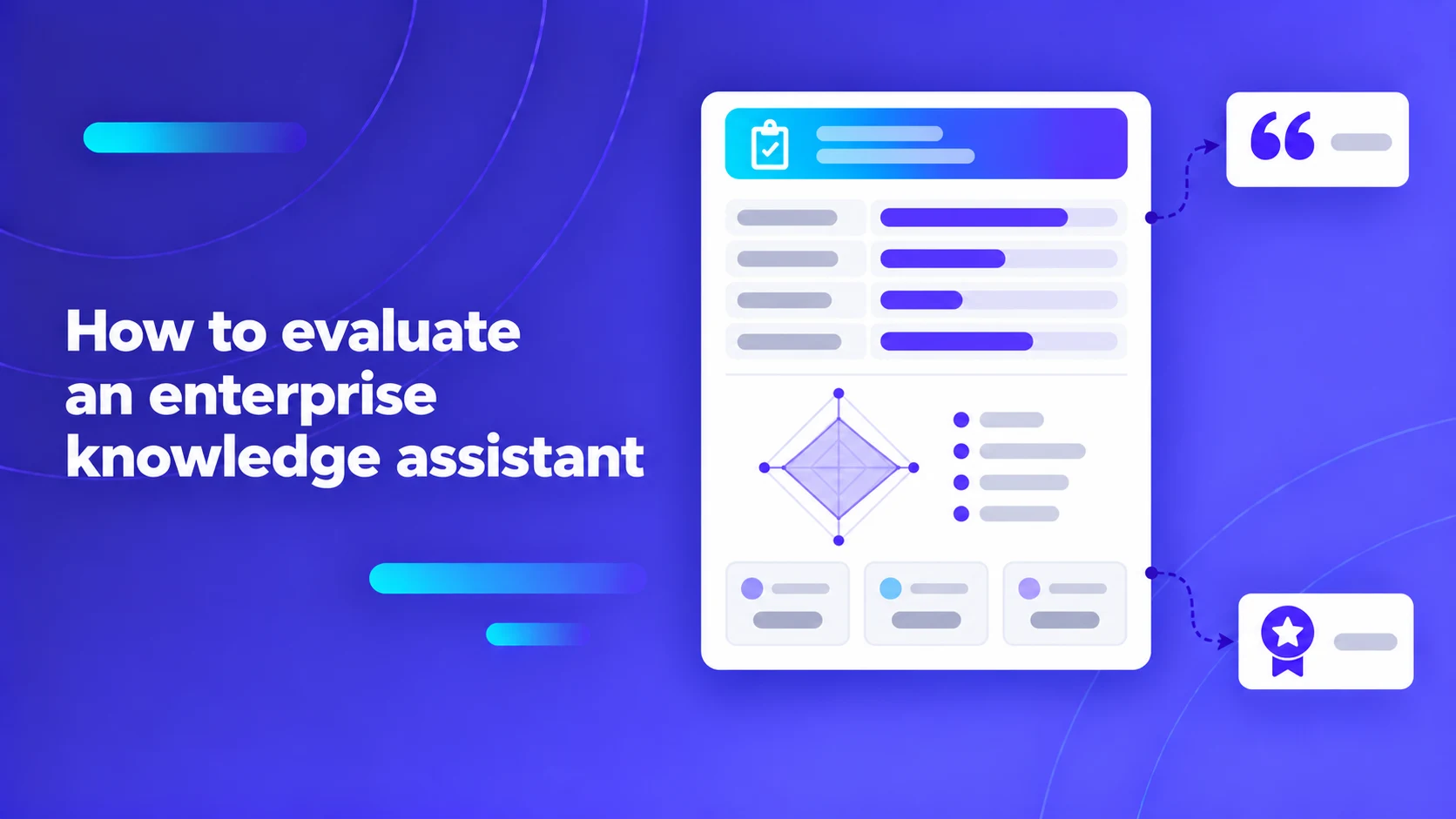
Enterprise knowledge assistant evaluation begins with assembling a representative, curated suite of real-world enterprise inquiries, defining explicit source boundaries and role-based access controls, and implementing an evidence-based scoring rubric that rigorously tests synthesized claims against ground-truth source passages. Evaluating an autonomous assistant or retrieval-augmented generation (RAG) system cannot rely on anecdotal executive demonstrations or subjective "helpfulness" impressions. A production-grade evaluation framework subjects the system to deliberate adversarial permutations—including superseded documents, conflicting policies, permission revocations, and out-of-scope inquiries—measuring whether the assistant reliably answers, abstains, cites evidence, or escalates to human oversight.
A dependable evaluation methodology decouples the assessment into distinct, independently measurable architectural layers: retrieval performance, semantic entailment, conversational grounding, tool invocation accuracy, and boundary enforcement. By isolating failure modes across these discrete stages, engineering leaders and business stakeholders can make defensible, data-backed go/no-go deployment decisions rather than deploying uncalibrated models into high-stakes business environments.
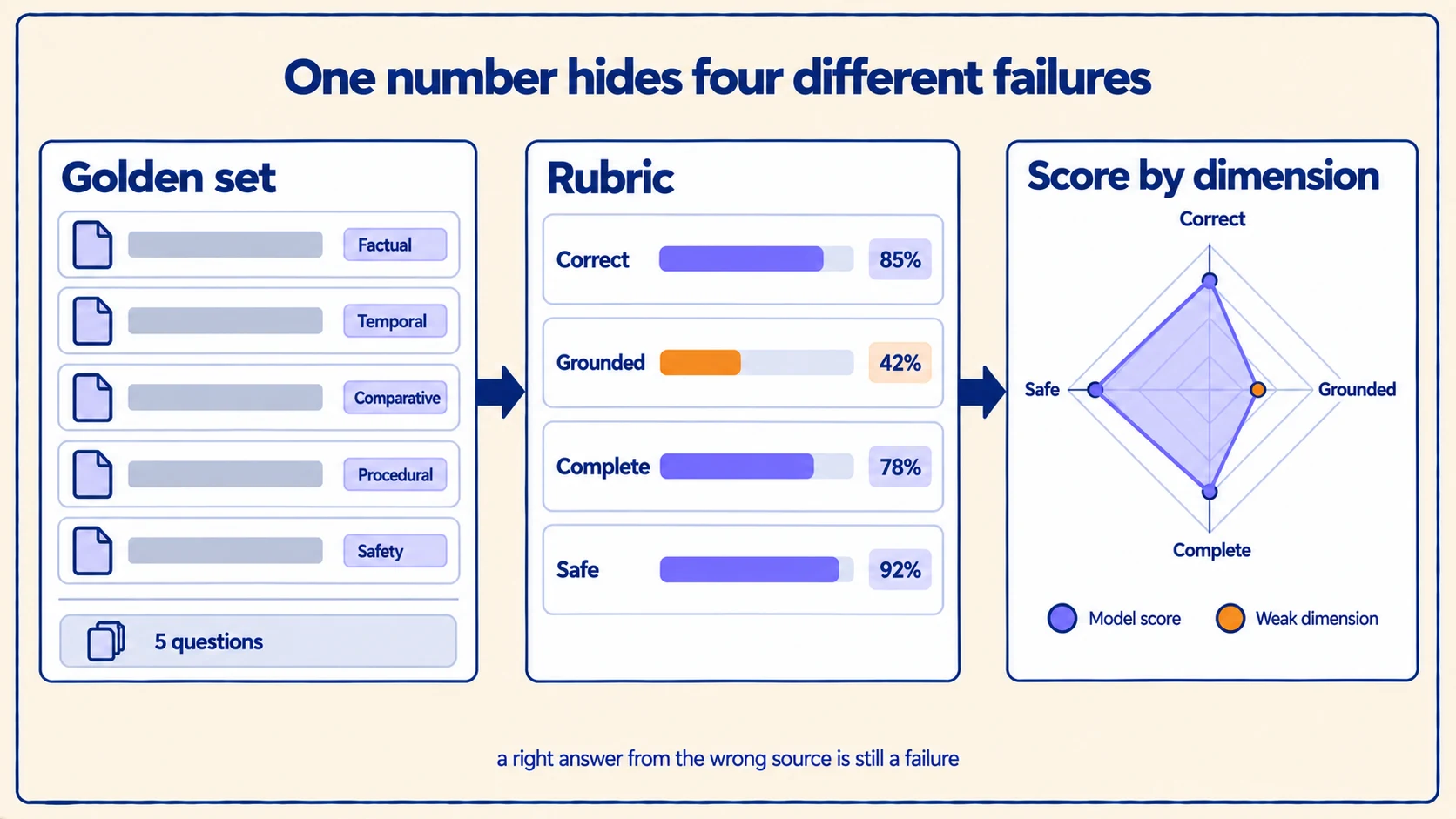
[!IMPORTANT] Never evaluate an enterprise knowledge assistant using aggregated percentage scores alone. An overall accuracy rating of 94% can easily mask a 100% failure rate on critical regulatory boundaries or access-revocation rules. Production acceptance criteria must establish hard, non-negotiable blocking gates: any failure to respect document security ACLs, any silent hallucination on financial calculations, or any unauthorized mutation of external records must immediately halt deployment regardless of high aggregate scores.
1. Establishing the evaluation charter and decision boundaries
Before indexing corporate repositories or prompting models, organizations must draft an explicit evaluation charter. This document aligns technical architects, compliance officers, and operational business leads around the specific problem statement, authorized user personas, participating knowledge silos, and objective acceptance thresholds.
1 ┌─────────────────────────────────────────┐2 │ Enterprise Evaluation Scope │3 └────────────────────┬────────────────────┘4 │5 ┌──────────────────────────────┼──────────────────────────────┐6 ▼ ▼ ▼7[Persona & IAM Mapping] [Knowledge Boundary Def] [Operational Gateways]8- Senior Project Manager - Active Q3/Q4 Project Plans - Zero ACL leakage allowed9- Field Support Engineer - Technical Support SOPs - 100% citation entailment10- Tier-1 Helpdesk Agent - (Exclude HR & Payroll docs) - Sub-second tool timeoutA well-structured evaluation charter articulates:
- Target Audience & Role Taxonomy: Which specific employee groups will interact with the assistant, and what are their corresponding enterprise directory entitlements?
- Knowledge Boundaries & Exclusions: What specific file repositories, document types, and database tables are included? Crucially, which sensitive domains (e.g., executive compensation, pending litigation, merger deliberations) are strictly prohibited from indexing?
- Operational Scope: Is the assistant restricted to read-only question answering and document summarization, or is it authorized to invoke downstream tools and state-changing APIs?
- Go/No-Go Deployment Gates: What are the minimum acceptable metrics for factual grounding, retrieval recall, citation precision, and boundary compliance required to authorize transition from pilot to production?
Evaluating an assistant on read-only synthesis does not validate its readiness for autonomous workflow execution. If an agent will eventually perform actions, it requires a dedicated evaluation track governed by our pilot task-completion metrics methodology.
2. Source inventory, provenance, and authorization mapping
An enterprise assistant is only as dependable as the document estate feeding its retrieval pipeline. Organizations must catalog every connected repository, detailing document ownership, synchronization frequency, schema variations, and access control models.
When auditing connected repositories, engineering teams should evaluate three primary retrieval architectures:
- Direct Federated Search: Querying underlying enterprise APIs (e.g., Jira, ServiceNow, Google Drive) dynamically at runtime. This preserves real-time document freshness and native user ACLs, but introduces API rate-limit bottlenecks and variable latency.
- Centralized Managed Indexing: Ingesting, parsing, chunking, and embedding corporate documents into a dedicated vector and hybrid-search database. This provides sub-second query performance and advanced multi-vector retrieval, but demands continuous synchronization pipelines to prevent stale embeddings.
- Enterprise Knowledge Graph Integration: Linking unstructured text chunks to structured business entities and relational ontologies, as detailed in Exemplary AI's knowledge graph architecture.
Understanding document-level security is essential. As outlined in the Microsoft Azure AI Search guidance on document-level access control, enterprise search systems must enforce security filtering at query time—matching the user's security identifiers (SIDs) or role claims against document Access Control Lists (ACLs). An evaluation framework must explicitly confirm that the knowledge assistant never retrieves, synthesizes, or cites information from documents the querying user lacks permissions to inspect.
3. Curating a representative golden evaluation dataset
A rigorous evaluation dataset reflects the actual linguistic complexity, ambiguities, and edge cases encountered in daily enterprise operations. Testing solely against textbook queries with direct keyword matches produces inflated, fragile confidence scores.
To evaluate real-world readiness, the test suite should encompass six distinct scenario families, organized as illustrated in the following synthetic 60-case benchmark distribution:
| Test Case Family | Test Volume | Target Architecture Dimension | Expected System Behavior |
|---|---|---|---|
| Direct Lookup (Single-Source) | 15 cases | Dense retrieval recall & semantic extraction | Extracts verbatim factual facts with precise sentence-level citation |
| Multi-Hop Synthesis | 12 cases | Cross-document reasoning & chunk linking | Combines facts across multiple repositories with complete multi-source attribution |
| Temporal & Version Conflict | 10 cases | Freshness filtering & metadata handling | Identifies active revision and explicitly disclaims or flags superseded drafts |
| Missing Information & Scope Gaps | 9 cases | Out-of-domain detection & abstention | Formulates polite, unambiguous abstention without inventing speculative answers |
| Permission Boundary & Negative ACL | 8 cases | Query-time security filter enforcement | Denies existence or safely abstains; zero citation or metadata leakage |
| Malformed Input & Ambiguous Scope | 6 cases | Context disambiguation & conversational recovery | Asks clarifying questions or outlines assumptions before executing retrieval |
The benchmark suite must incorporate messy enterprise realities: misspelled project names, internal acronyms, outdated colloquialisms, and poorly formatted tables. Every test item must feature a human-validated ground-truth answer key specifying mandatory factual points, acceptable phrasing variations, required citation targets, and strictly prohibited claims.
4. Citation precision, spatial grounding, and verification
In regulated enterprise environments, answers without verifiable citations are unpublishable. However, verifying citations requires far more than checking whether a blue link appears in the UI.
As documented in the Anthropic Claude citations guide, modern frontier APIs provide structured citation pointers that map directly to input document tokens. In an end-to-end evaluation, engineers must distinguish between the existence of a reference and the factual entailment of the claim it supports:
1[Synthesized Assertion] ──► "Contractors qualify for 30-day cluster access."2 │3 ▼4[Cited Document Chunk] ──► "Contractors require VP sponsorship prior to provisioning."5 │6 ▼7[NLI Entailment Check] ──► Classification: CONTRADICTION8 │9 ▼10[Evaluation Outcome] ──► CITATION GROUNDING FAILURE (Critical Defect)Engineering teams must systematically apply the methodology outlined in our deep-dive on verifying AI answer citations. This involves decomposing complex answers into atomic propositions, validating that each proposition is logically entailed by its cited text chunk, and ensuring that no ungrounded claims slip into the final output under the guise of authoritative citations.
5. Running reproducible baseline benchmarks and agentic evaluations
To establish a defensible baseline, all evaluation runs must be strictly reproducible. System configurations—including LLM model checkpoints, temperature settings, system prompts, retrieval parameters (e.g., top-k, dense-sparse hybrid weights, re-ranking models), and document corpus snapshots—must be version-controlled and recorded.
When evaluating agents that execute multi-step workflows, evaluation becomes significantly more nuanced than grading static text responses. In their foundational research on agentic evaluation, the Anthropic guide to demystifying evals for AI agents distinguishes between grading conversational transcripts and evaluating the final environment state. An assistant might sound confident and courteous in its conversational output while completely failing to execute the necessary API transactions, passing malformed parameters, or leaving orphaned locks on enterprise records.
[!TIP] Evaluate agentic assistants through environment state assertion: after the agent declares a task complete, run independent database queries and API inspections to verify that the target system transitioned to the expected state. Never rely on the model's self-reported success message.
6. The multi-dimensional enterprise scoring rubric
Production readiness cannot be evaluated along a single axis. Evaluation frameworks must assess six orthogonal dimensions, grading each test case on an explicit qualitative scale:
| Evaluation Dimension | Core Evaluation Question | Example Production Failure Mode | Diagnostic Resolution Path |
|---|---|---|---|
| 1. Grounded Faithfulness | Is every factual assertion strictly substantiated by retrieved context? | Assistant invents an unstated penalty fee not present in the contract | Tighten system prompt temperature; enforce strict NLI entailment filter |
| 2. Retrieval Completeness | Did the retrieval engine surface all necessary context fragments? | Missed an appendix containing updated service-level agreements | Adjust hybrid search alpha weight; expand chunk overlap window |
| 3. Temporal Freshness | Does the system prioritize the active policy over superseded drafts? | Quotes an archived 2024 handbook instead of the current 2026 handbook | Implement metadata timestamp boosting; prune deprecated vector spaces |
| 4. Security & ACL Boundary | Does the output leak restricted data to unauthorized identities? | Assistant discloses a confidential executive compensation band | Enforce query-time security trimming; audit enterprise ID token propagation |
| 5. Graceful Abstention | Does the assistant decline to answer when evidence is missing? | Fabricates a plausible-sounding server reboot procedure | Calibrate abstention thresholds; train model on explicit abstention examples |
| 6. Tool Execution Integrity | Did downstream tool calls use valid parameters and minimal privileges? | Passed an unvalidated string into an SQL query parameter | Implement JSON Schema validation; apply token downscoping at API gateway |
To automate scoring across hundreds of test executions, organizations can deploy automated LLM-as-a-judge pipelines. As outlined in the Microsoft Azure AI Foundry evaluation documentation, automated evaluators must be calibrated against human expert judgments. Teams should continuously measure inter-annotator agreement (e.g., Cohen's kappa) between human domain experts and automated evaluators, reviewing and investigating all discrepancies before trusting automated benchmarks for deployment gates.
7. Stress-testing under dynamic enterprise edge cases
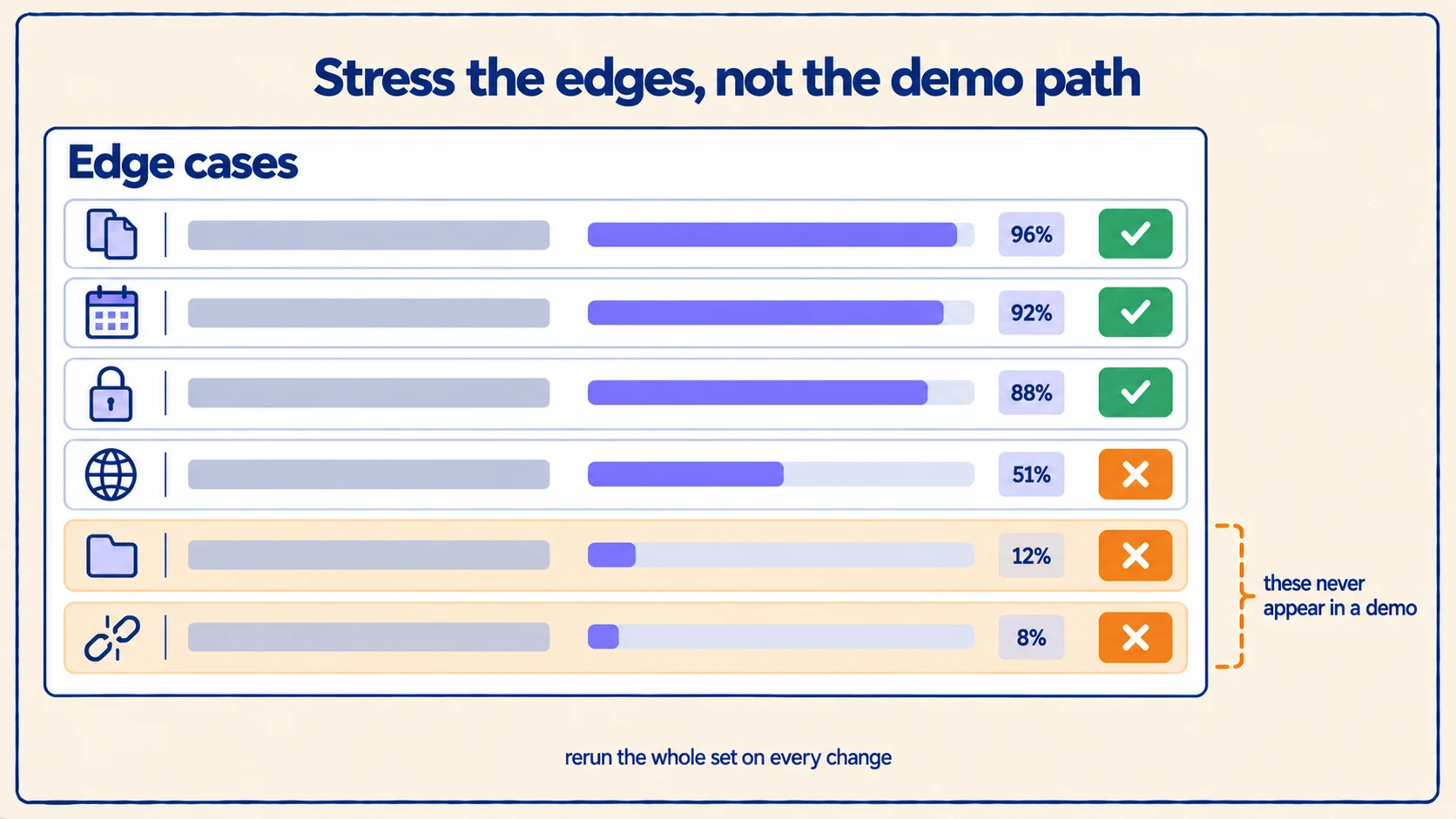
A static benchmark run only proves that an assistant works under ideal laboratory conditions. Real-world corporate environments are dynamic: documents are updated, employee permissions change, policies contradict one another, and network integrations experience partial outages.
A comprehensive evaluation program deliberately stresses the assistant across five critical operational edge cases:
Dynamic Knowledge Freshness and Invalidation
Upload a revised corporate travel policy that alters per-diem allowances. Measure the exact time elapsed before the assistant begins citing the new rates and stops citing the old ones. Our blueprint for enterprise AI knowledge freshness provides the testing harness for validating zero-cache latency.
Conflicting and Ambiguous Policy Documents
Introduce two authentic documents with contradictory guidance—for example, a global corporate security policy requiring 90-day password rotations and a local subsidiary policy mandating annual rotations. Verify whether the assistant blindly hallucinates a compromise, quotes only one at random, or transparently highlights the discrepancy and identifies the governing document hierarchy, following the protocols in our guide on handling conflicting documents in AI assistants.
Real-Time Access Control Revocation
Authenticate a test session as an authorized user, verify they can query sensitive project data, immediately revoke their permissions in the corporate directory (e.g., Okta or Entra ID), and re-issue the query within the same active session. The system must immediately deny access. Detailed implementation details are available in our analysis of AI knowledge access revocation.
Calibrated Answer Abstention
Submit realistic inquiries regarding topics that do not exist within the indexed corporate knowledge base. The assistant must decline to answer cleanly rather than synthesizing speculative information, adhering to the principles in our guide to enterprise AI answer abstention.
Resilient Partial Failure Recovery
For agentic assistants that orchestrate multi-step operations (e.g., drafting a memo, creating a calendar invite, and dispatching a Slack alert), inject synthetic network timeouts on step three. Verify whether the agent executes compensatory rollbacks, preserves intermediate state, or alerts operators without corrupting enterprise data, following our runbook on AI agent partial failure handling.
8. Governance, human approval, and least-privilege tool security
When assistants evolve into autonomous agents capable of modifying corporate data, evaluation must incorporate governance and security boundaries:
1[Agent Emits Action Proposal]2 │3 ▼4[Least-Privilege Tool Gateway] ──► Violates Policy ──► [Deterministic Deny]5 │6 ▼ (Policy Permitted)7[Risk Classification Engine]8 │9 ├─► Low Blast Radius ──► [Execute with Ephemeral Token]10 │11 └─► High Blast Radius ──► [Human Approval Gate]12 │13 ├─► Rejected / Expired ──► [Halt & Abstain]14 └─► Approved ──► [Execute & Log to Audit Trail]Every tool integrated into an agent must adhere to the principles outlined in least-privilege AI agent tools. Tools must never execute using broad administrative credentials; instead, they must operate under downscoped tokens tied directly to the authenticated user's permissions, with strict parameter schema validation.
Furthermore, high-impact mutations—such as updating customer contracts, approving expenditures, or provisioning external access—must be gated by robust human-in-the-loop controls. As detailed in our guide to human approval for AI agent actions, the evaluation harness must test whether approval prompts serialize the exact target payload, reject stale or mutated tokens, and maintain an immutable AI agent action audit trail for compliance auditing.
9. Creating the production deployment decision record
The culmination of an enterprise knowledge assistant evaluation is a formal Production Decision Record (PDR). This document synthesizes quantitative benchmark results, security audit logs, and qualitative failure analyses into an unambiguous deployment verdict:
1Production Decision Record: Q3 Project Assistant Pilot2- Evaluation Date: 2026-09-183- Evaluated Architecture: Hybrid Dense/Sparse RAG with Knowledge Graph Validation4- Benchmark Test Suite: 60 Curated Enterprise Scenarios (v2.4)5- Deployment Verdict: CONDITIONAL APPROVAL (Restricted to Tier-1 Internal Staff)6 7Key Performance Indicators:8- Grounded Faithfulness: 98.3% (Pass Threshold: >= 95.0%)9- Citation Precision: 96.7% (Pass Threshold: >= 95.0%)10- Negative Permission Leaks: 0 violations across 15 adversarial ACL tests (GATE PASSED)11- Out-of-Domain Abstention: 100% (Zero ungrounded hallucinations observed)12- Unhandled Partial Tool Failures: 0 (Compensatory rollback verified)13 14Identified Gaps & Remediation Requirements:151. Re-ranking latency on multi-hop queries averaged 2.4 seconds; optimize cross-encoder batching.162. Technical documents containing multi-page merged tables exhibited an 8% drop in retrieval precision; deploy specialized table extraction pre-processors prior to tenant-wide rollout.By documenting exact configuration versions, empirical benchmark scores, and identified limitations, the organization establishes a durable baseline. Any future updates to the underlying foundation model, embedding pipeline, or system prompts can be evaluated against this gold-standard dataset to guarantee zero performance regression.
Accelerating your enterprise AI evaluation journey
Evaluating an enterprise knowledge assistant is not a one-time project; it is an ongoing engineering discipline that safeguards institutional trust, regulatory compliance, and operational resilience. By establishing rigorous golden benchmarks, decomposing citation entailment, and stress-testing dynamic boundary conditions, technology leaders can deploy AI assistants that deliver genuine business value while maintaining uncompromising security standards.
To explore how Exemplary AI provides out-of-the-box infrastructure for automated evaluation, grounding inspection, and enterprise-wide governance, explore our platform capabilities across Exemplary AI Agents and Enterprise Management. Book an enterprise architecture demo to evaluate your proprietary enterprise workflows, test our knowledge graph grounding, and inspect real-time governance controls against your organization's custom acceptance criteria.