When internal documents disagree: which source should AI trust?
Resolve conflicting internal sources with applicability, authority, version, and effective-date checks before an AI assistant presents a conclusion.

Sarath Chandran
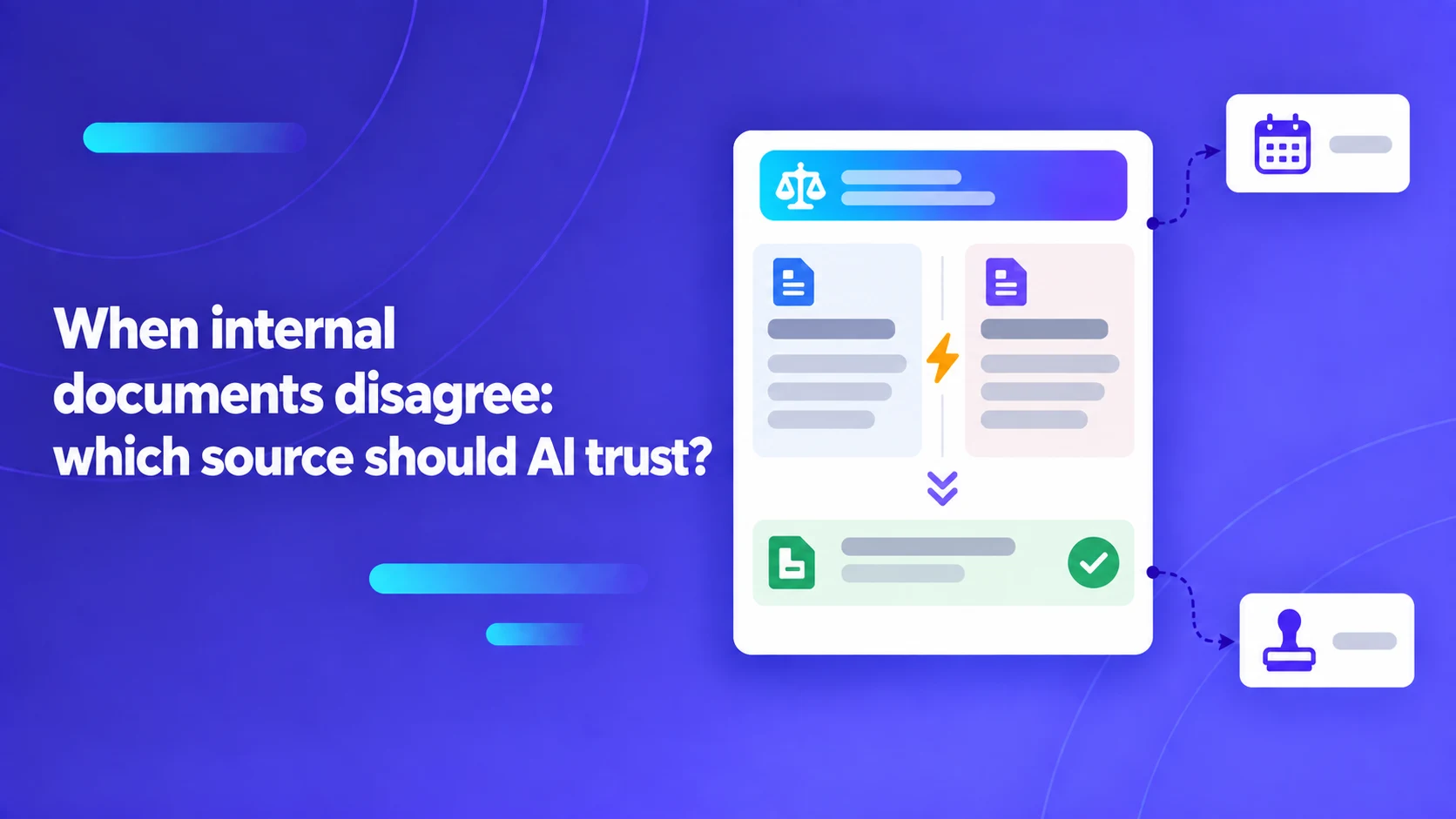
When internal documents disagree, an AI assistant needs an explicit way to establish applicability, identify authoritative sources and disclose unresolved conflicts. Choosing the newest file or the most confidently worded passage is not enough. The organization must decide which source governs the question.
In enterprise knowledge management, conflicting documentation is not an edge case; it is the natural operational state of growing corporations. Over years of organizational growth, acquisitions, and restructuring, enterprises accumulate hundreds of thousands of documents stored across SharePoint, Confluence, Google Drive, and local network drives. Outdated travel expense policies coexist with revised 2026 guidelines; regional employment handbooks contradict global headquarters directives; and informal executive meeting summaries propose policy changes that were never formally ratified by legal counsel. When an employee queries an AI knowledge assistant, a semantic vector search frequently retrieves two mutually incompatible documents with near-identical cosine similarity scores. If the system lacks explicit precedence architecture, the LLM will either guess randomly, hallucinate an unapproved compromise, or quote whichever passage happens to be worded with the highest linguistic assertiveness.
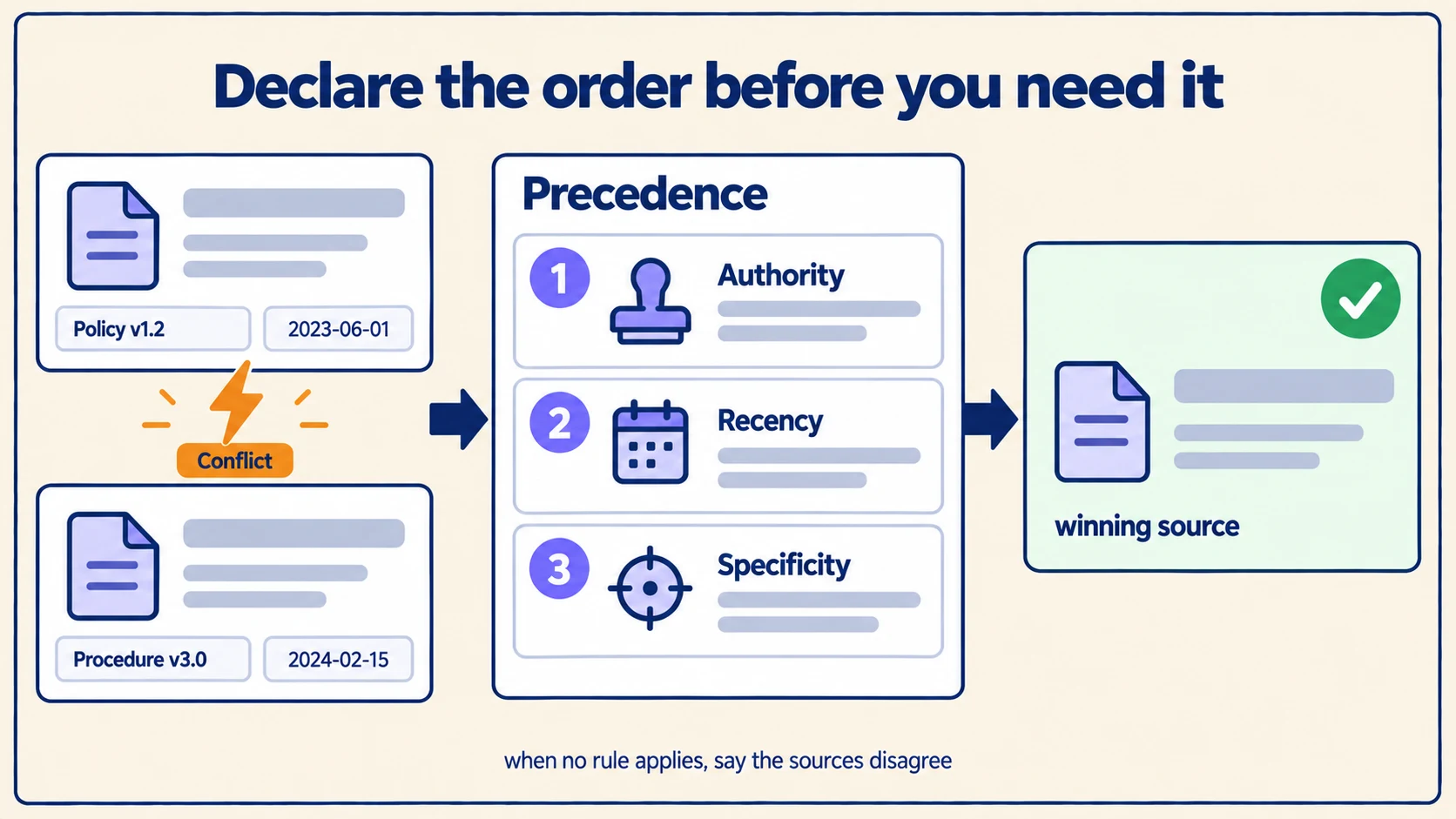
Key Architecture Rule: Never rely on language model intuition or semantic vector similarity to resolve document contradictions. Conflict resolution must be governed by deterministic metadata hierarchies—evaluating document authority tiers, formal approval states, jurisdictional scopes, and effective lifecycle dates prior to context synthesis.
Categorize the five distinct archetypes of enterprise knowledge conflict
To diagnose and resolve document disagreements, knowledge engineering teams must categorize contradictions into a structured operational taxonomy:
The table below outlines the five primary contradiction archetypes, their underlying mechanisms, and the deterministic verification checks required to resolve them.
| Conflict archetype | Root operational mechanism | Representative enterprise scenario | Mandatory technical resolution check |
|---|---|---|---|
| 1. Temporal / Version Drift | Outdated legacy policy remains indexed beside replacement. | Employee handbook v2.1 states 15 days PTO; v3.0 states 20 days PTO. | Evaluate lifecycle_status == 'APPROVED' and filter effective_date <= CURRENT_DATE. |
| 2. Jurisdictional / Geographic | Local statutory regulations override global corporate defaults. | US headquarters travel policy mandates per-diem; German works council mandates receipt expense. | Match requester's jurisdictional metadata tag (user_country) against document scope. |
| 3. Hierarchical Authority | Informal planning discussions contradict formal corporate standards. | Engineering Slack post proposes 90-day password expiry; ISO-27001 standard mandates 365 days. | Filter by document authority tier (STANDARD vs POLICY vs UNRATIFIED_DRAFT). |
| 4. Scoped Exception vs. General | Project-specific exemption carves out a variance from standard rules. | Global cloud security policy prohibits public S3; Project Apollo granted formal 30-day waiver. | Verify whether requester or target asset matches the explicit exemption registry. |
| 5. Irreconcilable Contradiction | Two formally approved, active documents state opposing mandates. | Safety manual A requires valve shutoff at 100 PSI; engineering guideline B requires 150 PSI. | Abstain & Escalate: Alert content owners; do not synthesize an arbitrary middle ground. |
Anthropic’s engineering guide on effective context engineering for AI agents emphasizes that stuffing large amounts of contradictory context into an LLM's prompt forces the model to engage in uncontrolled cognitive friction, frequently producing hallucinations or sycophantic responses that agree with whoever asked the question rather than corporate truth.
A worked enterprise scenario: The Project Cedar workspace dilemma
To observe how conflict resolution operates in practice, examine a concrete enterprise scenario. An employee queries the internal HR and Security assistant: "How long can an external contractor maintain access to our shared engineering workspace?"
The retrieval system fetches three relevant snippets:
- Document A (Corporate IT Standard v3.0, Approved): "Temporary contractor workspace credentials automatically expire after 30 days unless an explicit manager renewal is filed."
- Document B (Project Cedar Executive Charter, Approved): "To accelerate delivery, all external contractors embedded within Project Cedar receive a 60-day access window during the active Q3 surge period."
- Document C (DevOps Weekly Meeting Notes, Draft): "Bob suggested extending contractor access to 90 days across all teams to reduce IT ticket volume."
A naive RAG assistant that averages or blends these passages might hallucinate: "Contractor access generally ranges between 30 and 90 days depending on team discussions." This answer is completely useless and actively dangerous for security compliance.
A properly architected enterprise assistant applies deterministic precedence logic:
- Identifies Document C as an unratified meeting note (
tier: informal_discussion), filtering it out from authoritative policy generation. - Identifies Document A as the baseline global standard (
30 days). - Detects Document B as an active, approved jurisdictional exception (
60 days). - Emits a structured, contextual response: "Under standard Corporate IT Policy, contractor access expires after 30 days. However, if the contractor is assigned to Project Cedar, an approved exception extends access to 60 days during Q3. Would you like to confirm the contractor's project assignment?"
Pro Tip: When two documents directly contradict each other without clear precedence metadata, instruct your knowledge assistant to synthesize an explicit comparative summary: "Document A (updated Jan 2026) specifies Net-30 payment terms, while Document B (updated March 2026) specifies Net-45. Because both documents are marked active, please verify with Finance." Highlighting the conflict is infinitely more valuable than fabricating an unverified consensus.
Construct declarative precedence hierarchies
To automate conflict resolution, enterprise knowledge architects must embed structured metadata tags into document ingestion pipelines:
- Authority Tier (
authority_level): Numerical ranking (e.g., Tier 1: Board Policies & Legal Bylaws; Tier 2: Corporate Operating Standards; Tier 3: Departmental Guidelines; Tier 4: Working Meeting Notes). Higher tiers strictly override lower tiers. - Effective Date Windows (
valid_from,valid_to): Bounding time intervals ensuring future policy announcements are not treated as active, and expired guidelines are permanently deprecated. - Jurisdictional Scope (
applicable_jurisdiction): Geographical and organizational scopes (e.g.,EMEA,DACH,US_FEDERAL,FINANCE_DEPT). - Approval State (
status): Strict state enumeration:DRAFT,UNDER_REVIEW,APPROVED,SUPERSEDED,ARCHIVED.
Microsoft's RAG evaluation documentation in Azure AI Foundry formalizes the measurement of groundedness and retrieval quality, emphasizing that evaluating RAG requires measuring whether the retrieval stage fetched the authoritative document or was distracted by conflicting noise.
Make the conflict visible instead of resolving it silently
A precedence hierarchy decides which document wins. It does not decide whether the reader should be told there was a contest, and those are separate questions with different answers depending on the stakes.
Silent resolution is correct when the rule is uncontroversial and the loser is plainly superseded — a draft against its own published version, a page explicitly marked obsolete. It is wrong whenever the conflict itself is information the reader needs. If two current, authoritative policies disagree about notice periods, an assistant that picks one and presents it confidently has destroyed the single most useful fact available: that the organization does not have one answer.
The failure mode is subtle because the output looks excellent. A confident, well-cited, fluent answer that happens to conceal an unresolved disagreement is far more damaging than an answer that says the sources disagree, because nobody reviews it.
| Conflict character | Resolve silently? | What the reader should see |
|---|---|---|
| Draft against published | Yes | The published version, cited |
| Superseded by an explicitly newer revision | Yes | The current revision, with its date |
| Regional variant of a global policy | No | The variant that applies to them, and that a global policy also exists |
| Two current sources of equal authority | No | Both positions, both citations, and a clear statement that they disagree |
| Numeric mismatch in the same document family | No | Both figures and their sources — never a silently chosen one |
The last row deserves emphasis because arithmetic invites bad behaviour. When two reports give different revenue figures for the same quarter, no precedence rule produces a correct number. Averaging them is fabrication. Picking the newer one is a guess dressed as a decision. Reporting both, with sources, is the only honest output, and it is exactly the discipline described in our guide to validating extracted data against business rules.
Give precedence rules an escape hatch
Every precedence hierarchy eventually meets a case its authors did not imagine, and what the system does at that moment determines whether people trust it.
A hierarchy that always produces a winner will produce one here too — arbitrarily, on a tiebreak that carries no real authority, such as which document happened to be indexed more recently. The result is a confident answer whose confidence is manufactured by the tiebreak rather than earned by the evidence.
Design the rules to be able to fail:
- Let the hierarchy return "undecided." If no rule fires decisively, that is a legitimate outcome and should be representable rather than collapsed into an arbitrary pick.
- Route undecided cases to abstention. The assistant reports the disagreement and cites both sides. This is the same mechanism as answer abstention and should reuse it rather than growing a parallel path.
- Count undecided outcomes as a signal, not a failure. A rising count means the corpus has developed a genuine contradiction that a human owner needs to resolve at the source. That is the system doing its job.
- Never break ties on index order, file size or retrieval score. None of these carry editorial authority, and a tiebreak that looks arbitrary in an incident review is worse than no answer.
Pro Tip: Instrument the tiebreak. Log which precedence rule decided each conflicted answer, and review the distribution monthly. A rule that fires constantly is usually masking a corpus problem — most often an authority label that is applied too liberally, so half the corpus claims to be the canonical source and the hierarchy is resolving contests it should never have been asked to judge.
Fix the corpus, not only the retrieval
Conflict handling is a mitigation. Every conflict the assistant resolves at query time is a contradiction that exists in the source repositories and that a human being will also encounter — in a search result, a shared link or a printed copy — without any precedence hierarchy to protect them.
A knowledge assistant is unusually good at finding these contradictions, because it reads the whole corpus in a way no individual does. That makes the conflict log one of the more valuable by-products of running one, and most organizations never look at it.
Route the findings back:
- Report recurring conflicts to the document owner, with both sources attached. The assistant already identified them; the only missing step is delivery.
- Track time-to-resolution at the source. A conflict resolved in the repository disappears permanently. One resolved only at query time recurs on every related question, forever.
- Watch for conflicts concentrated in one space. A single wiki area generating most contradictions usually signals an ownership gap rather than a content problem, and reassigning it fixes more than any retrieval change.
- Retire rather than edit. When a stale document is the loser, marking it superseded is better than deleting it: deletion breaks existing links and destroys the audit trail, while an explicit supersede marker makes future precedence decisions trivial and self-documenting.
Treated this way, the precedence hierarchy stops being a permanent crutch and becomes a measuring instrument — one that quantifies how internally consistent the organization's documentation actually is, and shows whether that is improving.
Track conflict as an ongoing operational metric
A conflict test harness is a gate. It tells you the assistant handles the conflicts you knew about on the day you wrote the tests, and it says nothing about the conflicts the corpus acquired last week.
Four measurements turn conflict handling from a launch checklist into an operational discipline, and none of them requires labelled data:
- Conflict detection rate. The share of answers where retrieval surfaced two or more passages that the precedence rules put in tension. A sudden rise usually means a bulk import landed without superseding its predecessors.
- Silent-resolution rate. The share of those answers where the assistant picked a winner without telling the reader. This should trend toward zero, and any non-trivial value is a design bug rather than a content problem.
- Escalation volume by document pair. Conflicts cluster. Two documents accounting for a large share of escalations is a content-ownership problem with a name attached, and it is fixable once rather than mediated repeatedly.
- Time from escalation to corpus fix. The interval between a conflict being flagged and the underlying documents being reconciled. A growing interval means the escalation path has become a place conflicts go to be logged rather than resolved.
Review these with the document owners, not only with the platform team. Every number above describes a state of the corpus; the engineering system can surface a conflict and route it, but only the owner of the policy can decide which version governs.
Build a synthetic conflict evaluation test harness
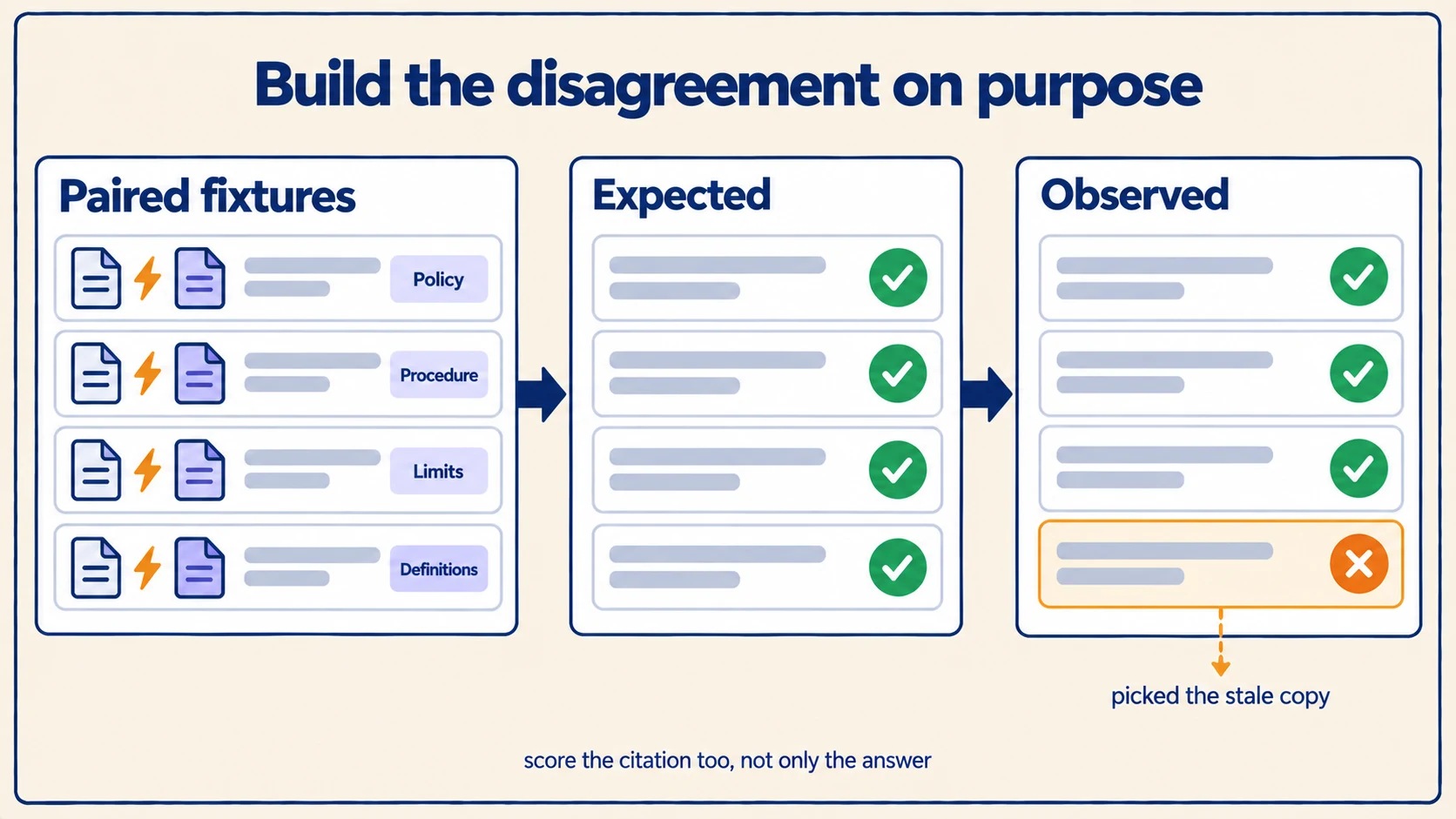
To verify that your assistant resolves disagreements accurately, construct a dedicated conflict evaluation test suite:
- Create Paired Test Fixtures: Author pairs of synthetic test documents containing deliberate, controlled contradictions across versioning, geography, and authority.
- Execute Multi-Turn Scenarios: Submit prompts representing different user personas (e.g., an employee based in Berlin vs. an employee based in New York querying the same parental leave benefit).
- Assert Retrieval Filtration: Verify that the vector database retrieval filter excludes draft notes and superseded policies before context enters the LLM prompt.
- Score Citation Accuracy: Ensure citations link exclusively to the governing document, as detailed in our guide to verifying AI answer citations.
- Verify Update Propagation: Update a policy and verify that the assistant reflects the newly active document within the agreed synchronization window, following our frameworks for enterprise AI knowledge freshness.
For a complete architectural evaluation methodology, consult our foundational enterprise knowledge assistant evaluation guide.
To explore how our platform architecture resolves complex enterprise document conflicts, discover Exemplary AI's knowledge graph and schedule an enterprise architecture demo to evaluate automated document precedence and conflict triage workflows on your organization's actual documentation.