When an AI assistant should say it lacks enough information
Evaluate useful abstention, precise clarification, and partial answers when permitted evidence is missing, ambiguous, inaccessible, or conflicting.

Sarath Chandran
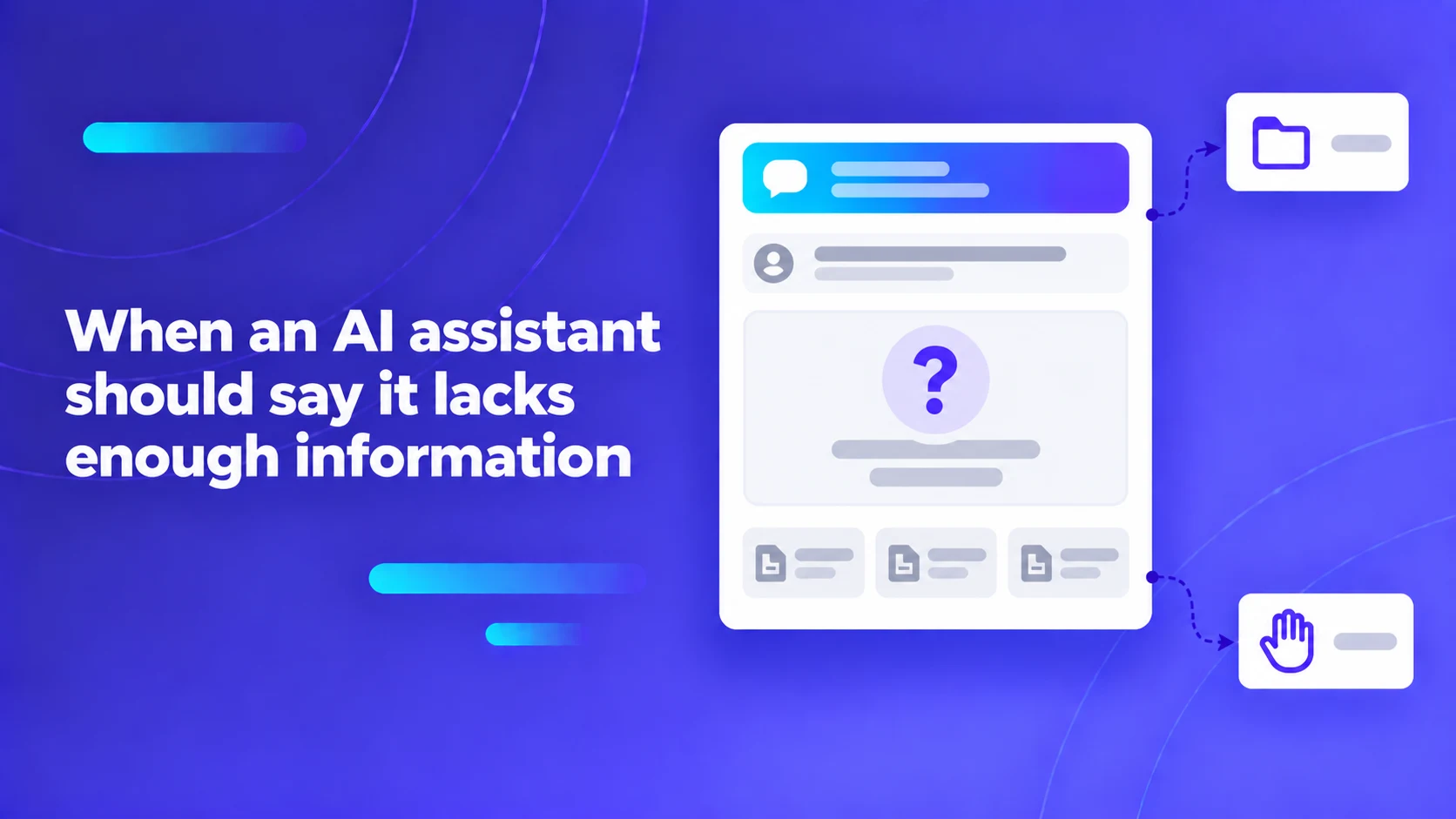
An enterprise AI assistant should abstain from a factual answer when the evidence available to the current user cannot support it. A useful abstention identifies the missing requirement, answers any separable part that is supported, and offers a precise next step. It should not invent a plausible rule, treat a retrieval failure as proof that no rule exists, or expose restricted information while explaining why it cannot answer.
In regulated enterprise environments—such as clinical pharmaceuticals, nuclear engineering, securities law, and statutory financial accounting—the cost of an ungrounded hallucination is asymmetric. A single confident, fabricated answer regarding an FDA dosage protocol, an SEC reporting deadline, or an IT security exception can trigger millions of dollars in regulatory fines or operational outages. Yet, default generative foundation models are inherently conditioned by pre-training to be conversational, helpful, and eager to please—compulsively generating plausible-sounding answers even when underlying knowledge bases contain zero supporting evidence. Enterprise AI platforms must be architected with calibrated epistemic abstention: the verified capability to recognize the boundaries of accessible knowledge and decline to answer gracefully.
Key Architecture Rule: Abstention is not a system defect; it is a primary reliability metric. An enterprise knowledge assistant must achieve high epistemic selectivity—maximizing straight-through answers on verifiable facts while deterministically abstaining whenever retrieved evidence is missing, contradictory, or inaccessible.
The six distinct archetypes of epistemic evidence failure
An AI assistant's refusal to answer should never be collapsed into a lazy, uninformative "I am sorry, but I cannot help with that" message. A production-grade platform must diagnose why it cannot answer and provide an actionable operational response.
The table below outlines the six distinct conditions of evidence failure and their required architectural responses.
| Underlying evidence condition | Root operational mechanism | Prescribed system response | Dangerous failure mode to prevent |
|---|---|---|---|
| 1. Complete Evidence Absence | Zero relevant documents exist in the enterprise corpus. | State clearly that available documentation does not establish the answer. | Hallucinating general industry common-sense as corporate policy. |
| 2. Ambiguous Parameter Gap | User prompt omits a decisive variable (e.g., date or region). | Prompt the user for the specific missing variable required. | Arbitrarily assuming a default value (e.g., assuming US jurisdiction). |
| 3. Unresolved Source Contradiction | Two active, approved documents state opposing rules. | Disclose the conflict objectively; identify the owning role to resolve it. | Blending numbers or picking whichever passage is worded most assertively. |
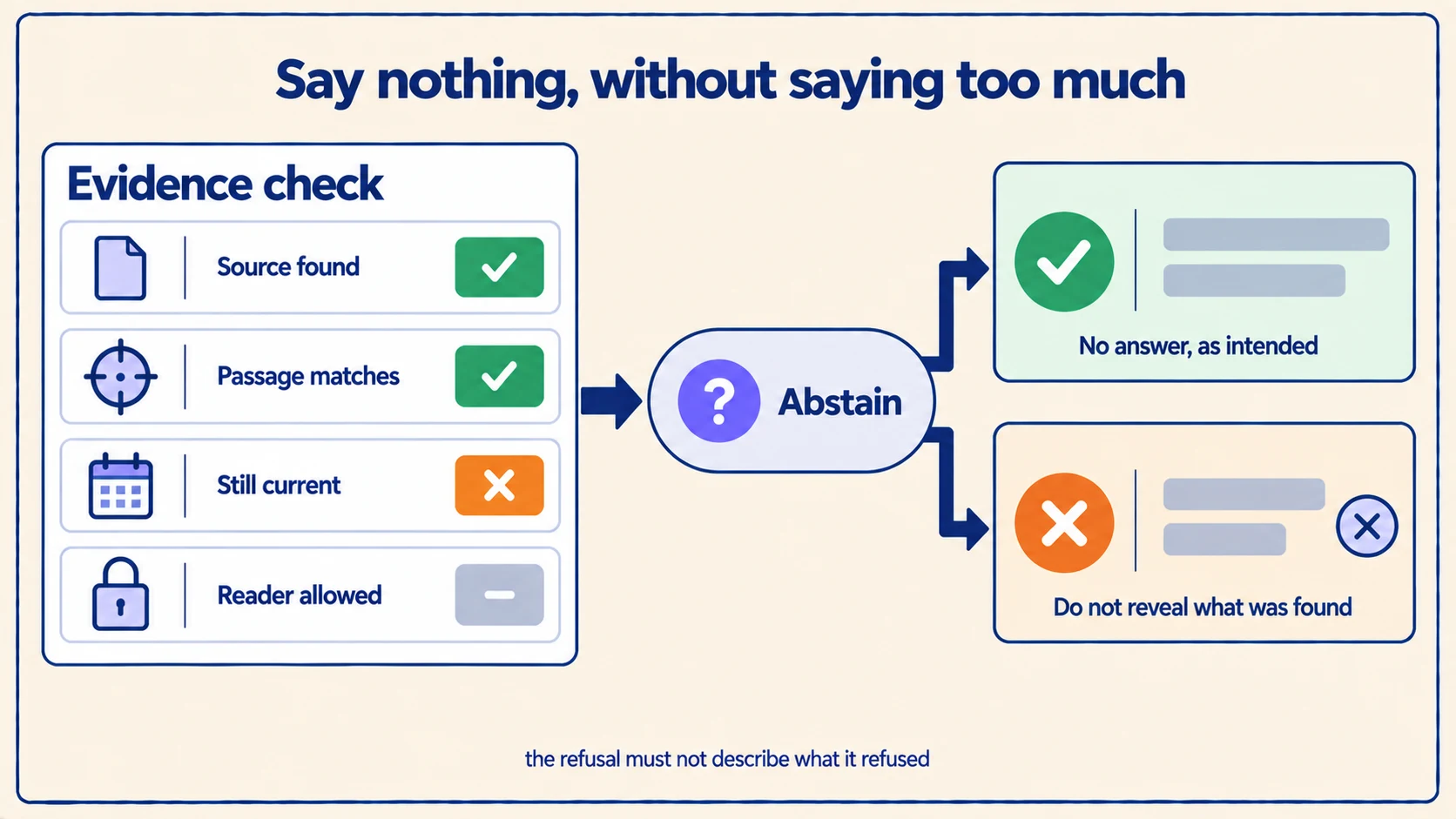
| 4. Permission / ACL Exclusion | Governing document exists, but user lacks clearance. | Abstain neutrally without confirming the existence of restricted files. | Leaking document titles or metadata in refusal explanations. |
| 5. Retrieval Infrastructure Outage | Vector database or search gateway times out. | Report temporary technical limitation; provide retry option. | Misrepresenting technical timeout as proof that no policy exists. |
| 6. Partial Evidentiary Grounding | General rule is supported; specific sub-clause is missing. | Answer supported sub-points; explicitly qualify the unproven gap. | Appending weak disclaimers after confident, unsupported claims. |
Microsoft's RAG evaluation framework in Azure AI Foundry treats groundedness, relevance, and completeness as independent evaluation axes. Evaluating abstention requires measuring whether the model strictly confines its output to the retrieved context envelope, refusing to extrapolate beyond provided tokens.
A worked enterprise scenario: The Project Cedar temporary workspace exception
To understand the difference between principled abstention and catastrophic extrapolation, consider a concrete enterprise scenario. An employee asks the internal operations assistant: "Can Project Cedar keep its temporary contractor workspace for 60 days?"
The system queries the internal knowledge base. The retrieval engine returns:
- Corporate Workspace Standard v3.1: "Temporary contractor workspaces are provisioned for a maximum duration of 30 days. Extensions beyond 30 days require explicit written approval from the Facility Workspace Director."
- Database Query Result for Project Cedar: Zero approved extension records exist under the user's current security clearance.
Now examine three competing system responses:
1. The Catastrophic Hallucination (Uncalibrated Model)
"Yes, Project Cedar can retain its workspace for 60 days. It is standard for critical priority projects to receive a 60-day operational waiver to support accelerated milestones." (Catastrophic failure: The model invented a non-existent policy, creating unapproved IT asset allocations).
2. The Lazy Non-Actionable Refusal (Over-Cautious Guardrail)
"I do not know the answer to your question. Please search the company intranet or contact IT." (Unhelpful failure: Discards the clear 30-day baseline standard already available in retrieved context).
3. Principled, Actionable Abstention (Enterprise Standard)
"Under Corporate Workspace Standard v3.1, temporary contractor workspaces are provisioned for 30 days by default, and extensions require written approval from the Facility Workspace Director. I do not have access to an approved 60-day exception record for Project Cedar. If you have an authorized approval document, please provide its tracking number, or contact the Facility Workspace Director to file a formal extension."
Notice that Response 3 provides immense business value: it delivers the known factual baseline (30 days), clearly identifies the missing prerequisite (the specific approval waiver), and directs the user to the exact administrative role capable of unblocking them.
Pro Tip: Train and prompt knowledge assistants to practice Segmented Answering: decompose multi-part questions into individual atomic claims. Answer supported clauses with verified citations, and explicitly abstain on unsupported clauses within the same conversational turn.
Prevent side-channel data leakage in abstention explanations
When designing fallback and refusal messaging, platform architects must guard against side-channel information leakage. In enterprises handling sensitive mergers and acquisitions (M&A), executive restructuring, or proprietary research, confirming that a document exists is itself a severe security violation.
Consider an unauthorized junior analyst who asks: "What are the severance terms outlined in the Project Titan acquisition agreement?"
- Vulnerable Abstention: "I cannot answer your question because you do not have permission to view the confidential document titled
Project_Titan_Acquisition_Term_Sheet_v4.pdflocated in the Executive M&A SharePoint library." (Severe leak: Confirms that Project Titan is an active acquisition and identifies the exact document location!) - Hardened Sovereign Abstention: "I cannot find any authorized documentation establishing severance terms for Project Titan under your current access permissions."
The hardened abstention provides zero cryptographic or semantic clues regarding whether the file exists, whether it is restricted, or whether it is absent entirely. Review our companion guide on AI knowledge access revocation to audit how permission boundaries are enforced across conversational interfaces.
Construct paired counterfactual evaluation datasets
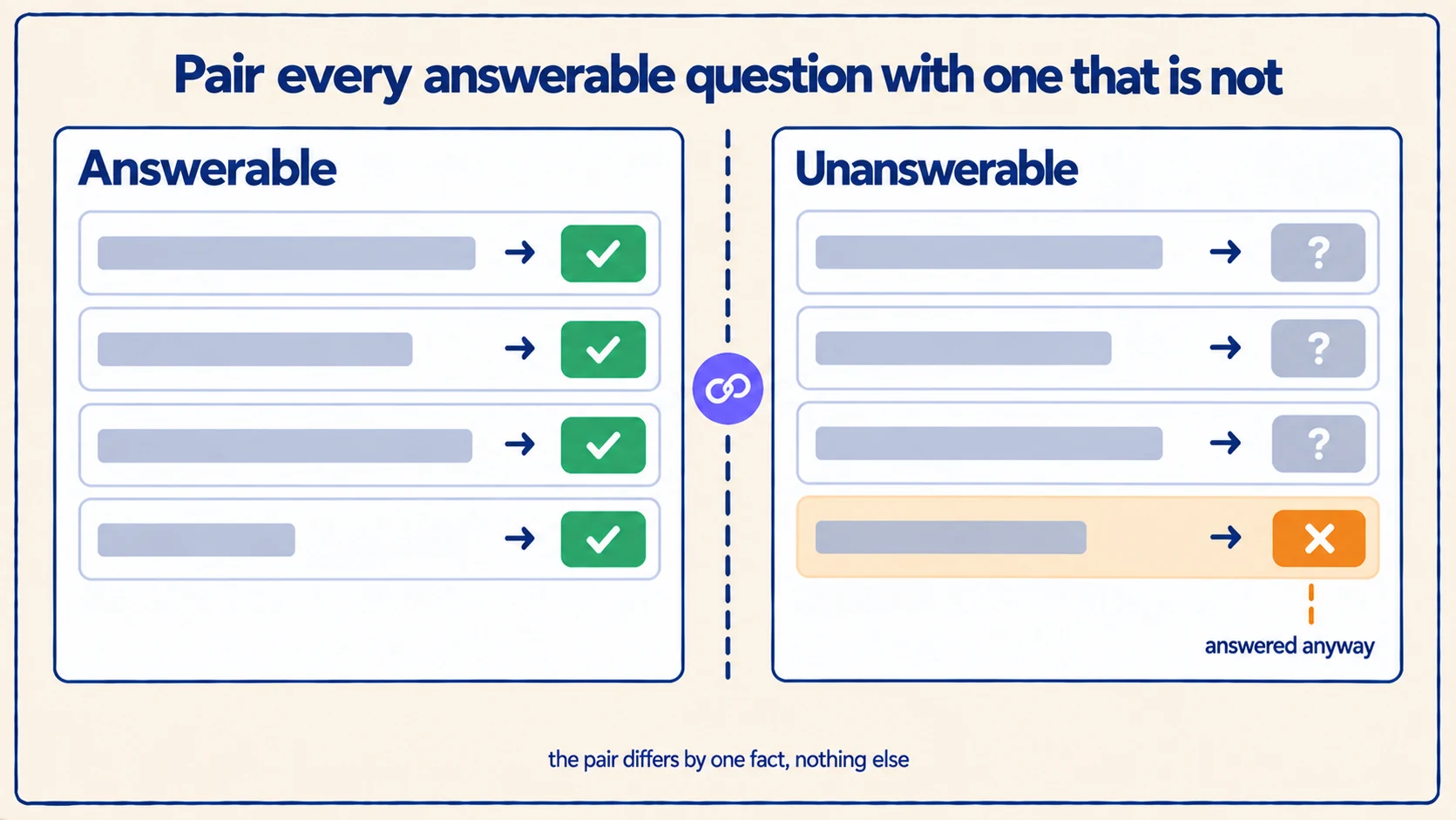
Evaluating an assistant's abstention capabilities requires constructing paired counterfactual evaluation datasets. Traditional question-answering benchmarks only test whether models answer when facts are present; counterfactual testing measures whether models stop when facts are removed.
Anthropic’s context engineering research emphasizes that carefully manipulating context windows reveals whether models rely on true grounding or fall back on pre-trained semantic priors.
To build an evaluation suite:
- Curate the Grounded Baseline: Take 50 real enterprise policy questions paired with source documents containing the exact answers. Verify that the assistant answers 100% of these with accurate citations.
- Generate Counterfactual Defect Pairs: For each of the 50 questions, create three modified variants:
- Variant A (Omitted Paragraph): Strip the single sentence containing the decisive fact. Assert that the model abstains on that specific detail.
- Variant B (Date Shift): Alter the effective date in the document to the year 2029. Assert that the model identifies the policy as not yet active.
- Variant C (Contradictory Conflict): Inject a second conflicting paragraph. Assert that the model identifies the contradiction and abstains from picking a winner, following our conflicting documents framework.
- Score the Selectivity Curve: Plot the system's Precision versus Recall. Penalize both Unsupported Answers (hallucinations) and Unnecessary Refusals (declining answerable questions).
Ensure that all grounded answers undergo rigorous citation checks, using the methodologies detailed in our guide to verifying AI answer citations.
For a complete architectural overview of evaluation frameworks, consult our foundational enterprise knowledge assistant evaluation guide.
To explore how our platform enforces principled abstention and semantic grounding, discover Exemplary AI's knowledge graph and schedule an enterprise architecture demo to evaluate abstention calibration on your organization's real-world document repositories.