How to verify that AI citations actually support an answer
Use a claim-level review to distinguish a valid citation from evidence that actually supports an enterprise AI answer and its qualifications.

Sarath Chandran
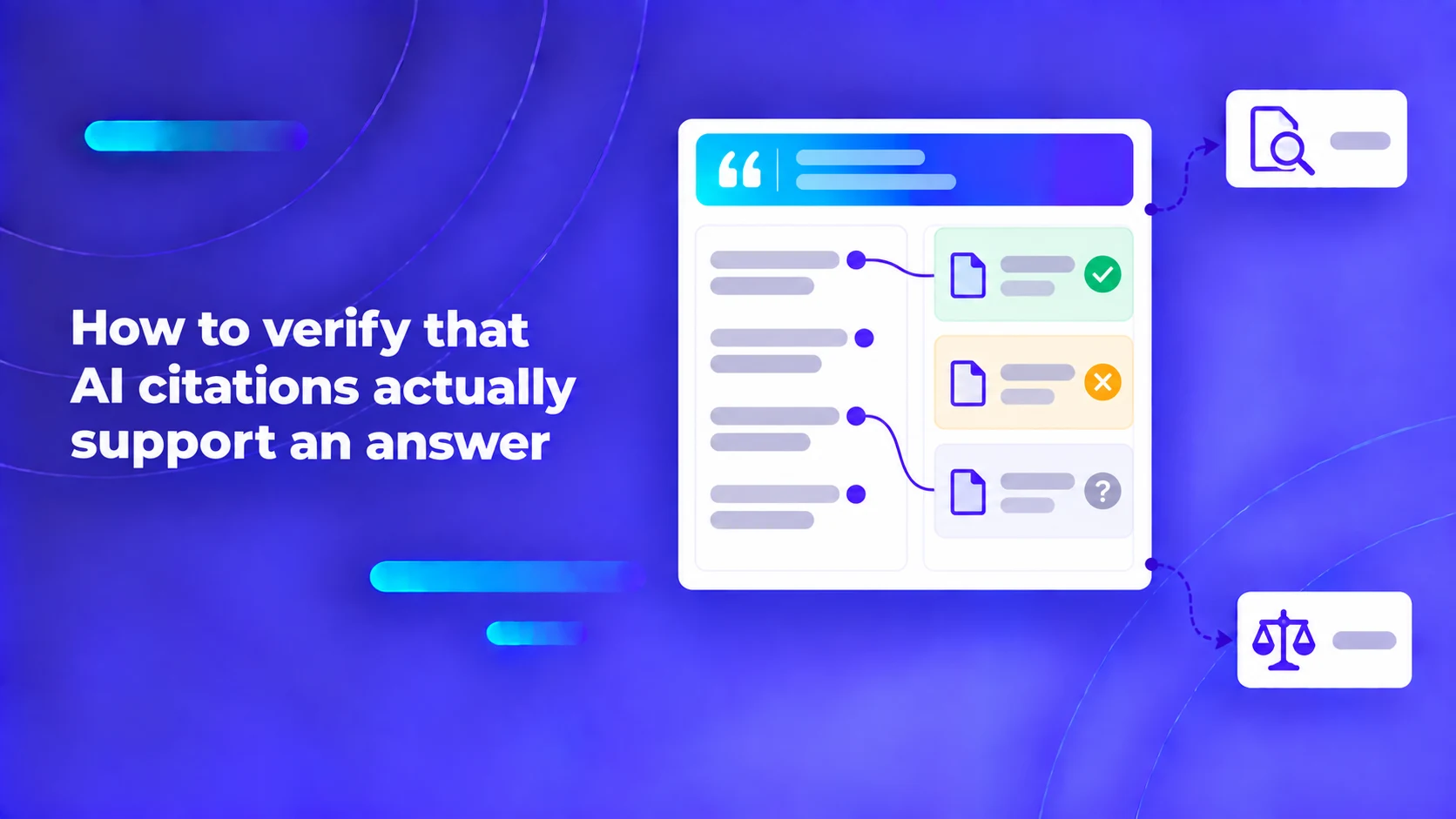
Verifying AI answer citations requires systematically proving that every factual claim asserted by an assistant is strictly entailed by the exact document passage referenced. Surface-level indicators—such as hyperlinking a document title, displaying an inline blue footnote tag, or appending a list of consulted URLs at the end of a message—frequently conceal severe factual inaccuracies. Rigorous enterprise citation verification demands decomposing synthesized responses into atomic propositions, validating spatial or textual token offsets against underlying source files, and confirming that the cited text actively supports the specific assertion rather than merely discussing the same general topic.
In high-stakes enterprise settings, an unverified citation creates a false sense of security that is more dangerous than an outright hallucination. When an answer contains no links, operators naturally exercise caution; when an answer includes six official-looking citations pointing to policy documents, readers instinctively trust the output. If those citations point to obsolete revisions, refer to tangential sections, or directly contradict the assistant's claims, critical business and legal decisions can be compromised.
[!IMPORTANT] Never evaluate citation accuracy by counting the volume of footnotes or links. High citation density often masks "citation stuffing" or "decoy referencing," where an LLM cites genuine documents to manufacture credibility while asserting claims absent from those texts. Verification must measure claim-level entailment: does the target passage contain sufficient semantic proof to validate the proposition without external assumptions?
Deconstruct answers into atomic claims before evaluating support
To conduct a valid citation audit, human reviewers and automated evaluation pipelines must avoid scoring entire paragraphs as single units. A multi-sentence answer typically weaves together multiple distinct assertions, some of which may be fully verified while others are ungrounded extrapolations.
The verification process follows a four-step diagnostic pipeline:
1[Assistant Output Generated]2 │3 ▼4[Atomic Proposition Decomposition]5 │ (Extract discrete factual claims)6 ▼7[Pointer Resolution Check]8 │ (Do document IDs, URI fragments, and page offsets resolve?)9 ▼10[NLI Entailment Scoring]11 │ (Evaluate semantic relationship: Entailment, Contradiction, or Neutral)12 ▼13[Scope & Qualification Audit]14 (Check temporal validity, target audience, and exception clauses)- Resolution & Provenance: Does the reference resolve to an existing document, page number, or character offset in the enterprise corpus?
- Semantic Entailment: Does the retrieved text logically prove the assertion under Natural Language Inference (NLI) criteria?
- Temporal & Contextual Applicability: Does the cited policy apply to the user's specific jurisdiction, organizational tier, and temporal window?
- Negative Claim Coverage: Are there factual claims made in the sentence that lack any supporting citation?
In their technical architecture documentation, the Anthropic Claude citations documentation illustrates how API-level citations return exact sentence-level character offsets pointing directly into the input context. While structural pointer extraction eliminates guessing which chunk the model examined, engineering teams must still independently verify whether the extracted passage truly substantiates the conclusion the model arrived at.
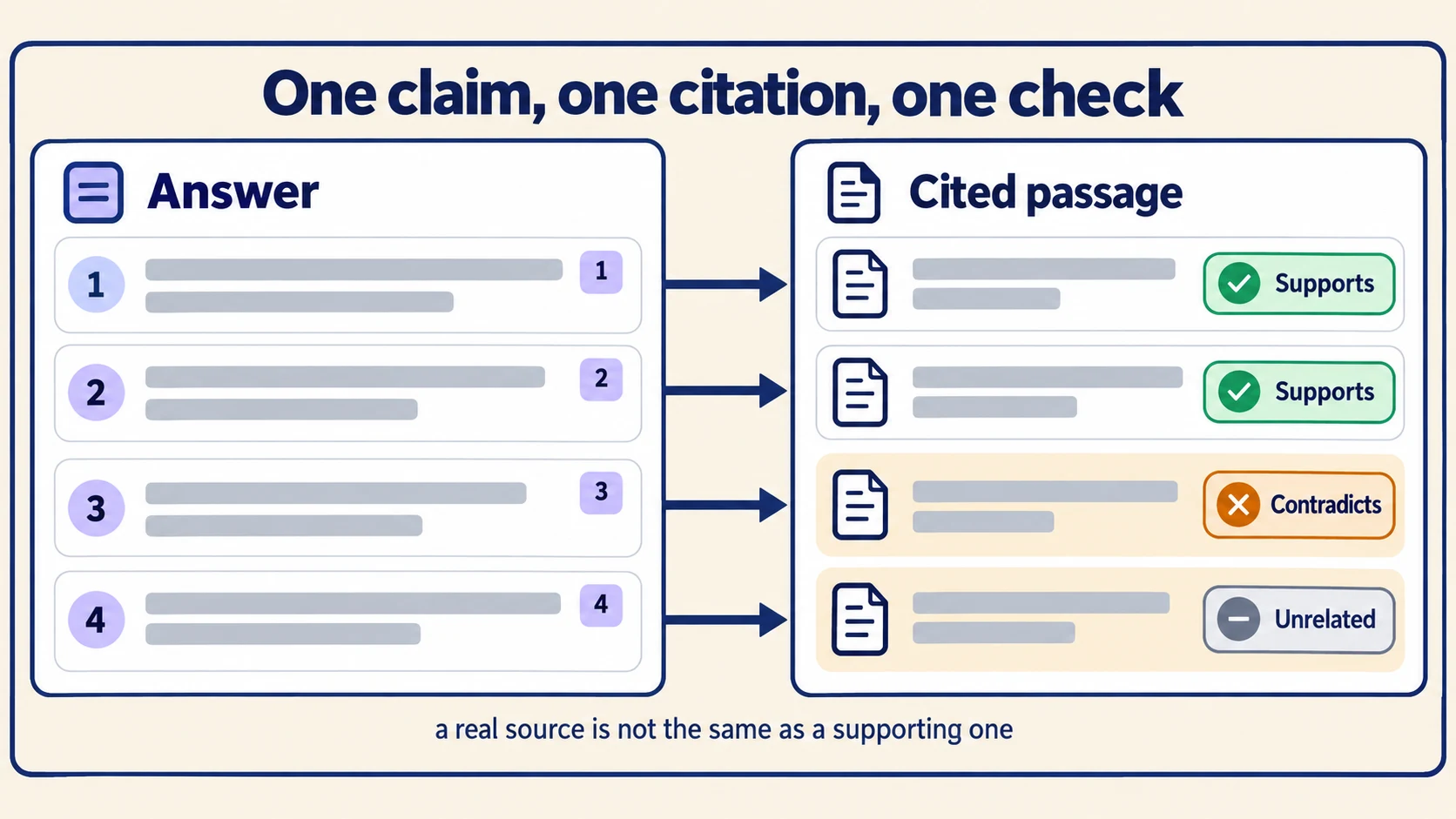
Diagnostic analysis: Four failure modes in a single synthetic answer
To understand how citation verification works in practice, examine the following synthetic evaluation scenario. An enterprise knowledge assistant is queried regarding temporary infrastructure access policies.
The approved internal policy document states:
“Active full-time engineering project members may request temporary sandbox cluster access for up to 30 calendar days. Third-party contractors and external vendors require formal written sponsorship from an internal VP before access can be provisioned. Access does not renew automatically; extensions require submitting a fresh requisition ticket 5 business days prior to expiration.”
Suppose the AI assistant generates the following response:
“All full-time staff and external contractors can provision sandbox cluster access immediately for 30 days, and the environment renews automatically upon expiration [Doc: Cloud-Infra-Policy-v3.2, p. 4].”
Although the footnote links directly to the authentic, current infrastructure policy, a claim-level decomposition exposes catastrophic grounding failures across every clause:
| Extracted Atomic Claim | What the Authoritative Source Establishes | Entailment Classification | Operational Risk Level |
|---|---|---|---|
| Claim 1: All staff and contractors qualify equally | Policy restricts access to project members; contractors require VP sponsorship | Contradiction / Overgeneralization | High: Bypasses mandatory security sponsorship gates |
| Claim 2: Access can be provisioned immediately | Policy states members “may request”; no instant provisioning is promised | Unsupported / Hallucination | Medium: Sets false operational expectations |
| Claim 3: Duration is 30 days | Policy specifies “up to 30 calendar days” (subject to discretionary approval) | Missing Qualification | Low: Omits discretionary ceiling nuance |
| Claim 4: Environment renews automatically | Policy explicitly states “does not renew automatically; requires fresh ticket” | Direct Inversion / Contradiction | Critical: Causes unexpected infrastructure termination |
In this scenario, a naive metric that checks whether Cloud-Infra-Policy-v3.2 is a valid file would score this answer as 100% cited. In reality, the answer inverts core policy requirements and exposes the enterprise to security violations.
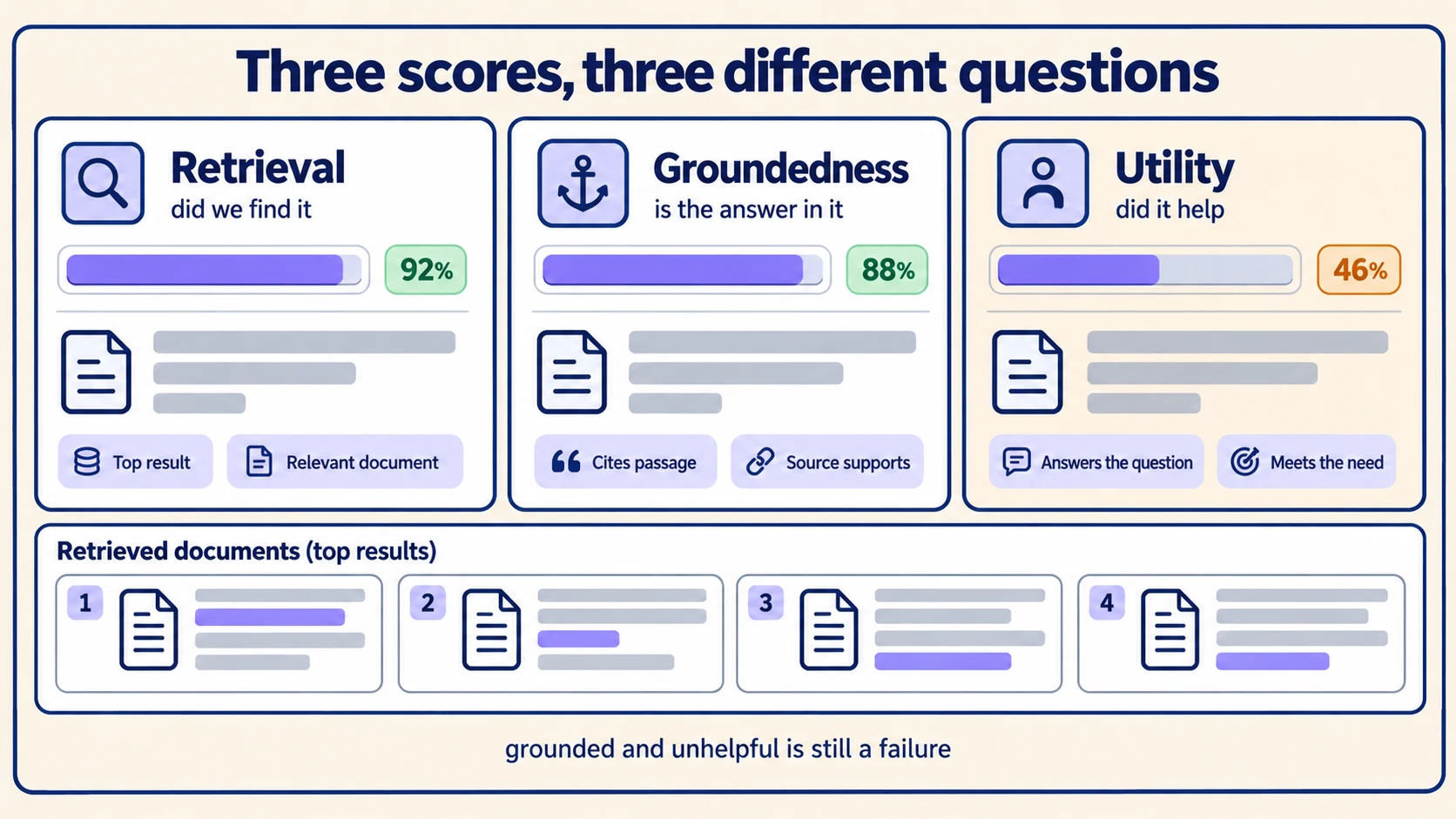
Distinguishing groundedness, retrieval relevance, and answer utility
A robust evaluation methodology decouples the quality of citations from the quality of retrieval and the practical usefulness of the answer. As highlighted in the Microsoft Azure AI Foundry guide on RAG evaluators, conflating these dimensions into an aggregate "helpfulness" score obscures the root cause of production failures.
1 ┌─────────────────────────────────────┐2 │ System-Level Performance │3 └──────────────────┬──────────────────┘4 │5 ┌───────────────────────────┼───────────────────────────┐6 ▼ ▼ ▼7[Retrieval Recall & Precision] [Groundedness & Entailment] [Answer Completeness & Utility]8Did search retrieve the correct Does the generated text match Did the answer actually solve the9passage and latest version? the retrieved evidence? user's underlying inquiry?- Groundedness without Utility: An assistant might faithfully summarize an irrelevant document. For example, if a user asks how to renew cluster access, and the assistant responds, “Temporary sandboxes were introduced in fiscal year 2024 [Doc A, p. 1],” the claim is 100% grounded and cited, but the response is operationally useless.
- Utility without Groundedness: An assistant might correctly state that cluster access is requested via Jira Service Management based on its pre-trained parametric knowledge. If that statement is not grounded in the supplied internal documentation, it cannot be verified and risks propagating outdated corporate procedures.
[!TIP] Enforce strict label separation during offline benchmarking: mark each test turn with three independent boolean flags:Is_Fully_Grounded,Is_Relevance_Satisfied, andIs_Answer_Actionable. IfIs_Fully_Groundedis false, reject the output regardless of how eloquently it answers the user's question.
Designing citation UI viewports for rapid human inspection
How citations are presented in the user interface directly influences whether human reviewers catch subtle hallucinations or succumb to review fatigue.
Engineering teams should follow four UX principles when architecting citation viewports:
- Inline Micro-Anchors over Footnote Blobs: Place discrete citation chips directly adjacent to the exact clause they substantiate (e.g.,
[Clause 3.1]), rather than dumping six general links at the conclusion of a 400-word response. - Interactive Side-by-Side Split View: Clicking a citation chip must not open an external tab or download a 50-megabyte PDF. It should immediately open an integrated document viewport alongside the answer, automatically scrolling to the exact page and highlighting the bounding box of the supporting sentence.
- Differential Visual Indicators for Inferred vs. Quoted Claims: If an agent paraphrases multiple sections, the UI should visually distinguish direct verbatim quotes from synthesized generalizations, allowing human auditors to prioritize their inspection on high-entropy passages.
- Access-Aware Citation Masking: Verify that citations do not leak restricted metadata. If a user asks a question whose answer is partially derived from a document the user lacks permission to view, the citation chip must not expose confidential document titles or file paths.
Building a gold-standard citation verification benchmark
To measure citation accuracy reliably, organizations must construct a curated evaluation dataset containing at least 150 diverse enterprise queries. The benchmark must represent realistic document structures, including complex nested tables, multi-column layouts, scanned forms, and conflicting historical amendments.
The Verification Rubric
| Rubric Dimension | Full Pass Criteria | Partial Failure Criteria | Outright Rejection Criteria |
|---|---|---|---|
| Citation Precision | 100% of attached citations contain direct semantic proof for their parent sentence | Citation points to the correct document, but references a tangential subsection | Citation points to a completely irrelevant file or hallucinated URL |
| Citation Recall | Every factual statement in the answer has at least one valid supporting citation | General framing sentences lack citations, but core numerical and procedural claims are cited | Core factual claims (dates, monetary amounts, rules) lack any citations |
| Claim Entailment | Natural Language Inference engine scores relationship as strict ENTAILMENT | Statement is technically plausible but contains minor unverified extrapolations | Statement directly contradicts the source text (CONTRADICTION) |
| Temporal Validity | Cited document is the active, non-superseded revision | Citation is valid for prior revision, but superseded within the last 30 days | Citation cites deprecated or obsolete documentation |
For continuous automated monitoring in CI/CD pipelines, teams can deploy automated LLM-as-a-judge evaluators calibrated against this rubric. By feeding the retrieved passage and the synthesized claim into a fine-tuned cross-encoder or structured judge prompt, systems can flag questionable citations before messages stream to end users.
Next steps in enterprise agent governance
Validating citations is an essential component of a trustworthy enterprise AI architecture, but it must be paired with automated checks for knowledge freshness and version sync as well as strategies for resolving conflicting enterprise documents.
For a complete framework on establishing end-to-end evaluation harnesses across retrieval, synthesis, and tool calling, read our master guide on how to evaluate an enterprise knowledge assistant. To see how our platform provides citation verification, grounding inspection viewports, and audit-ready governance, explore Exemplary AI Knowledge Graph and book an enterprise architecture demo today.