Measuring an AI pilot: task completion, errors, and human rework
Measure verified task completion, human repair, material errors, access boundaries, and user effort so an AI pilot score reflects finished work.

Sarath Chandran
AI agent pilot metrics should measure whether users reached the intended task outcome, how much correction they needed, and whether the system respected the task's boundaries. A fluent answer or a high answer-quality score is useful evidence, but it cannot establish that the requested work was completed. Define completion before running the pilot, verify the final state, and keep assistance, retries, and failures visible in the denominator.
Across the enterprise technology landscape, hundreds of corporate AI initiatives languish in "Pilot Purgatory." Platform teams launch internal proof-of-concept assistants, report impressive vanity metrics—such as "10,000 queries submitted," "4.2 out of 5 user satisfaction rating," or "high linguistic fluency"—and yet business unit executives refuse to authorize production rollout. The root cause of this disconnect is a fundamental measurement failure: tracking conversational activity rather than task completion. A conversational agent can generate three pages of beautifully formatted prose praising a company's project management processes while failing completely to create the JIRA ticket, update the database milestone, or verify the safety checklist requested by the user.
Key Architecture Rule: Measure AI agents by environmental state changes, not chat transcripts. A task is completed if and only if the target system of record reaches its verified, intended post-condition without unauthorized side-effects or ungrounded claims.
Formulate deterministic, observable task completion rules
To evaluate an autonomous agent pilot rigorously, platform engineering and business leadership must replace ambiguous goals (such as "help analysts draft reports faster") with declarative, testable completion contracts.
A production-grade task completion rule must specify:
- Target Artifact / Action: The exact entity created, updated, or retrieved (e.g., "Generate a formal vendor performance assessment draft in Google Docs").
- Mandatory Schema & Invariants: Specific structural requirements (e.g., "Must include vendor name, contract ID, quarterly SLA uptime percentage, and total penalty invoice deduction").
- Evidentiary Grounding Bounds: Evidence standards (e.g., "Every SLA assertion must cite page-level coordinates from the uploaded monthly vendor logs").
- Action Boundary & Permitted Scope: Explicit behavioral constraints (e.g., "Save the draft to the
/Vendor_Reviews/2026/folder; do NOT send an email to the vendor or mark the invoice as approved").
Anthropic’s comprehensive guide on demystifying evals for AI agents emphasizes that rigorous agent evaluations must decouple the transcript of the interaction from the actual state of the environment following execution. If an agent emits a message saying "I have scheduled the maintenance shutdown," but the maintenance database shows no scheduled outage, the task is a confirmed failure.
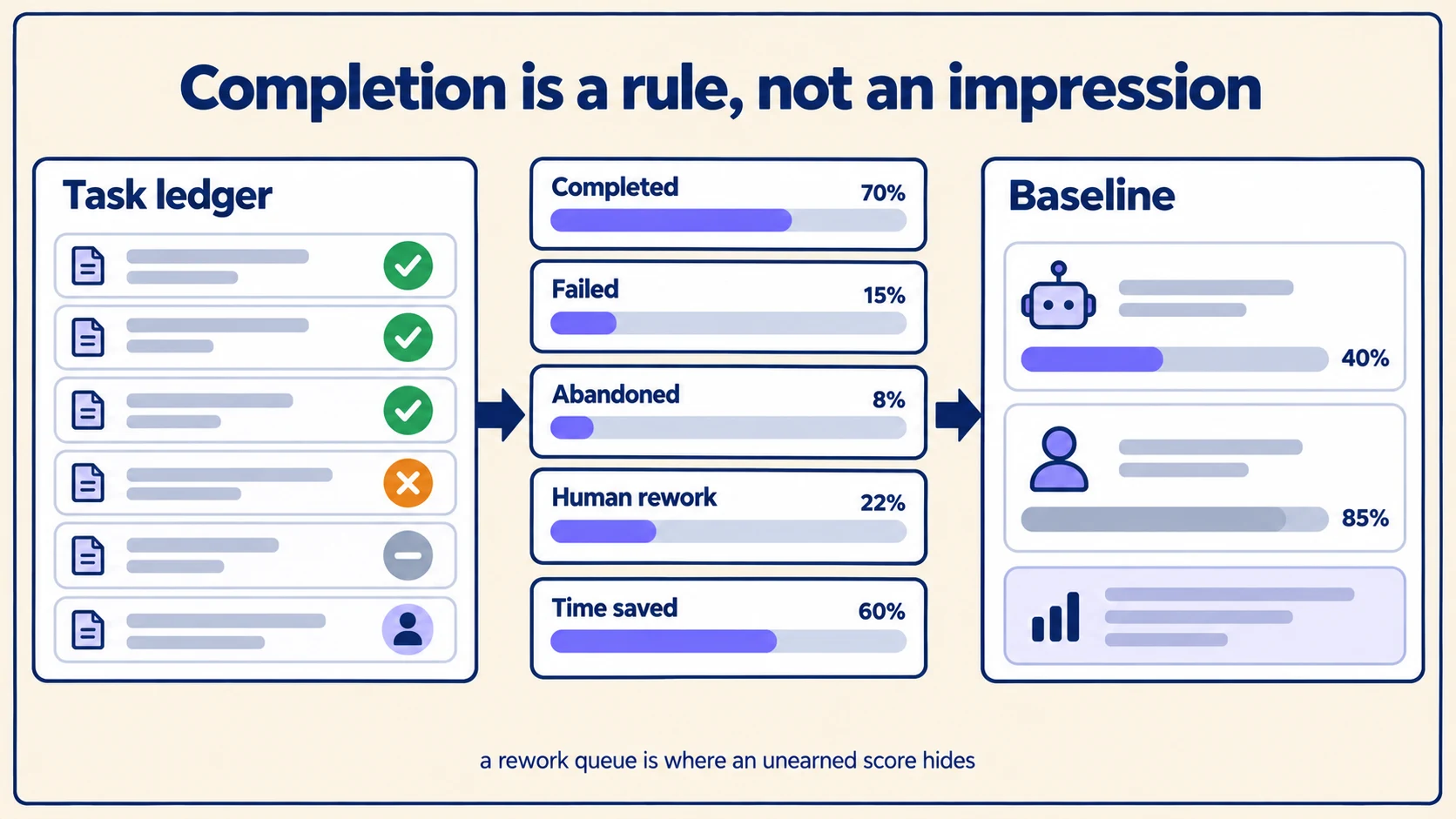
A worked pilot evaluation ledger: The project update benchmark
To understand how completion metrics function in practice, examine a controlled evaluation of 20 realistic project management requests submitted to an autonomous enterprise agent. The table below categorizes the observed outcomes. The figures below are deliberately synthetic and illustrative; they do not represent proprietary customer data or vendor benchmark claims.
| Observed execution outcome | Attempt count | Evaluated status | Counted as unassisted completion? |
|---|---|---|---|
| Fully Autonomous Success | 12 | Target document created, verified grounding, valid schema, no intervention. | YES |
| Silent Write Failure | 3 | Agent emitted a complete draft in chat, but failed to write to the database. | NO (Execution failure) |
| Factual Date Hallucination | 2 | Draft saved to disk, but contained an invented milestone deadline date. | NO (Grounding failure) |
| Assisted Human Repair | 2 | Draft completed only after a human reviewer re-selected the source file. | NO (Assisted completion) |
| Graceful Abstention | 1 | Agent refused to proceed because two conflicting project versions were present. | YES (Correct abstention) |
Now examine how metric definitions alter the apparent success of the pilot:
- Total Ingestion Cohort: 20 eligible task attempts.
- Unassisted Completion Rate (UCR): 13 / 20 = 65.0% (including the 12 direct completions and 1 valid abstention).
- Assisted Completion Rate (ACR): 2 / 20 = 10.0%.
- Total Pipeline Yield (UCR + ACR): 15 / 20 = 75.0%.
- Critical Failure Rate (Silent writes + hallucinations): 5 / 20 = 25.0%.
Notice that counting the two human-assisted tasks as autonomous successes would dishonestly inflate the perceived automation rate from 65% to 75%. In enterprise operations, human intervention incurs direct labor costs; separating unassisted straight-through automation from assisted repair is vital for accurate ROI modeling.
Pro Tip: In agent evaluation rubrics, always treat a correct, verified abstention as a successful outcome. If an agent is asked to update a project record but discovers that the project identifier is ambiguous, halting and asking for clarification is the correct behavior. Treating an abstention as a failure incentivizes models to guess blindly, generating catastrophic hallucinations.
The five core metrics of enterprise agent pilots
Rather than tracking subjective user satisfaction scores, enterprise platform teams should standardize on five quantitative, objective performance indicators:
1. Unassisted Completion Rate (UCR)
UCR = tasks completing 100% of requirements without human intervention / total eligible task attempts
Measures true straight-through automation capacity.
2. Assisted Completion Rate (ACR)
ACR = tasks completing successfully after operator guidance or repair / total eligible task attempts
Measures the system's ability to recover gracefully with human-in-the-loop collaboration.
3. Mean Human Intervention Time (MHIT)
MHIT = average active operator minutes spent reviewing, correcting and unblocking an agent
Measures the human labor burden required to shepherd tasks to completion.
4. Boundary Violation Rate (BVR)
BVR = attempts violating safety, access or scope constraints / total task attempts
Measures compliance security: unauthorized tool execution, out-of-scope database writes, or disclosure of restricted documents. In high-security enterprise environments, BVR must be 0.0%.
5. Net Economic Labor Delta (Delta T)
Delta T = manual baseline time - (agent execution time + human review time)
Measures whether the automated workflow actually saves time compared to legacy human-only operations.
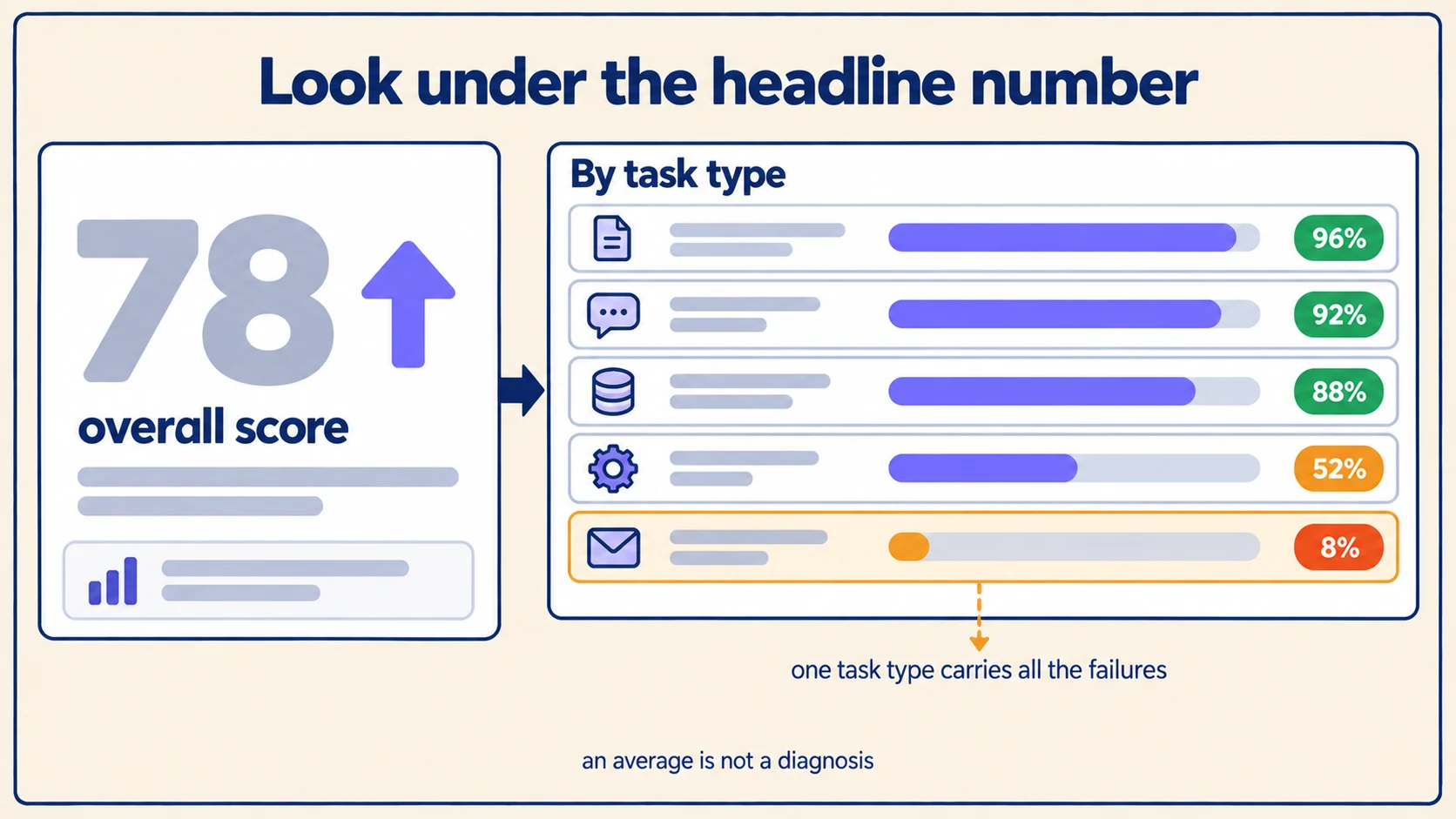
Diagnose failure below the top-line headline score
When an agent pilot scores a disappointing 60% completion rate, declaring that "the AI model isn't smart enough" provides zero actionable guidance to engineering teams. Platform architects must decompose failures into their constituent subsystem mechanisms.
Microsoft's Azure AI Foundry agent evaluator documentation outlines formal evaluation dimensions for isolating tool calling mechanics, planning efficiency, and grounding fidelity.
Categorize every failed attempt into a structured diagnostic taxonomy:
- Retrieval & Ingestion Failure: The vector search engine failed to retrieve the necessary source chunks, starving the agent of grounding context.
- Planning & Decomposition Breakdown: The agent failed to construct a logical multi-step execution graph (e.g., attempting to update a database record before fetching its foreign key).
- Tool Parameter Schema Failure: The LLM hallucinated an invalid argument or emitted malformed JSON that failed the tool's input schema validation.
- Authorization / Policy Interception: The agent attempted an action that was rightfully blocked by enterprise role-based access control (RBAC) middleware.
- Grounding & Citation Hallucination: The agent performed the write successfully, but populated fields with unverified data. Use our specialized citation verification methodology to audit factual grounding.
- Environmental Timeout / Network Drop: The agent logic was flawless, but an underlying database pool was exhausted or an external API gateway timed out, as detailed in our guide on ai-agent partial failure handling.
Establish an empirical human baseline comparison
An agent completion rate cannot be evaluated in a vacuum. A 75% unassisted completion rate may sound mediocre until an audit reveals that human junior analysts executing the identical manual workflow achieve only 72% accuracy due to manual copy-paste fatigue.
To conduct a rigorous baseline study:
- Select 50 representative real-world task requests.
- Have experienced human employees complete the tasks manually using standard enterprise software tools.
- Record the total elapsed time, active hands-on-keyboard time, error rate, and rework frequency.
- Run the identical 50 tasks through the autonomous agent platform under identical starting conditions.
- Measure the delta: compare end-to-end cycle time, error frequency, and total human review effort.
If an agent completes a complex report in 30 seconds, but the output is so unreliable that a human senior manager must spend 45 minutes manually verifying every single line item against source PDFs, the net operational value is negative. Autonomous agents only deliver positive enterprise ROI when human verification time is dramatically lower than manual generation time.
Review our in-depth frameworks on enterprise AI answer abstention and our comprehensive enterprise knowledge assistant evaluation guide to structure multi-dimensional evaluation suites.
To explore how our platform empowers autonomous enterprise workflows, discover Exemplary AI enterprise agents and schedule an enterprise architecture briefing to observe automated pilot benchmarking, task completion telemetry, and human-in-the-loop review interfaces.