Validating extracted data against business rules
Separate extraction errors from inconsistent source documents using explicit field, arithmetic and cross-record validation rules.

Sarath Chandran
Recognizing a value correctly does not establish that the value is valid for the business process. A document can be perfectly legible and still contain inconsistent totals, missing references or an impossible combination of fields. Document extraction validation should identify those problems while preserving what the source actually says.
In automated back-office pipelines—such as accounts payable, trade finance, customs clearance, and insurance claims—machine learning models are frequently blamed for "data errors" when they have actually transcribed flawed source documents with high fidelity. If an invoice issued by an external supplier contains an arithmetic error where line items sum to $1,300 but the printed invoice total reads $1,200, an OCR model that transcribes "$1,200" has performed its job accurately. If an automated script silently alters the line items or recalculates the total to force the ledger to balance, it obscures a genuine commercial dispute and commits financial fraud. Automated validation must enforce business invariants while maintaining an uncompromised record of truth.
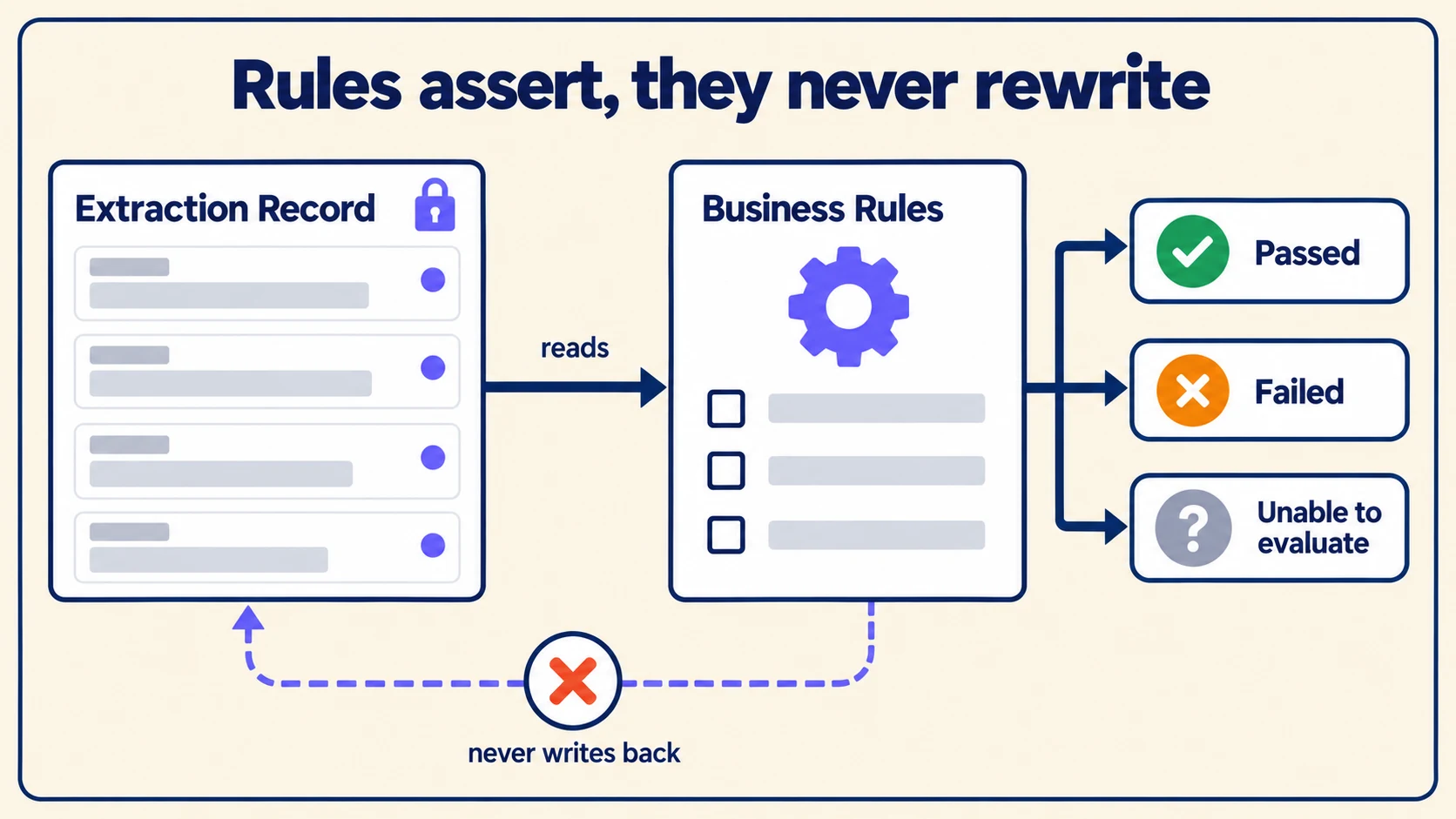
Key Architecture Rule: Never allow business validation rules to mutate raw extraction records silently. Business rules must evaluate data as an independent audit assertion layer, emitting deterministic pass, fail, or exception signals alongside cryptographic pointers to the source text.
Write validation rules in business language before technical encoding
Before writing custom Python scripts, Common Expression Language (CEL) rules, or SQL stored procedures, engineering teams must collaborate with business process owners to articulate explicit validation invariants.
A robust business rule specification must articulate:
- Rule Invariant Name: A human-readable identifier (e.g.,
RULE_INVOICE_LINE_SUM_EQUALS_SUBTOTAL). - Target Schema Scope: The exact fields, entities, and line-item tables governed by the assertion.
- Preconditions & Activation Criteria: Conditions under which the rule applies (e.g., "Applies only to commercial physical goods invoices; service invoices without shipping manifests are exempt").
- Tolerances & Thresholds: Allowable mathematical variance (e.g., penny-rounding tolerances for multi-currency tax distributions).
- Failure Consequence & Routing: The specific operational workflow triggered upon violation (e.g., route to accounts payable dispute resolution queue).
Google Cloud's document validation documentation establishes the critical architectural distinction between checking extracted entity integrity and executing automated post-processing corrections. Validating assertions without corrupting original source values ensures regulatory compliance across enterprise intake workflows.
An illustrative freight manifest and exception scenario
To understand how validation rules operate in high-throughput logistics, consider a synthetic international air freight packing list. The table below illustrates how different validation assertions evaluate an incoming shipment record. The figures below are deliberately synthetic and illustrative; they do not represent proprietary customer data or benchmark claims.
| Field identifier | Extracted value | Applied validation assertion | Validation outcome & operational action |
|---|---|---|---|
| Shipment Reference | SH-042-X | Format check: Must match regex ^SH-[0-9]{3}-[A-Z]$. | PASS: Syntax is valid; triggers ERP database lookup. |
| Cargo Box A Count | 8 | Data type: Positive integer > 0. | PASS: Valid numerical quantity. |
| Cargo Box B Count | 5 | Data type: Positive integer > 0. | PASS: Valid numerical quantity. |
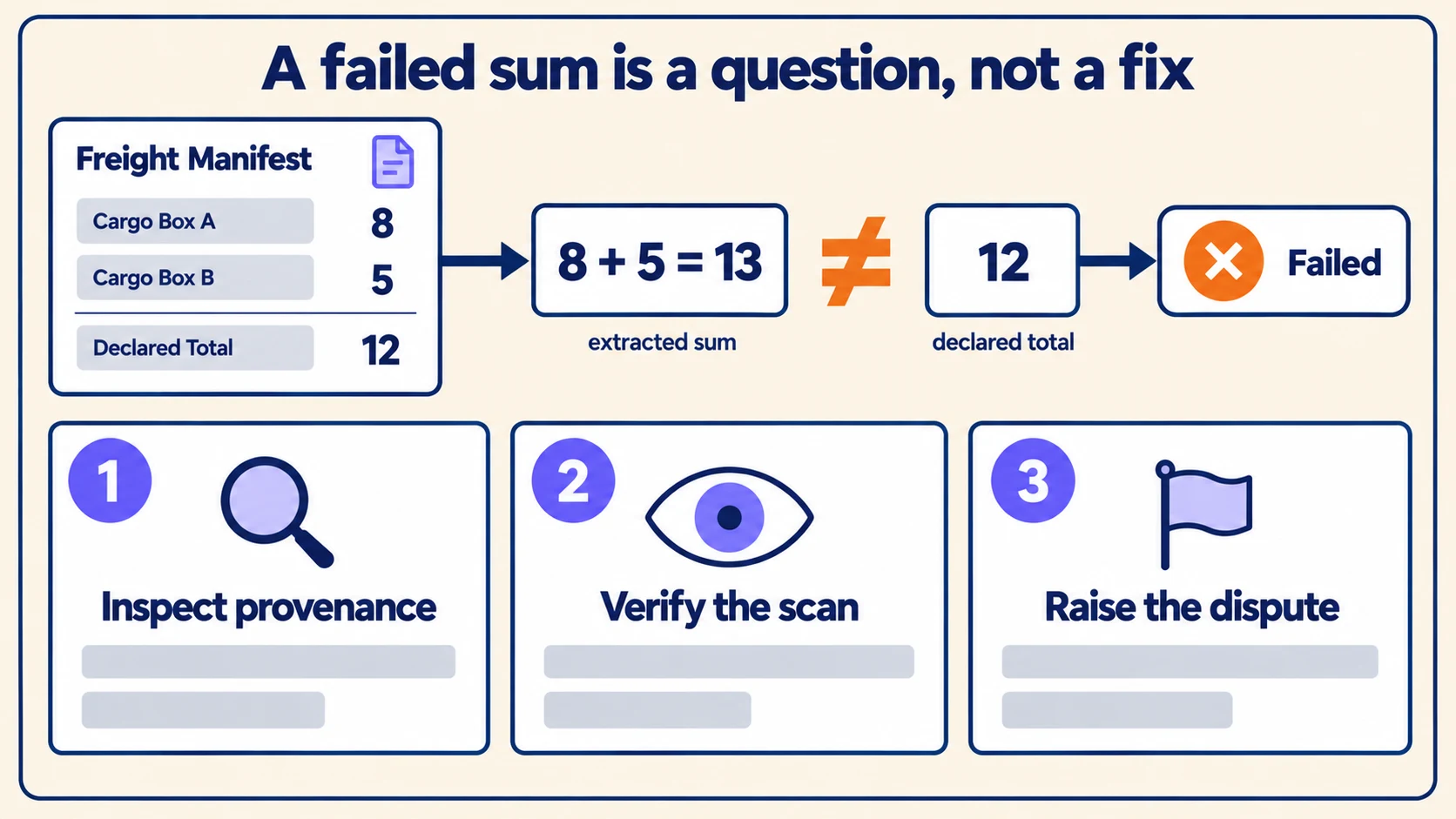
| Declared Total Boxes | 12 | Arithmetic invariant: Total == Sum(Box A, Box B). | FAIL (Discrepancy): Extracted sum is 13, declared is 12. |
| Gross Weight Unit | (Empty / Null) | Dependency: If Gross Weight is present, Unit is required. | FAIL (Missing Context): Weight value 450 lacks unit code (kg vs lbs). |
In this synthetic scenario, the arithmetic validator catches an immediate discrepancy: 8 + 5 = 13, yet the printed document asserts a total of 12.
The pipeline must not guess whether Box A was actually 7 or whether the total was 13. It must execute automated root-cause triage:
- Inspect Provenance: Retrieve high-resolution page crops for the Box A, Box B, and Total fields.
- Verify OCR Fidelity: If the source scan physically printed "13" and the OCR misread it as "12", correct the OCR token.
- Trigger Dispute Workflow: If the physical scan genuinely printed "12", generate a structured supplier discrepancy notice flagging the arithmetic defect before payment is authorized.
Pro Tip: In financial documents, always implement a penny-rounding tolerance rule (ABS(CalculatedTax - ExtractedTax) <= 0.02) when validating line-item sums against grand totals. Due to fractional tax calculations across individual items, legitimate commercial invoices frequently exhibit one-to-two-cent rounding variances that should not halt straight-through processing.Deploy a four-tier validation hierarchy
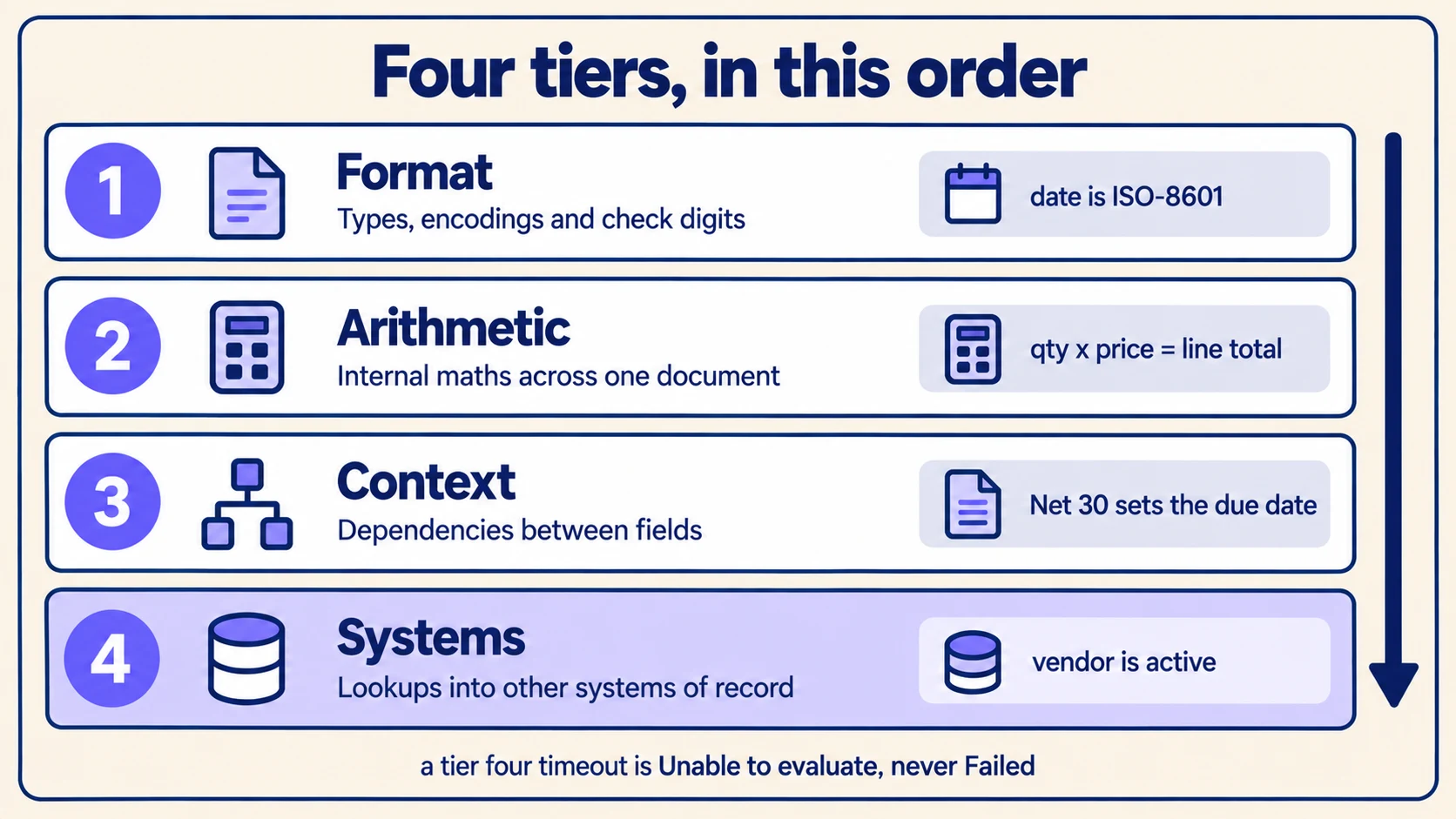
Modern document pipelines must structure validation across four cascading layers of increasing complexity:
- Syntactic & Format Validation: Evaluates data types, character encodings, regular expressions, and check-digit algorithms (e.g., verifying that a credit card number passes Luhn validation or that a date adheres to ISO-8601).
- Relational & Arithmetic Validation: Evaluates internal mathematical consistency across document fields (e.g., line-item quantities multiplied by unit prices equal line totals; subtotal plus tax equals grand total).
- Cross-Field Contextual Validation: Evaluates logical dependencies between separate fields on the same document (e.g., if
Payment Termsis"Net 30",Due Datemust be exactly 30 days afterInvoice Date). - Referential & System-of-Record Validation: Evaluates extracted entities against external enterprise databases (e.g., verifying that the extracted
Vendor IDmatches an active, approved vendor in SAP with a matching bank account routing number).
Google Cloud's document validation expression reference demonstrates how declarative expressions using the Common Expression Language (CEL) can enforce complex, multi-field assertions without requiring brittle, hard-coded software releases.
Preserve an explicit "unable to evaluate" operational state
A binary pass/fail validation framework is fundamentally insufficient for mission-critical enterprise workflows. A validation rule may fail to evaluate not because the data is invalid, but because a prerequisite service was unreachable or an upstream field was ambiguous.
Maintain three distinct execution outcomes:
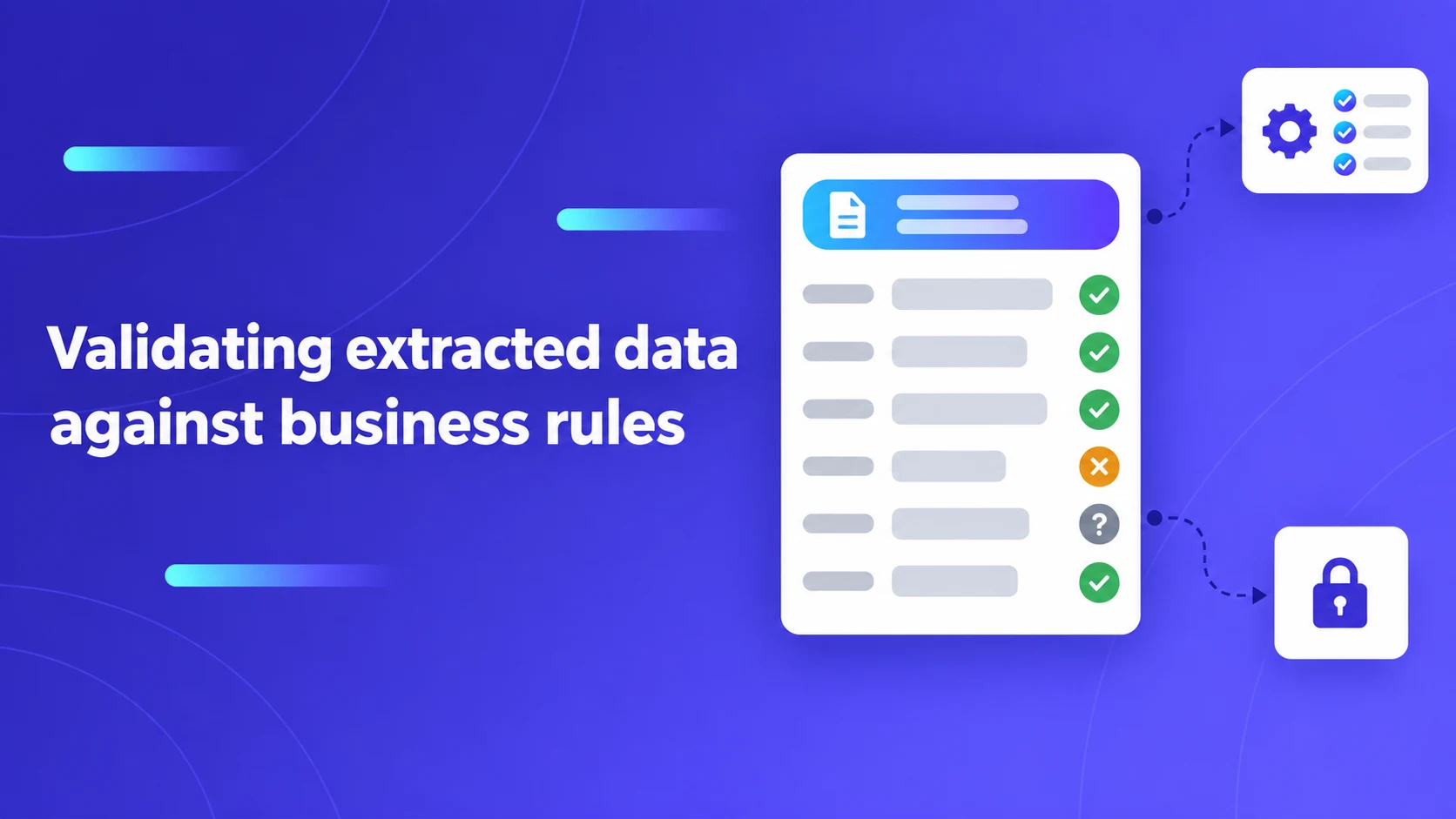
PASSED: The invariant was successfully evaluated and the assertion holds true.FAILED: The invariant was successfully evaluated and the data explicitly violates the business rule.UNABLE_TO_EVALUATE: The assertion could not be computed due to missing input fields, unresolved OCR ambiguity, or external API timeout.
Treating an external database network timeout as a "validation failure" causes legitimate supplier invoices to be rejected or flagged as fraudulent. Maintaining clean separation between system execution health and business data integrity ensures operational resilience.
Ensure that all values undergo standardized normalization prior to running cross-field comparisons, following the frameworks outlined in our guide to normalizing extracted dates, currencies, and identifiers.
Decide where each rule belongs before you implement it
The same assertion can usually be implemented in three places, and the choice determines how quickly it can change and who is allowed to change it.
A rule can live in the extraction pipeline, in the system of record, or in the human review interface. Teams tend to put everything in the pipeline because that is the codebase they are working in, and then discover a year later that the finance team cannot adjust a tolerance without an engineering release.
| Where the rule lives | Fits | Costs |
|---|---|---|
| Extraction pipeline | Format, arithmetic and cross-field checks that depend only on the document | Changing it needs a deployment unless the rules are declarative and externally stored |
| System of record | Referential checks against vendors, contracts, accounts and limits | Runs after intake, so a bad record has already been created and must be reversed |
| Review interface | Judgement calls, and anything where the right answer depends on context the pipeline cannot see | Consumes reviewer time for every document it touches, not only failures |
The practical guidance is narrow: put a rule in the pipeline when it can be decided from the document alone, put it in the system of record when it needs enterprise state, and never split one invariant across two of them. A total-equals-sum check implemented in both places drifts the moment one is updated, and the two then disagree on documents that sit near the tolerance boundary.
Declarative rule expressions are what make the first row tolerable. The CEL specification defines a small, side-effect-free expression language with predictable evaluation, which means a rule can be stored as data, reviewed by someone who does not write application code, and changed without a release.
Version rules the way you version code
A validation rule set is not static configuration. Tolerances change, new document types arrive, regulators add requirements, and a rule that was correct last quarter can be wrong this quarter. Without versioning, none of that is visible in the record.
The failure is specific and it surfaces during audit. A document validated in March passes under the March rule set. In September an auditor re-runs validation, the current rules are stricter, and the document now fails. Nothing about the document changed. Without a recorded rule version, there is no way to show that the original decision was correct at the time it was made, and the finding stands.
Four properties make a rule set auditable:
- A version identifier stamped on every validation result, so any outcome can be traced to the exact assertions that produced it.
- An effective date range per rule, so re-evaluating a historical document uses the rules that were live when it was processed rather than today's.
- A recorded owner and rationale, because a tolerance with no explanation is a tolerance nobody will dare change.
- A deprecation path rather than deletion, since removing a rule outright makes every historical result referencing it unresolvable.
Pro Tip: Before activating a new or tightened rule, shadow-run it against the last quarter of processed documents and count how many would have failed. A rule that would have flagged forty per cent of historical volume is not catching fraud — it encodes an assumption the business does not actually hold, and activating it will bury the exception queue on day one.
Route exceptions by cost, not by rule
Once validation produces exceptions, the pipeline's economics are decided by what happens to them. A queue that treats every failure identically forces a reviewer to spend the same attention on a missing unit code as on a six-figure total mismatch, and the expensive cases wait behind the trivial ones.
Route on the consequence of being wrong, not on which rule fired:
- Auto-resolve what is unambiguous. A missing unit code on a supplier who has used kilograms on every previous shipment is resolvable from history — but record the inference and its basis, never as a silent edit to the extracted value.
- Batch the systematic failures. Forty documents failing the same rule from the same supplier is one supplier conversation, not forty review tasks. Group by rule and counterparty before assigning.
- Escalate by exposure. A discrepancy on a payment of a few hundred deserves different handling from one on a payment of several hundred thousand, even when the rule and the percentage error are identical.
- Time-box the rest. An exception with no owner and no deadline becomes a backlog, and a backlog eventually gets cleared by bulk approval — which is the same as having no validation at all.
Measure the rule set, not only the extractor
Extraction accuracy is measured routinely. The rule set almost never is, which is how validation frameworks quietly decay into noise generators that reviewers learn to click through.
Three measurements are enough to keep a rule set honest, and all three come from data the pipeline already stores:
- Per-rule firing rate. A rule that has never fired in six months is either redundant or broken, and both are worth knowing. A rule that fires on most documents is describing normal business practice rather than an exception.
- Per-rule override rate. Where reviewers consistently mark a failure as acceptable, the rule is wrong — its tolerance is too tight, or its precondition is too broad. This is the single most actionable number in the whole framework.
- Share of
UNABLE_TO_EVALUATEby cause. A rising share pointing at one external dependency is an infrastructure problem wearing a data-quality costume, and it should be triaged as an outage rather than as a validation backlog.
Review these quarterly with the business owners who wrote the invariants. Rules written once and never revisited are the reason validation frameworks lose credibility: reviewers learn which failures are real and which are habitual, and once they are habitually overriding a rule, they are no longer reading the ones that matter.
Maintain complete data provenance and correction histories
When human reviewers or automated rules apply corrections to resolved exceptions, maintain an immutable audit trail. In regulated financial and healthcare environments, regulatory auditors require evidence proving who modified a value, when the change occurred, what the original source document displayed, and which business rule triggered the intervention.
As detailed in our in-depth guide on document extraction source provenance, every extracted entity, calculated field, and reviewer modification must remain cryptographically bound to the underlying PDF page coordinates and image bounding boxes.
For a comprehensive blueprint on designing automated enterprise document systems, consult our foundational AI document-processing guide. Learn how our enterprise File store preserves audit trails and how autonomous Agents manage exception resolution. Then, schedule an enterprise architecture demo to evaluate automated business rule validation against your organization's real-world document workflows.