Multilingual OCR: what to test beyond language support
Build a multilingual document evaluation that distinguishes recognition, reading order, field interpretation and translation.

Sarath Chandran
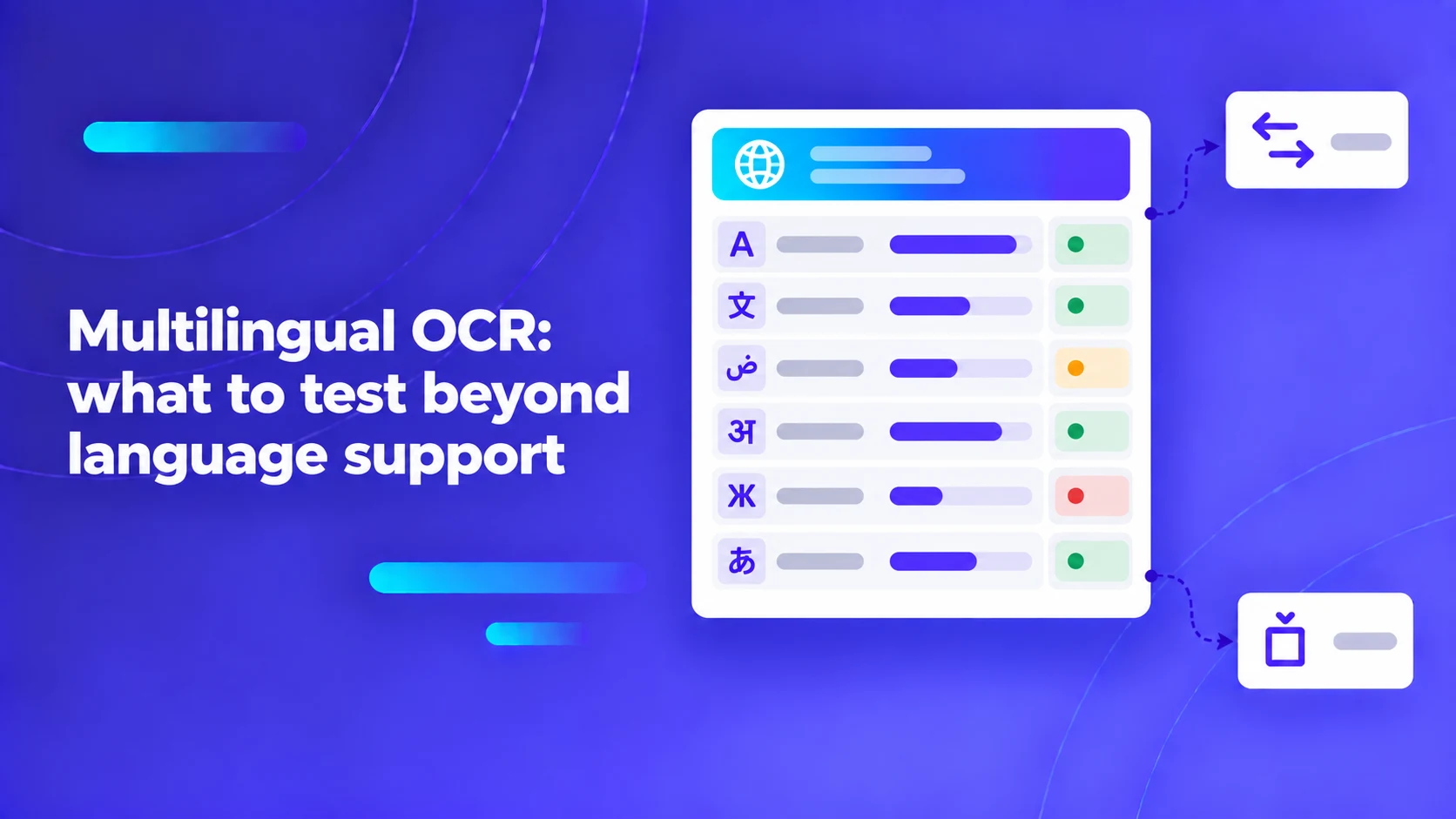
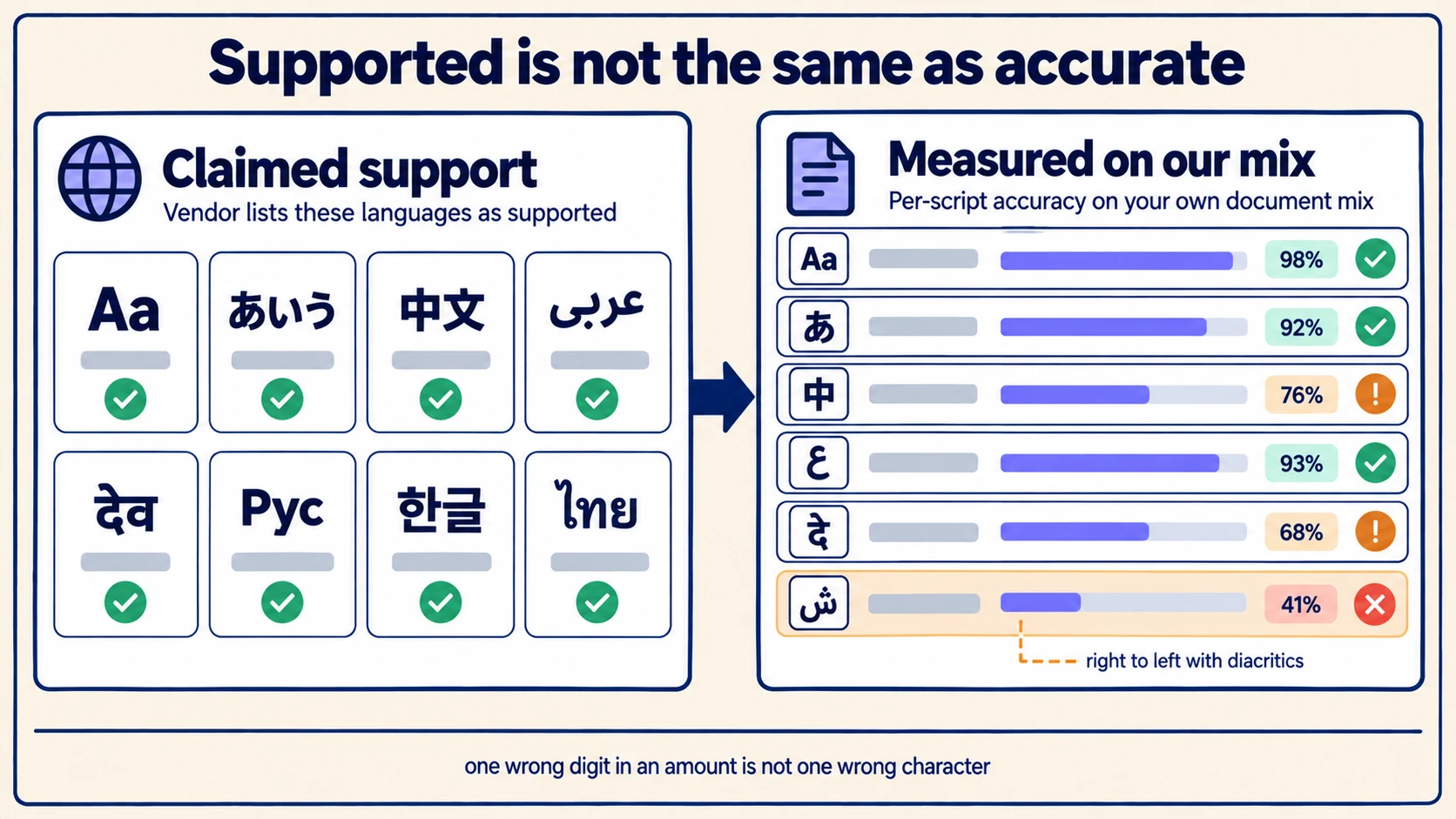
A language-support list is the starting point for evaluating multilingual OCR, not a result for your documents. Recognition can vary with script, handwriting, layout, image quality and the mixture of languages on a page. A system that reads a printed paragraph may still struggle to preserve the meaning of a bilingual form or a table containing local number formats.
Global enterprises operating across multiple jurisdictions handle a continuous stream of mixed-language documents: cross-border customs declarations, multilingual clinical trial reports, international contracts, and supply chain bills of lading. When these documents enter an automated processing pipeline, naive evaluations that rely on vendor-published "supported language" marketing checkmarks inevitably fail. Real-world multilingual documents rarely present uniform text in a single isolated language. Instead, they mix right-to-left (RTL) scripts with left-to-right (LTR) technical codes, combine CJK logographs with Latin serial numbers, and intersperse localized numeric delimiters that confuse standard parsing engines.
Key Architecture Rule: Evaluate multilingual document extraction across four isolated layers—glyph recognition, reading order preservation, entity association, and semantic normalization. Conflating these distinct operational stages into a single pass/fail metric conceals the true root causes of downstream processing failures.
Match the test to the actual document population
Describe the documents you expect before selecting samples. Record language, script, document family, printed or handwritten content, digital or scanned origin, and whether multiple languages appear in the same field.
Do not infer a document's language from the sender's country of origin. A logistics hub in Rotterdam may process invoices written in German, customs clearances in French, and packing slips in English with Dutch delivery notes. Similarly, a clinical trial research form originating in Tokyo may feature a Japanese narrative body alongside English pharmacological abbreviations, Latin chemical names, and numeric assay measurements. The only actionable unit of analysis is the document instance and its specific field structures.
Microsoft's OCR language-support documentation separates support by feature, script family, and model version. It also cautions against forcing a static language hint parameter when the document language is uncertain or dynamically mixed across pages. Forcing an engine into a Latin-only mode when processing a document with Cyrillic or Arabic notations forces the model to substitute phonetic approximations or drop tokens entirely. Always inspect the exact service endpoints and model versions being evaluated, and validate them directly against an empirically gathered corpus of representative enterprise paperwork.
A structured multilingual evaluation matrix
To establish an objective baseline, construct an evaluation matrix that isolates distinct linguistic and structural challenges across your target document population. The following matrix illustrates how test scenarios should pair specific linguistic challenges with distinct extraction and semantic interpretation questions. The data below is deliberately synthetic and illustrative; it does not represent vendor benchmarks or product capabilities.
| Synthetic sample scenario | Linguistic & structural challenge | Token recognition question | Layout & entity interpretation question |
|---|---|---|---|
| English–French research form | Complex diacritics (é, à, ç, œ) and hyphenated legal terminology | Are all accent marks and composite glyphs preserved without character corruption? | Are bilingual field labels correctly separated from user-entered research responses? |
| Arabic–English shipping bill | Bidirectional (Bidi) text mixing RTL Arabic with LTR Latin serial numbers | Are Arabic character ligatures and numeric digits extracted in correct logical sequence? | Does each LTR container tracking code remain associated with its corresponding Arabic description? |
| Japanese–English equipment log | Mixed script (Kanji, Hiragana, Katakana, Latin alphanumeric) with vertical layouts | Are non-standard technical model numbers copied faithfully without phonetic transliteration? | Does the vertical-to-horizontal text flow maintain column alignment across tabular specifications? |
| Multilingual handwritten amendment | Cursive corrections written over printed multi-currency tables | Can handwritten script be extracted without corrupting background printed borders? | Is the amended value mapped to the original line item rather than creating an orphaned entity? |
| Regional currency & date formats | Space delimiters, periods as thousands separators, and day-first date ordering | Are punctuation marks, apostrophes, and currency symbols (€, ¥, £, ₹) recognized? | Does the parser interpret 04.05.2026 correctly based on the document jurisdiction? |
A comprehensive international evaluation suite must reflect the actual variance of your enterprise intake pipeline. For every cell in your test plan, catalog the volume of available samples and document known edge cases. An empty handwritten test partition is an absence of operational evidence, not an assumption of system competence.
Pro Tip: In bidirectional documents (such as Arabic or Hebrew paired with Latin identifiers), automated engines often swap adjacent columns in multi-column tables due to incorrect reading-order heuristics. Always verify the logical reading sequence in bounding-box outputs before accepting table extraction.
Establish reference answers with native-fluent reviewers
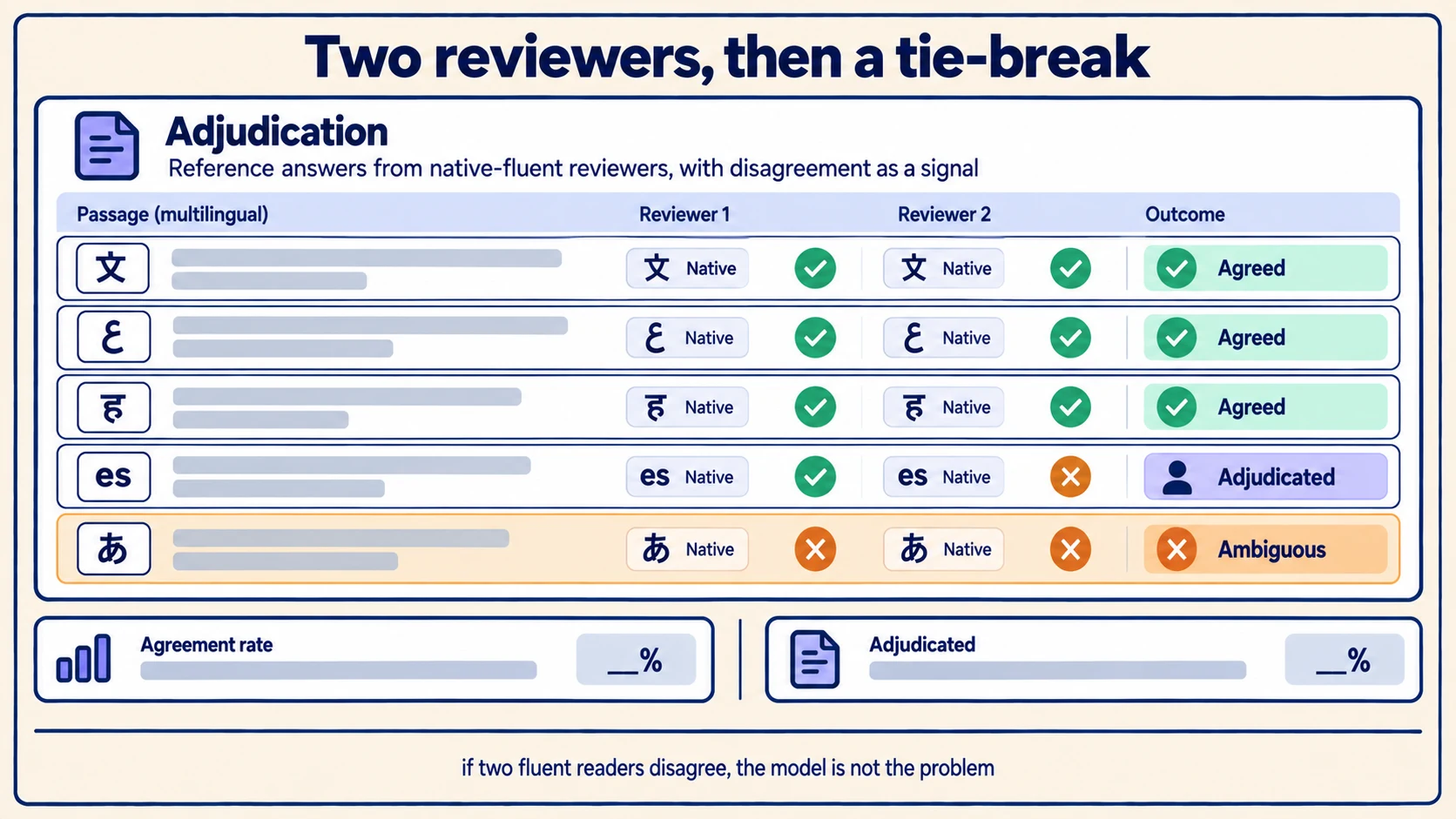
Automated scoring is only as trustworthy as the ground-truth reference dataset against which it is compared. Establish ground truth using professional reviewers who are native or professionally fluent in the target languages and scripts.
- Dual-Reviewer Protocol for Ambiguous Cases: For high-stakes legal, medical, or financial documents, implement a dual-blind transcription protocol where two independent native speakers transcribe the source. Discrepancies should be adjudicated by a lead linguistic auditor.
- Explicit Uncertainty Tagging: Instruct transcribers never to guess or "clean up" degraded glyphs. If a character is physically smudged or illegible, annotate it as
[ILLEGIBLE]rather than interpolating the word based on contextual clues. - Separate Literal Transcription from Semantic Translation: A product SKU or chemical identifier must retain its exact typographical form. A person's legal name may have an established transliteration, but that transformation must be governed by an explicit enterprise data policy, not an arbitrary decision by an automated translation model.
- Predefined Normalization Rules: Define strict comparison rules prior to running evaluation scripts. Specify how evaluation tooling should handle non-breaking spaces, zero-width joiners, soft hyphens, and Unicode normalization forms (NFC vs. NFD).
Measure where the business meaning changes
While character error rate (CER) and word error rate (WER) provide useful technical metrics for OCR research teams, enterprise business processes require evaluating where semantic meaning breaks down. A 1% character error rate that misreads an invoice total from $10,000 to $70,000 represents a total operational failure, whereas a 1% error rate on a standard legal disclaimer paragraph has zero financial consequence.
Evaluate entity-level and relationship-level integrity:
- Entity Linking: Does a translated date field link to the correct shipping event?
- Numeric Precision: Are localized monetary amounts paired with the correct currency symbol, and are comma/decimal point conventions resolved accurately?
- Directional Order: In RTL contexts, did the engine reverse the sequence of alphanumeric tracking numbers?
Google's document evaluation guidance outlines standardized methodologies for evaluating extracted entities, bounding boxes, and precision-recall curves against structured ground-truth schemas. When conducting multilingual evaluations, segment your precision and recall reporting by language, document family, and field type. Presenting an aggregate "96% accuracy" figure across an entire enterprise repository hides catastrophic failure modes occurring in specific low-resource language subsets.
Keep normalization and translation workflows observable
A correctly recognized textual string can still produce invalid downstream records if normalization logic is flawed. For instance, extracting the string "05/06/2026" without locale context leaves ambiguity: does it represent May 6 or June 5? The OCR recognizer performed its duty flawlessly by transcribing the characters; the error occurs in the interpretation layer.
Similarly, automated machine translation should not be treated as an invisible step within the OCR pipeline. When an automated agent or pipeline translates localized foreign-language documents, the original source string, the recognized language code, and the translated string must all remain accessible in the audit log. Reviewers must be provided with side-by-side verification interfaces showing the original scanned page, the exact bounding box, the raw extracted transcript, and the normalized target entity.
Our in-depth analysis on normalizing extracted values provides practical frameworks for handling localized dates, currencies, and identifiers across global enterprise data streams.
Diagnose pipeline bottlenecks before replacing models
When an evaluation reveals poor multilingual extraction performance, avoid the knee-jerk reaction of immediately swapping the underlying foundational model. Diagnose which architectural component failed:
- Ingestion & Resolution: Was the scan resolution below 300 DPI, causing delicate diacritic marks to blur together? Consult our poor-scan-quality OCR triage method to establish image acquisition standards.
- Language Identification: Did an upstream language classifier misidentify the primary script, passing erroneous hints to the recognition engine?
- Layout & Token Ordering: Did complex multi-column layouts cause text blocks from adjacent language columns to interleave?
- Entity Extraction & Parsing: Did downstream post-processing regexes assume Latin date formats or reject non-ASCII alphanumeric vendor codes?
Systematic diagnosis reveals that many extraction failures originate in pre-processing, layout analysis, or normalization rules rather than raw OCR engine capabilities. Retest all modifications against your established reference dataset and track regressions using automated CI/CD evaluation pipelines.
To learn how to structure resilient end-to-end extraction architectures, explore our comprehensive AI document-processing guide. Learn about the secure multi-tenant architecture of our File store and autonomous Agents, and schedule an enterprise architecture demo to test your multilingual document packages in a live environment.