One PDF, several documents: testing document splitting
Test page boundaries, repeated document types and missing pages before extracting records from a combined PDF packet.

Sarath Chandran
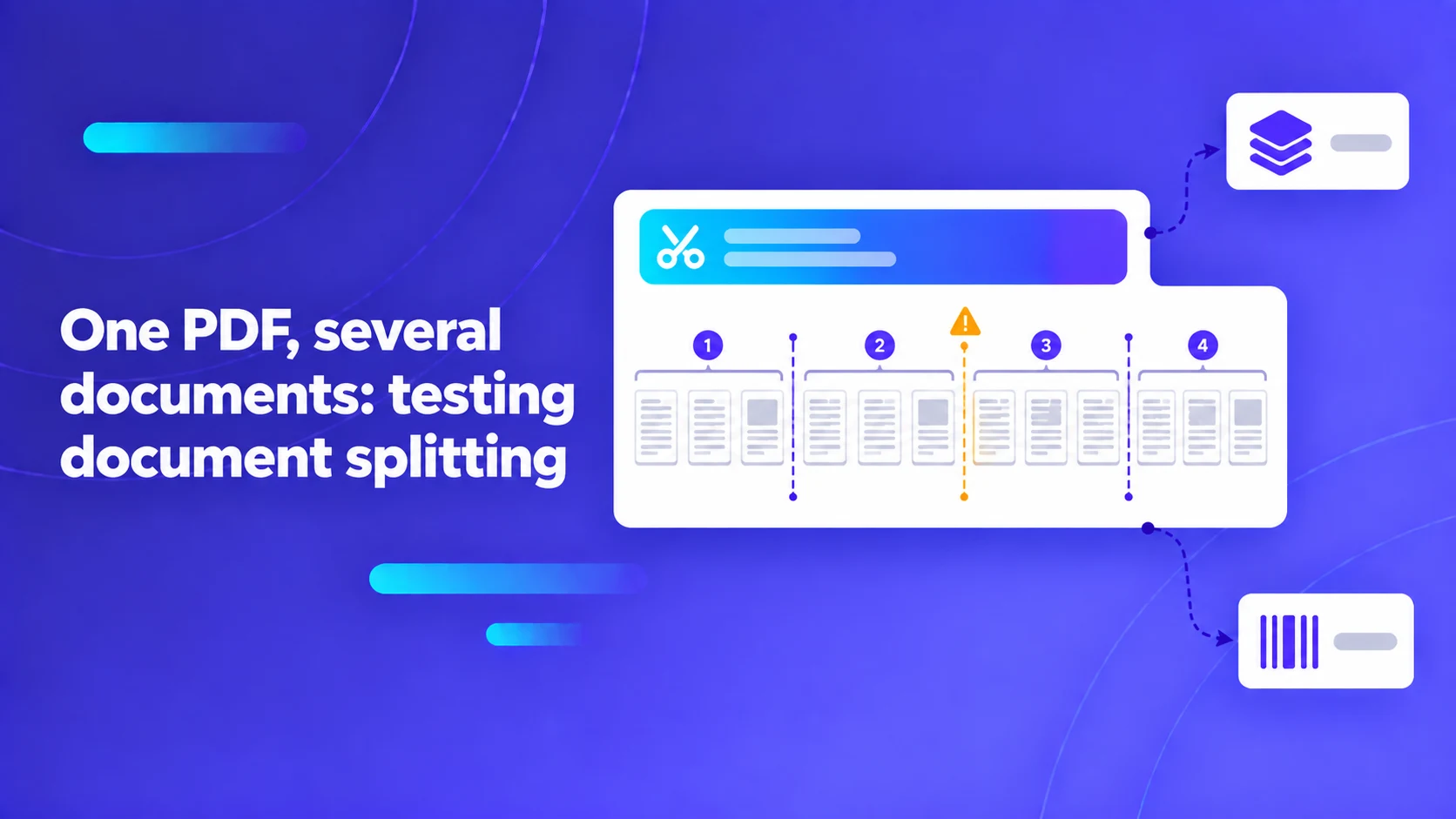
A PDF is a container, not a guarantee that its pages belong to one document. A single upload may contain an application, supporting evidence, a cover letter and several repeated forms. Before extracting fields, establish which pages should be interpreted together. A wrong boundary can join one organization's name to another organization's records while leaving every individual word correctly recognized.
In high-volume commercial workflows—such as mortgage underwriting, insurance claim adjudication, and legal discovery—incoming submissions routinely arrive as massive multi-page PDF files containing dozens or hundreds of scanned pages. When automated systems naively ingest a 50-page bundle as a single monolithic document, catastrophic data contamination occurs. An applicant's personal identification documents become intermingled with a co-borrower's tax returns, or two separate commercial loan applications scanned during the same branch scanning session become merged into a single corrupted entity. Individual words and numbers are transcribed with flawless OCR accuracy, but the relational bindings across physical pages are completely shattered.
Key Architecture Rule: Treat document packet splitting as an independent, foundational stage preceding entity extraction. Never allow downstream field extractors to process multi-page uploads without verified document boundary maps and instance-level isolation.
Separate three fundamentally different intake decisions
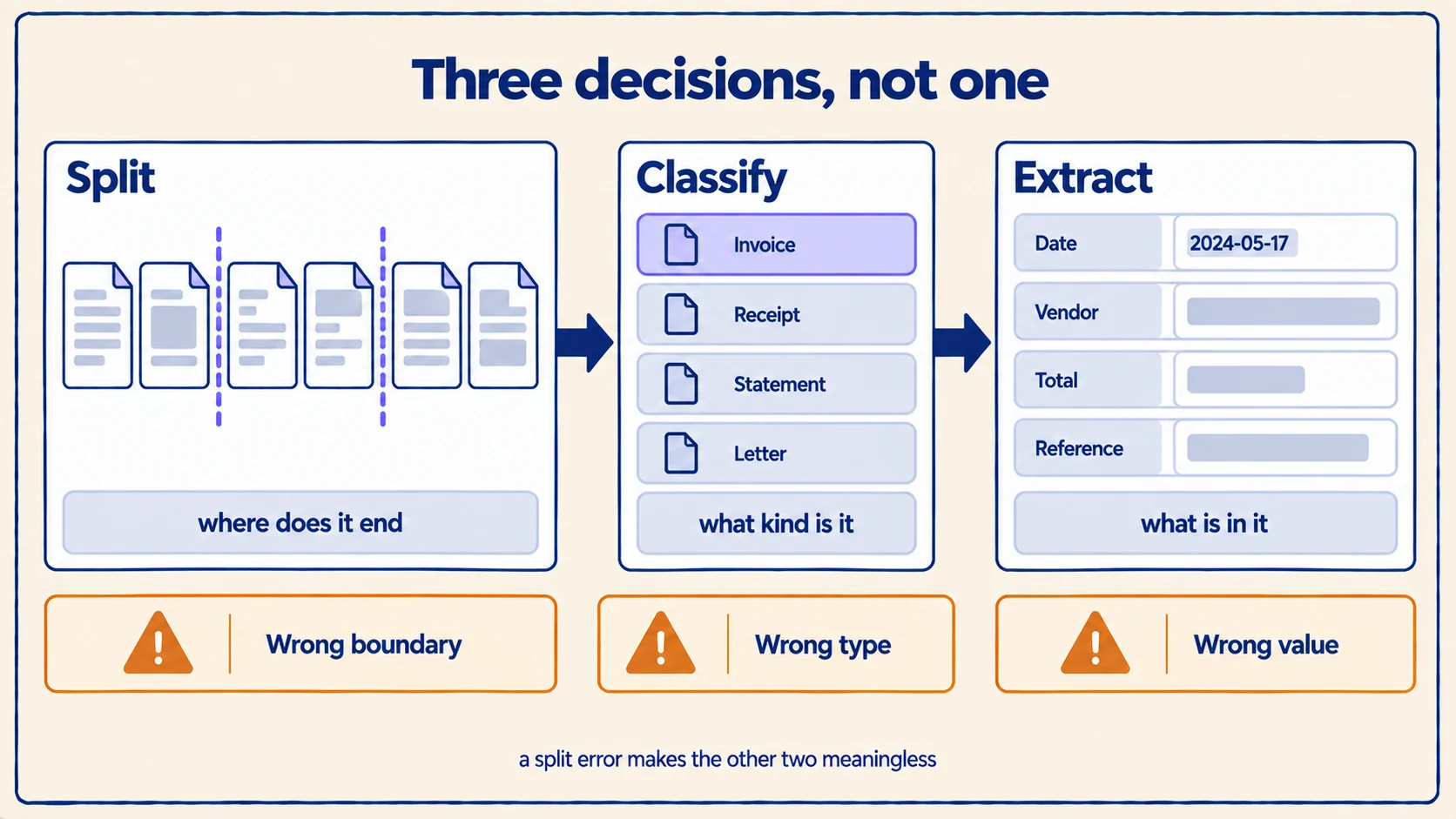
When processing complex document bundles, engineering teams must decouple three distinct analytical decisions:
- File Ingestion & Normalization: Validating file integrity, decompressing image streams, and establishing page-level coordinates.
- Page-Level Classification: Determining the functional type of each individual page (e.g., distinguishing a cover sheet from a bank statement or W-2 form).
- Instance Boundary Delimitation (Document Splitting): Determining where one logical business transaction ends and another begins.
Page classification provides vital evidence for splitting, but it cannot resolve document instance boundaries on its own. For example, in a batch submission containing three separate residential lease agreements, pages 1, 3, and 5 may all be classified as "Lease Agreement Page 1". A classifier that evaluates pages in isolation cannot determine whether page 2 belongs to lease instance A, whether page 4 belongs to lease instance B, or whether a page was scanned out of sequence.
Microsoft's custom document classifier documentation outlines distinct architectural patterns for document splitting, including single-document mode, independent page classification, and automated multi-page boundary detection. Selecting the appropriate model architecture depends on document heterogeneity and operational error tolerances.
Keep your document classification taxonomy strictly separated from boundary detection logic; a system can achieve 100% classification accuracy on individual pages while still generating completely invalid document splits.
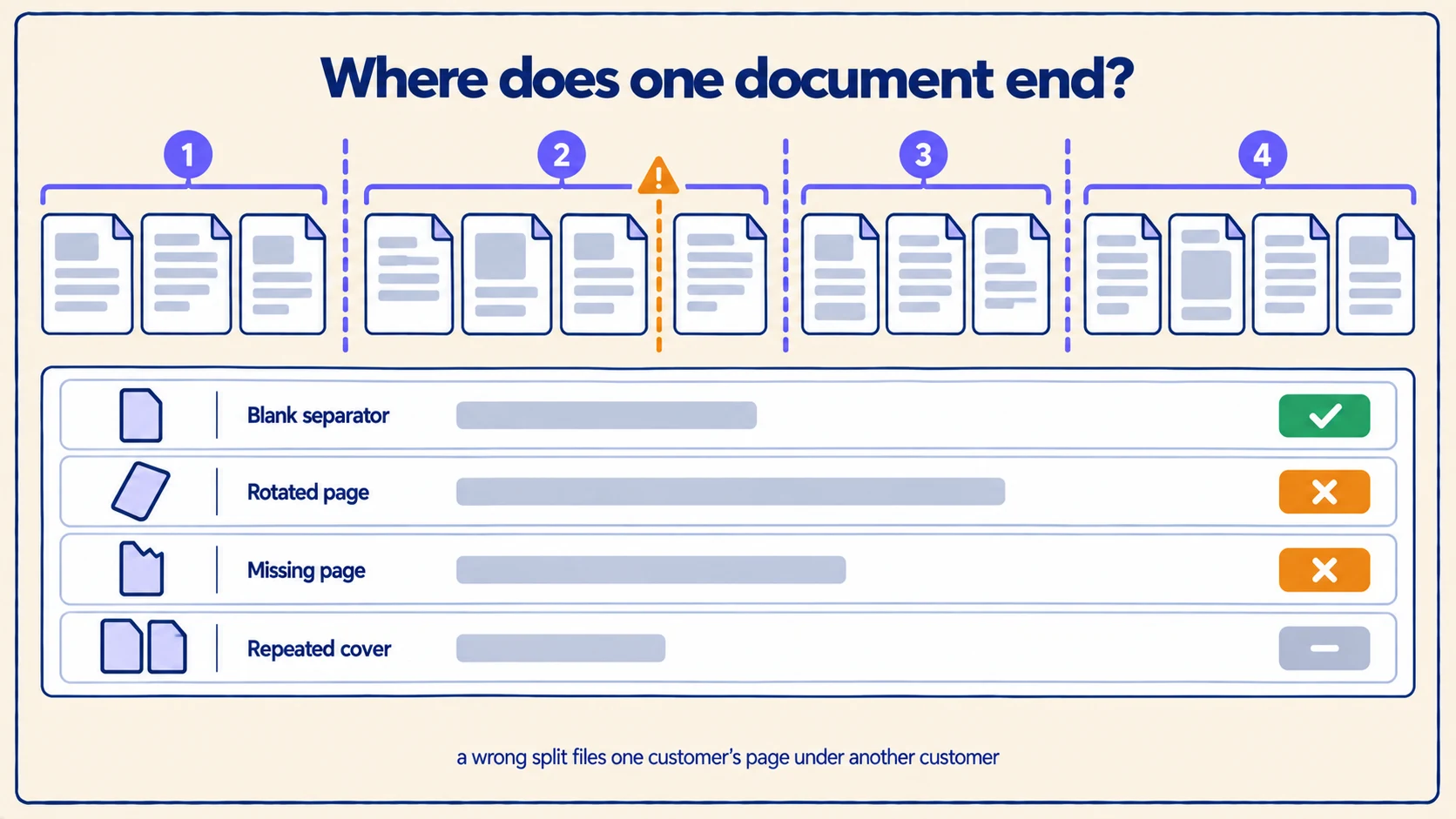
Construct an expected page boundary map
To evaluate boundary detection models rigorously, construct a synthetic multi-document packet that models real-world enterprise intake complexity. The table below illustrates a representative synthetic commercial registration bundle. The values below are deliberately synthetic and illustrative; they do not represent proprietary customer data or benchmark claims.
| Page Range | Intended Document Instance | Boundary Detection Signals & Evidence | Downstream Risk If Split Fails |
|---|---|---|---|
| Page 1 | Cover Correspondence | Formal letterhead, transmittal memo, explicit list of attached documents. | If merged with Page 2, transmittal dates overwrite legal filing dates. |
| Pages 2–4 | Facility Registration A | Unique registration ID REG-901; explicit "Page X of Y" pagination numbering. | If split internally, registration clauses become separated from signature blocks. |
| Page 5 | Blank Separator Sheet | High whitespace ratio; scanner separator barcode or blank feed page. | If parsed as a document, generates phantom empty entity records. |
| Pages 6–7 | Equipment Schedule A | Inherits ID REG-901; continuous tabular line items without trailing totals. | If split across pages, inventory items become orphaned without parent assets. |
| Pages 8–10 | Facility Registration B | New registration ID REG-902; identical form template to Registration A. | If merged with Registration A, applicant entities and bank accounts are commingled. |
| Page 11 | Insurance Certificate B | Certificate of insurance naming applicant B; distinct legal layout. | If attached to Registration A, compliance verification fails audit. |
Creating this explicit boundary map prior to testing allows engineering teams to calculate instance-level precision and recall. Notice that retaining the initial cover letter on Page 1 provides critical context: it explains why a particular appendix was omitted or highlights urgent processing requirements, even if it is not an extraction target itself.
Pro Tip: Look for continuity invariants across page boundaries: matching document reference numbers in running headers, continuous "Page X of Y" pagination strings, matching corporate entity names, and continuous sentence flows across page breaks. When these invariants break, treat it as a strong boundary transition signal.
Test real-world packet anomalies that clean samples conceal
Evaluation suites populated solely by pristine, perfectly sequenced scans fail to reveal how automated splitting breaks down in production. Introduce realistic operational anomalies into your challenge sets:
- Missing Boundary Markers: Packets scanned without barcode separator sheets or blank dividing pages.
- Inverted & Rotated Pages: Documents scanned upside down or sideways, confusing visual layout detectors.
- Duplicate Page Scans: High-speed scanner jams resulting in duplicated pages within a single file stream.
- Interleaved Submissions: Two separate document sets accidentally interleaved during manual feeder loading.
- Non-Standard Multi-Page Continuations: Complex tables spanning across pages with repeated or missing headers.
Amazon Web Services details algorithmic techniques for analyzing layout geometry and column signatures in its multi-page table handling reference. Review our in-depth guide on table extraction structure errors to ensure tabular continuations across page breaks do not trigger false document boundary splits.
When testing ambiguous packets, require the system to quantify its boundary confidence. If an algorithm cannot determine whether an attachment belongs to Document A or Document B, routing the packet to a human triage station is an operational victory; guessing blindly and risking a privacy violation is a catastrophic architectural failure.
Score splitting at the instance level, not the page level
Page-level accuracy is the metric most splitting systems report, and it is close to meaningless. A fourteen-page packet with one misplaced boundary scores thirteen out of fourteen pages correct — about ninety-three per cent, which sounds like a system ready for production. In instance terms, that same error has destroyed two of the four documents in the packet: the one that lost a page and the one that gained it. Fifty per cent of the business objects are wrong.
Measure what the downstream process consumes:
- Exact instance match. The share of documents whose page range is exactly right, start and end. This is the number that predicts how much of the packet can be processed without review, and it is always lower than page accuracy.
- Boundary precision and recall. Precision is the share of predicted boundaries that are real; recall is the share of real boundaries the system found. They fail differently and must be reported separately, for the reason the next section sets out.
- Contamination rate. The share of instances containing at least one page belonging to a different entity. In a regulated intake this is the only number a compliance reviewer will ask for, because every contaminated instance is a potential disclosure.
- Packet-level clean rate. The share of uploads where every instance is exactly right. Packets are the unit operators actually handle, and a packet with one bad boundary is a packet someone has to open.
A splitting system should report all four. A vendor that reports only page accuracy has chosen the metric that flatters the product most.
Treat over-splitting and under-splitting as different failures
The two error directions look symmetrical on a confusion matrix and are nothing alike in operation, which is why a single confidence threshold tuned to maximise overall accuracy usually tunes the system in the wrong direction.
| Over-splitting | Under-splitting | |
|---|---|---|
| What happens | One document is broken into several fragments | Two or more documents are merged into one |
| Downstream effect | Fragments fail extraction for missing required fields | Extraction succeeds and produces a plausible, wrong record |
| How it surfaces | Immediately, as a validation failure | Late, often after the record has been acted on |
| Recovery | Merge the fragments in the review interface | Requires noticing at all, which is the hard part |
| Compliance exposure | Low — no data crosses an entity boundary | High — two parties' data are commingled |
Under-splitting is the one to weight against. A fragment that fails extraction announces itself; a merged pair of registrations produces a complete record where one applicant's bank details sit under another applicant's name, and nothing in the output signals a problem. The business rule validation layer will catch some of these — a mismatched reference number between header and signature block, for instance — but it catches them by accident rather than by design.
The practical consequence is that a boundary threshold should be biased toward splitting where the two entities differ, and the ambiguous cases should route to triage rather than resolve to whichever side the model marginally prefers.
Match the splitting strategy to how documents actually arrive
Boundary detection is often discussed as a modelling problem when it is frequently an intake problem. Where the upstream process can be changed, changing it is cheaper and far more reliable than any classifier.
| Strategy | Works when | Fails when |
|---|---|---|
| Physical separator sheets | You control the scanning operation | Documents arrive by email, portal or post |
| Submission metadata | The portal collects each document as its own upload | Users combine everything into one PDF before uploading |
| Structural signals | Forms carry reference numbers, pagination or letterhead | Free-form correspondence and handwritten attachments |
| Learned boundary model | Layouts are varied but statistically consistent | Genuinely novel document types, where it fails silently |
Most enterprise intakes need two or three of these together, with the cheap deterministic signals taking precedence and the model handling only what the deterministic signals leave undecided. A system that runs the model first and consults reference numbers afterwards has inverted the reliability ordering: it is asking the least certain component to make the decision and the most certain one to ratify it.
Pro Tip: Before investing in boundary detection, count what share of your volume arrives through a channel you control. If most packets come through your own portal, adding a per-document upload control removes the splitting problem for that share entirely — and moves the remaining effort onto the channels where it is genuinely unavoidable.
Monitor boundary quality in production, not only at evaluation
An evaluation packet set measures the splitter against documents you assembled. Production sends documents nobody assembled, and the distribution moves as partners change their scanning habits and forms are redesigned.
Three signals track boundary quality without needing labelled ground truth, and all three come from data the pipeline already produces:
- Distribution of instances per packet. A sudden rise in single-page instances means the splitter has started fragmenting; a fall means it has started merging. Either direction is worth an alert.
- Rate of reviewer boundary adjustments. Every merge or split a reviewer performs is a labelled correction the system generated itself, and clustering those by document type points straight at the failing family.
- Share of instances failing a required-field check. A rise concentrated in one document type is usually a splitting regression wearing an extraction costume, and diagnosing it as an extraction problem wastes the first week of the investigation.
Mitigate data privacy and compliance risks in splitting failures
In regulated environments subject to HIPAA, GDPR, or CCPA, document splitting errors represent severe compliance liabilities. Joining two different individuals' financial or medical records within a single extracted record constitutes an unauthorized data disclosure.
To mitigate compliance exposure:
- Instance Isolation: Store each split document as an independent immutable file object in secure object storage with strict tenant boundaries.
- Provenance Preservation: Maintain bidirectional pointers linking every extracted document instance back to the original composite upload and raw page ranges.
- Reversible Grouping: Ensure document boundaries can be adjusted by human reviewers without requiring manual re-upload of source files.
- Audit Logging: Record every automated and manual splitting decision, including model version, boundary confidence scores, and reviewer adjustments.
Practical evaluation criteria for enterprise demonstrations
When evaluating intelligent document processing vendors, do not settle for scripted demonstrations using isolated single-page forms. Require vendors to demonstrate multi-document splitting on challenging materials:
- Request a Live Boundary Test: Provide an unseparated 20-page PDF containing two instances of the identical form type separated by an appendix, and inspect the resulting boundary map.
- Evaluate the Splitting UI: Inspect the human-in-the-loop page-reordering interface. Can reviewers easily split, merge, delete, and re-order pages with drag-and-drop simplicity?
- Verify Cascade Reprocessing: When a reviewer modifies a page boundary, does the system automatically re-trigger extraction on the newly defined instances without manual intervention?
For a comprehensive overview of modern intake architectures, consult our foundational AI document-processing guide. Learn how our enterprise File store manages structured document hierarchies and how autonomous Agents coordinate multi-stage document ingestion. Then, schedule an enterprise architecture demo to evaluate automated document splitting against your organization's most complex multi-page files.