Why table extraction fails even when the text is correct
Evaluate headers, merged cells, units and page continuations so extracted table values retain their original relationships.

Sarath Chandran
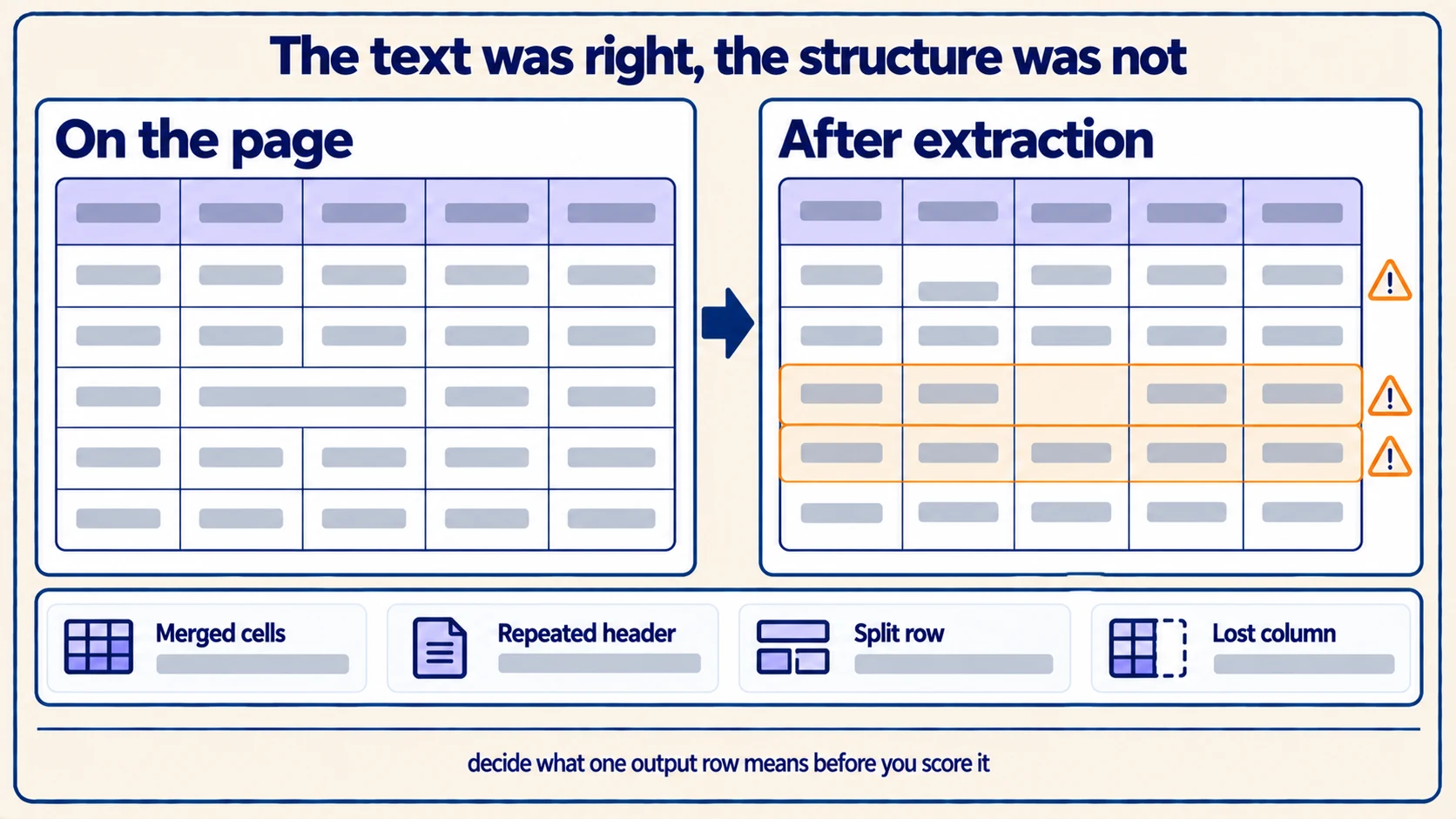
A table can contain correctly recognized words and still produce incorrect records. The failure often lies in the relationships: which heading applies to a value, whether a cell spans several rows, where a subtotal belongs, or whether a table continues onto the next page. Table extraction accuracy therefore needs to be assessed at the level of structure as well as text.
In enterprise enterprise data extraction pipelines, tabular data accounts for the highest operational value and the highest structural error rate. Financial ledgers, bills of materials, tariff schedules, medical lab panels, and logistics manifests store core business data inside grid hierarchies. When automated extraction fails on tables, the failure is rarely a failure of character recognition. Optical character recognition engines can read every single digit and letter flawlessly while the structural parser completely scramble the row-column coordinates, merges unrelated line items, or attributes a line-item subtotal as a billable product item. A spreadsheet export that appears cleanly formatted on the surface can conceal severe relational corruptions that cascade into enterprise resource planning (ERP) databases.
Key Architecture Rule: Never score table extraction accuracy solely on word-level or cell-level string matching. Table evaluation must enforce relational correctness—verifying that every extracted cell is bound to its canonical column header, parent group hierarchy, row record identifier, and arithmetic context.
Decide what one output row means in your schema
Before evaluating table extraction models, engineering teams must define what a single output record represents in the target operational system. A physical row printed on paper does not automatically correspond to a single logical database record.
Consider an industrial engineering specification sheet: one printed row may serve as a visual category header ("Centrifugal Pumps"), the subsequent four rows may list individual model variants with differing motor ratings, a sixth row may contain a multi-line engineering note wrapped across three lines, and a seventh row may display a section subtotal. Naively parsing every printed line as an independent data entity creates phantom records, corrupts inventory counts, and pollutes analytics data warehouses.
The target schema specification must clarify:
- Entity Rows: Source lines that instantiate a distinct business transaction or asset.
- Hierarchical Attributes: Parent category headings that must be inherited downwards across all grouped child rows.
- Wrapped Cell Text: Multi-line text fragments that belong to a single parent cell rather than constituting new records.
- Summary Checks: Subtotal, tax, and grand-total rows that must be validated as relational invariants rather than extracted as transactional items.
Amazon Web Services outlines these distinct structural components—including cell coordinates, column headers, row headers, merged spanning cells, table titles, and footer blocks—in its Amazon Textract table reference. Understanding these foundational primitives is critical when architecting automated validation rules, regardless of whether your pipeline deploys cloud vision APIs or self-hosted layout-aware transformer models.
A synthetic equipment schedule and failure modes
To illustrate the critical gap between character recognition and structural comprehension, examine the following simplified synthetic equipment schedule. The values below are deliberately illustrative and synthetic:
| Equipment group | Item model | Description & specifications | Quantity | Unit | Status |
|---|---|---|---|---|---|
| Pumps | P-101 | High-pressure centrifugal booster | 2 | units | In-Service |
| (Merged group) | P-102 | Submersible slurry pump with hardened impeller | 3 | units | In-Service |
| Sensors | S-204 | Digital pressure transducer (0-500 PSI) | 12 | units | Calibrated |
| Subtotal | (N/A) | Section verified subtotal | 17 | units | (Verified) |
A robust structural parser must output three discrete equipment asset records. The subtotal row must be routed to an arithmetic reconciliation check, not appended as a fourth piece of equipment. Crucially, Item P-102 must inherit the parent group attribute "Pumps" from the vertically merged cell above it, rather than emitting a blank or null category value.
Now examine what occurs when a structural parser fails. If the engine lacks merged-cell comprehension, it emits:
P-101associated with"Pumps".P-102associated with a blank category (or accidentally inheriting"Sensors").S-204associated with"Sensors".- A phantom fourth asset record for
"Subtotal"with an item quantity of 17.
In this catastrophic failure, every single number and word was recognized with 100% OCR confidence. Yet, the resulting inventory table reports double the actual equipment count and misclassifies critical industrial hardware.
Pro Tip: To prevent phantom row extraction on multi-line text descriptions, configure token bounding-box proximity thresholds. If a line lacks numeric quantity and pricing tokens while sharing horizontal alignment with the preceding row's description block, treat it as a wrapped description continuation rather than a new record boundary.
Taxonomy of table structural failures
Diagnosing table extraction errors requires isolating the specific structural mechanism that collapsed during processing:
- Header Association Inversion: A column value is erroneously bound to an adjacent column header due to skewed vertical separators or missing vertical rule lines.
- Row Grouping and Splitting: Multi-line wrapped text inside a single cell is parsed as multiple distinct rows, or adjacent tightly spaced rows are collapsed into a single corrupted record.
- Merged-Cell Attribution Collapse: Spanning headers (such as a single category cell spanning four data rows) are only assigned to the first row, leaving subsequent rows with empty foreign keys.
- Unit and Qualifier Detachment: Numerical values are extracted while their trailing unit designations (
kg,liters,MW,USD) or footnote superscripts are discarded or parsed into separate columns. - Summary and Subtotal Contamination: Summary lines, carriage totals, or page-end balance rows are ingested as transactional rows, distorting financial calculations.
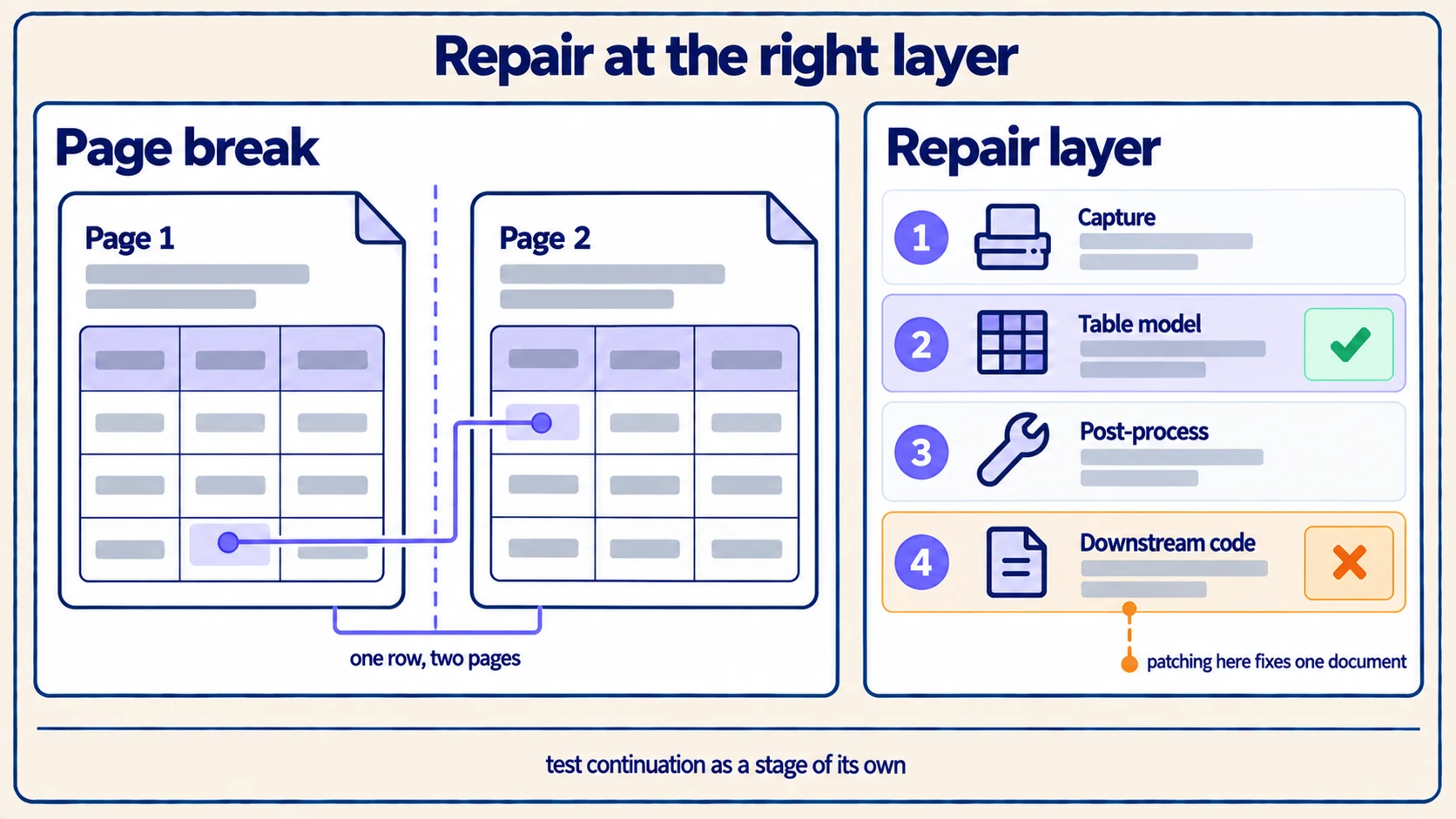
- Page-Break Continuity Rupture: Multi-page tables fail to stitch together, causing the continuation page to treat repeated column headers as literal data rows.
Categorizing extraction bugs according to this taxonomy prevents engineering teams from wasting time adjusting prompt wording when the true failure requires adjusting layout bounding-box clustering or post-processing reconciliation logic.
Test multi-page continuation as an isolated pipeline stage
In commercial contracts, financial disclosures, and supply chain invoices, tables routinely span multiple consecutive pages. Multi-page table handling requires specialized structural heuristics:
- Header Symmetry Verification: Does the second page repeat the identical column header sequence, or does it immediately plunge into data rows without headers?
- Column Coordinate Alignment: Do the horizontal bounding-box coordinates of columns on page two correlate within an acceptable tolerance with the columns on page one?
- Running Header and Footer Filtering: Are page numbers, running headers, and legal disclaimers cleanly excised from the middle of the tabular data stream?
- Interrupted Cell Stitching: If a long description cell is cut in half by a page boundary, does the stitching algorithm reassemble the split sentence?
Amazon's multi-page table handling documentation details algorithmic approaches for calculating column geometry overlap, verifying running tallies, and establishing table continuation links.
Note that multi-page table continuation is structurally distinct from splitting mixed document packets. A multi-page document may be correctly classified as a single 10-page master purchase agreement, while its internal 4-page pricing table is fragmented into four disconnected, unusable snippets.
Build a comprehensive table evaluation harness
A robust evaluation suite for enterprise tables must look beyond simple cell string comparison. Construct a ground-truth harness that scores four independent dimensions:
- Cell Count Precision and Recall: Total count of true data cells recognized versus false-positive noise cells.
- Adjacency Matrix Accuracy: Whether the spatial relationships (which cell is above, below, left, and right of each target cell) match the ground truth.
- Header-to-Value Binding: Percentage of data cells correctly linked to their complete hierarchical column and row headers.
- Record Integrity Score: Percentage of completely intact rows where all fields, units, and categories are 100% correct.
Complement spatial scoring with automated business-rule validation checks. If an invoice table lists five line items with individual subtotals, an automated arithmetic validator should sum the line totals and compare them against the extracted grand total. A failure to balance arithmetic is an immediate operational signal that row extraction was compromised.
Choose the repair at the correct architectural layer
When table extraction fails, applying a fix at the wrong layer creates fragile, unmaintainable hacks:
- Image & Scan Layer: If faint table borders disappeared due to thresholding binarization, adjust scan acquisition DPI or contrast curves rather than redesigning parsers.
- Layout Model Layer: If borderless tables are misread as narrative text, transition to a layout-aware vision transformer trained on coordinate bounding boxes.
- Heuristic Post-Processing Layer: If merged parent headers leave trailing cells empty, implement deterministic "fill-down" rules conditioned on row indentation and category boundaries.
- Human-in-the-Loop Review: When table structures remain inherently ambiguous (such as handwritten alterations over printed grids), route the table to an intuitive visual editor that allows human reviewers to adjust cell borders with a single click.
To design resilient, end-to-end document architectures, consult our foundational AI document-processing guide. Learn how our high-performance File store and autonomous Agents manage structured enterprise data extraction, and schedule an enterprise architecture demo to evaluate complex table extraction workflows on your organization's real-world document samples.