Normalizing extracted dates, currencies, and identifiers
Keep original values and resolve ambiguity before converting document dates, monetary amounts and identifiers into typed data.

Sarath Chandran
Document data normalization converts a source value into a representation that another system can use consistently. The difficult part is deciding when that conversion is supported by the evidence. A string can be recognized perfectly and still be ambiguous: “03/04/2026” has more than one plausible date interpretation, while “00127” may be an identifier rather than the number 127.
In production automated intake pipelines, raw text extracted from documents must interface with rigid downstream transactional databases, ERP systems, and data warehouses. Downstream APIs expect strict data formats: ISO-8601 UTC timestamps, IEEE-754 floating-point decimals, and validated ISO-4217 currency codes. However, physical business paperwork is generated in thousands of competing formats across global jurisdictions. When extraction pipelines apply naive string casting or undocumented regex transformations, catastrophic silent errors occur. Dates are shifted by months, monetary values are multiplied by orders of magnitude due to swapped decimal and thousand separators, and leading zeros in critical SKU identifiers are stripped away, corrupting inventory master data.
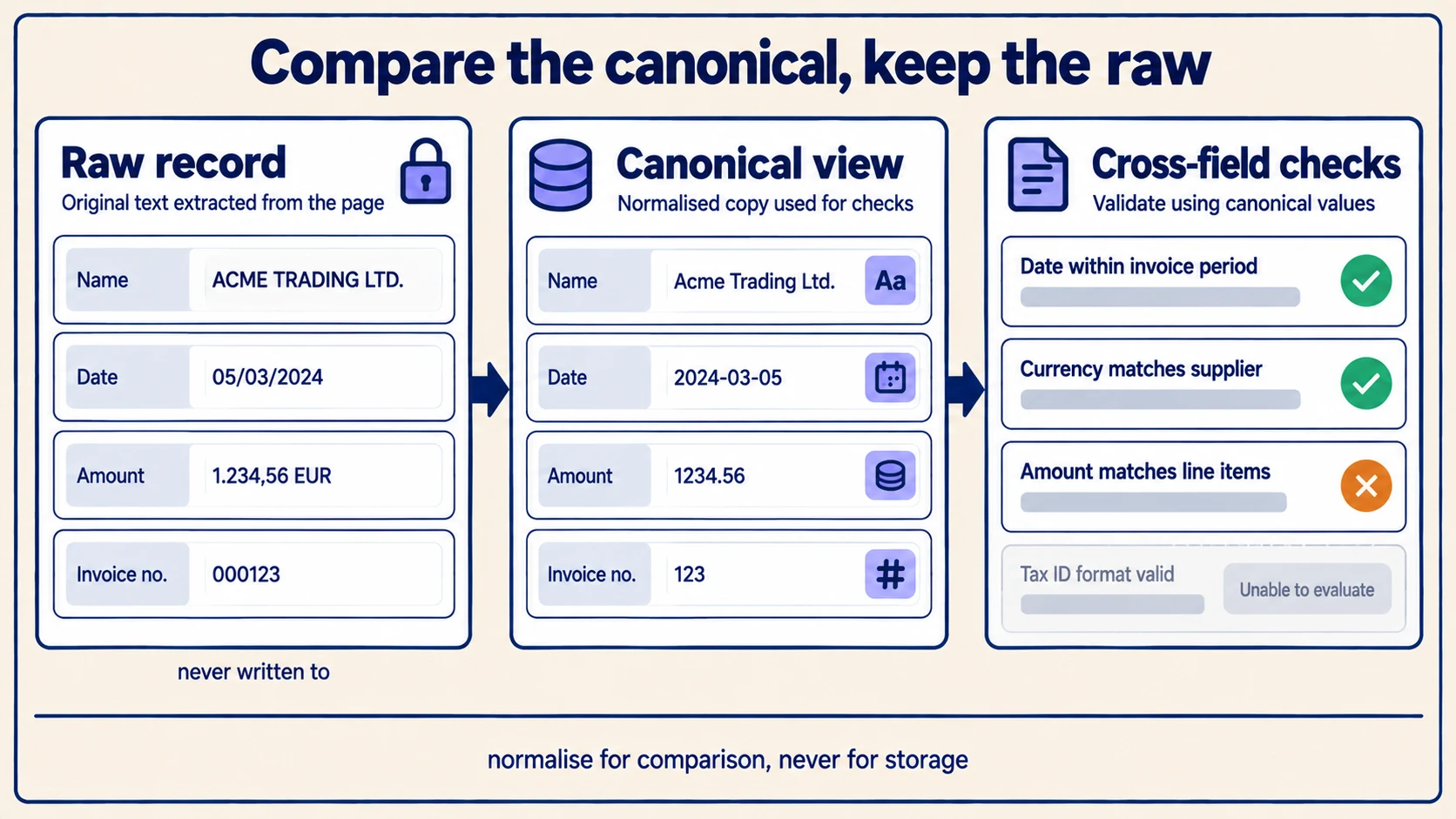
Key Architecture Rule: Always decouple the raw extracted string from the normalized schema representation. Maintain an immutable audit trail showing the original text on the page, the extraction bounding box, the intermediate parsed value, and the canonical normalized output.
Maintain three distinct data representations across the pipeline
To guarantee data integrity and auditability, enterprise architectures must treat normalization as an explicit, observable transformation stage rather than an invisible cleanup script. Maintain three distinct representations for every structured field:
- Source Surface Text (Raw String): The literal characters exactly as printed on the physical document page (e.g.,
"$ (1.250,50)","04/05/2026","0008492-A"). - Extracted Entity Object: The intermediate parsing token emitted by the layout model, preserving spatial bounding-box coordinates, page indices, and model confidence scores.
- Normalized Canonical Value: The typed, standardized data structure formatted according to enterprise data contracts (e.g.,
{ "amount": -1250.50, "currency": "USD" },"2026-05-04","0008492-A").
Google Cloud's normalized-value reference in Document AI formalizes this separation, explicitly defining normalized data structures alongside raw token offsets and cautioning that normalized fields must remain null when source ambiguity cannot be resolved deterministically. An absence of a normalized value is a correct and defensible operational state when evidence is insufficient; generating an invented or unverified guess is an architectural failure.
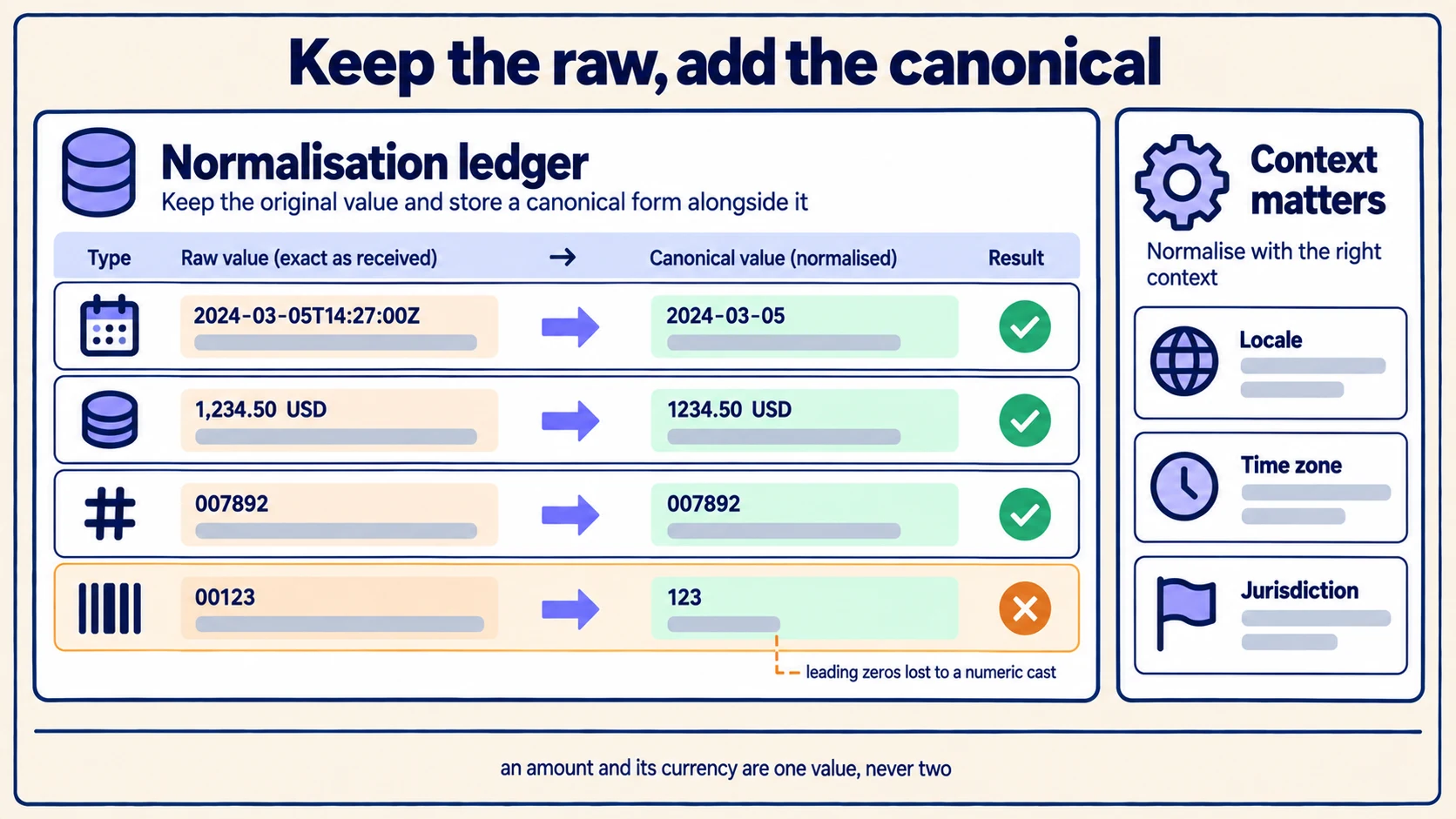
An illustrative normalization ledger and policy matrix
Before deploying normalization rules into production, engineering teams must collaborate with finance, legal, and operational stakeholders to codify deterministic resolution policies. The table below illustrates how diverse source inputs should be handled. The examples below are deliberately synthetic and illustrative; they do not represent customer data or specific benchmark metrics.
| Source surface text | Operational context | Deterministic resolution policy | Downstream risk if normalized naively |
|---|---|---|---|
14 September 2026 | Explicit English month name | Convert to canonical 2026-09-14. | (Low risk: unambiguous month representation). |
03/04/2026 | Undated international bill of lading | Preserve surface text; trigger locale rule or route to reviewer. | Naive US parsing yields March 4; European parsing yields April 3. |
1.234,50 EUR | German purchase order | Parse under Continental convention: 1234.50 EUR. | Inverting delimiters parses the value as 1.23 or throws an exception. |
(500.00) USD | Balance sheet accounting row | Parse accounting parentheses as negative: -500.00 USD. | Stripping parentheses converts a liability into an asset. |
00127 | Industrial valve serial number | Preserve leading zeroes as string: "00127". | Casting to integer produces 127, breaking foreign key lookups. |
12 kg | Air freight cargo manifest | Split into numeric quantity 12.0 and unit code "KGM". | Storing as string "12 kg" prevents freight weight sum validation. |
— (Em-dash) | Discount percentage cell | Store as explicit null with attribute not_applied. | Coercing dash to 0.00 can trigger false zero-discount compliance alerts. |
A schema-valid output does not guarantee business accuracy. A date converted to the wrong month will still pass JSON schema validation and insert cleanly into an SQL database, remaining invisible until an audit or payment default occurs.
Resolve calendar dates using declared jurisdictional context
Dates represent one of the most frequent sources of data corruption in cross-border commerce. To resolve dates accurately:
- Demand Explicit Evidence: Prioritize unambiguous textual markers (e.g., written month names like "October" or localized abbreviations like "Okt").
- Bind Format to Document Authority: Do not infer date conventions from the IP address, browser locale, or geographic coordinates of the person uploading the document. Bind the interpretation rule to the issuing authority or contractual jurisdiction named inside the document text.
- Isolate Functional Date Roles: Keep signature dates, invoice issue dates, payment due dates, and service delivery windows strictly separated. Never allow an extractor to substitute an issue date into a due date field simply because the format matches.
- Preserve Partial Dates: When a contract specifies only a quarter or month and year (e.g., "Q3 2026" or "November 2026"), never artificially synthesize a day (such as appending
-01or-30). Store the partial precision or flag the record for human verification.
Treat currencies and numerical amounts as atomic pairs
A monetary figure cannot be interpreted without its associated currency symbol or ISO code. A raw number 100,000 has vastly different commercial value depending on whether it represents Japanese Yen (JPY), US Dollars (USD), or Kuwaiti Dinar (KWD).
Key rules for financial normalization:
- Explicit Currency Binding: Always bind the extracted numerical amount to its currency code. If a document uses the dollar sign (
$), verify whether surrounding text designates United States Dollars (USD), Canadian Dollars (CAD), or Australian Dollars (AUD). - Delimiter Discipline: Continental European standards use periods for thousands separators and commas for decimals (
1.500,00), whereas Anglo-American standards use the exact reverse (1,500.00). Maintain document-family delimiter profiles to guide parsers. - Decouple Normalization from Conversion: Never perform foreign exchange (FX) conversions during document extraction. FX conversion requires spot rates, transaction timestamps, and treasury policies that must operate in downstream accounting engines, not inside an OCR pre-processing script.
Review our technical guide on multilingual OCR evaluation to understand how optical character engines distinguish visually similar currency glyphs and punctuation marks across international scripts.
Protect entity identifiers from destructive numerical casting
Alphanumeric identifiers—such as purchase order numbers, international bank account numbers (IBAN), vehicle identification numbers (VIN), and patient health IDs—must always be treated as immutable strings, never as numerical values.
- Preserve Leading Zeros: A taxpayer identification number starting with
"00"must retain those zeros; stripping them invalidates legal reporting. - Normalize Internal Separators Deterministically: Standardize formatting spaces in credit card numbers or IBAN codes only when downstream API specifications explicitly require removing whitespace. Never strip hyphens or slashes that separate logical sub-components of an identifier.
- Homoglyph Disambiguation: OCR models frequently confuse the digit
0with the capital letterO, and the digit1with the lowercaselor uppercaseI. Use check-digit algorithms (such as the Luhn algorithm for payment cards or Modulo 97 for IBANs) to validate string integrity.
Enforce multi-layer validation without rewriting evidence
Following normalization, execute structured business validation checks before passing records to production systems. Google Cloud's document validation documentation details approaches for executing cross-field checks and maintaining correction history.
Never force an ambiguous field to satisfy a validation rule by choosing the most convenient interpretation. If a date string can represent either March 4 or April 3, the fact that March 4 falls within the current billing cycle is a useful contextual clue, but it is not permission to overwrite the source record without human verification.
Every transformation, normalization rule, and reviewer edit must remain linked to the source page through cryptographic hash and bounding-box coordinates, as detailed in our guide to document extraction source provenance.
For a complete architectural blueprint of end-to-end document intake, read our foundational AI document-processing guide. Learn how our high-security File store protects enterprise records and how autonomous Agents manage complex data pipelines. Then, schedule an enterprise architecture demo to evaluate automated normalization rules on your organization's real-world document feeds.