Keeping extracted fields traceable to their source documents
Preserve source identity, page references, original text and transformations when turning documents into structured records.

Sarath Chandran
An extracted field is easier to trust when a reviewer can find the exact source that supports it. “From the uploaded PDF” is often insufficient: the file may contain several documents, later versions may exist, and the displayed value may have been normalized or corrected after extraction.
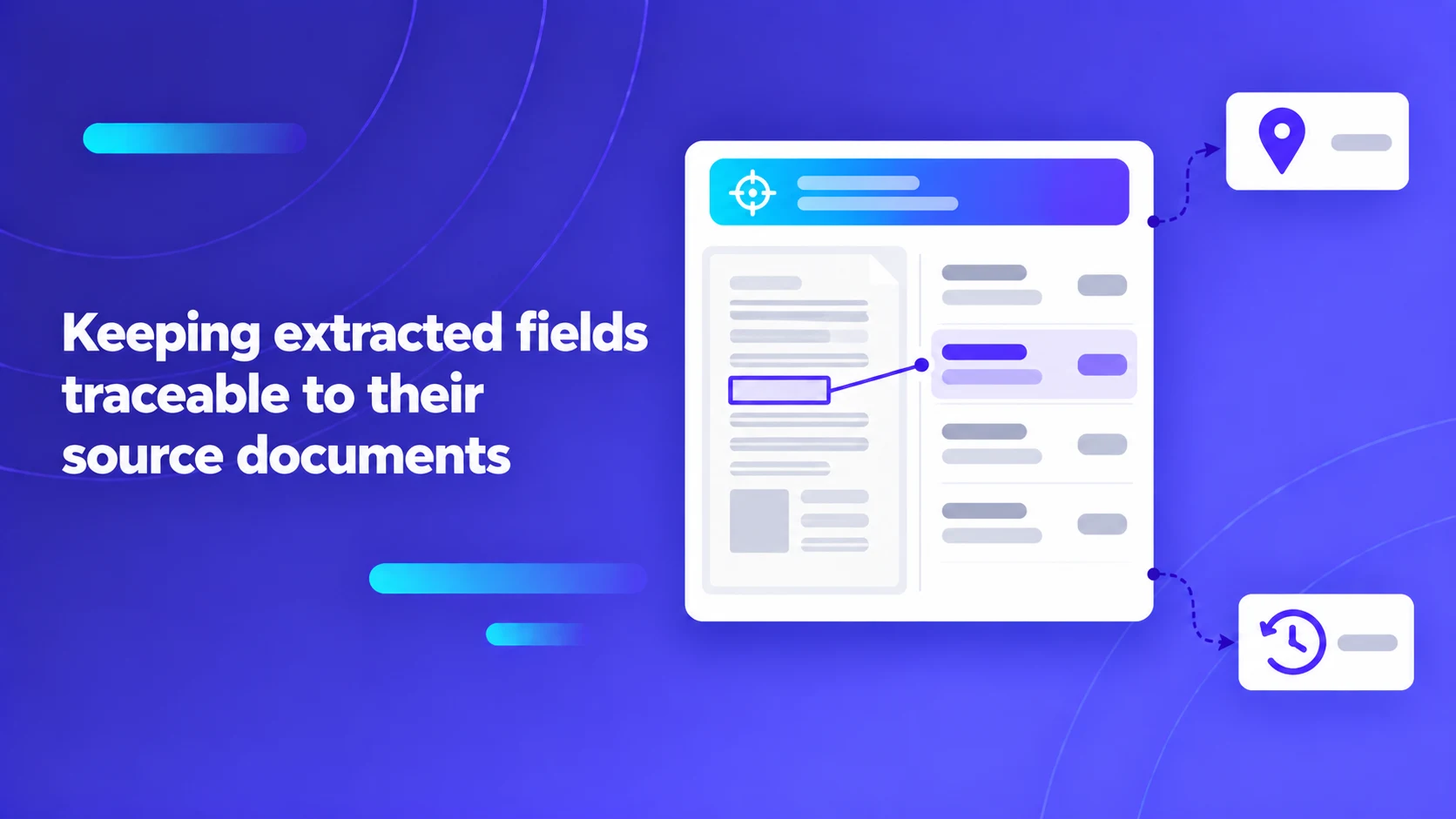
Document data provenance is the immutable chain of custody connecting an operational business value back to its raw physical artifact, its exact spatial coordinates on the printed page, and every automated or human transformation that touched it. In enterprise production environments—such as clinical drug trials, financial accounting, defense contracting, and statutory legal reporting—an ungrounded data value is fundamentally useless. If an internal auditor, an FDA inspector, or an SEC examiner disputes an extracted value in an annual filing, saying "our AI pipeline extracted it from an invoice somewhere in our cloud storage" is an immediate compliance violation. Organizations must be capable of establishing deterministic, bi-directional traceability from any database field back to the exact pixel coordinates on the source document page within seconds.
Key Architecture Rule: Every extracted record in your enterprise data warehouse must maintain immutable provenance pointers: the source file's SHA-256 hash, zero-indexed page number, normalized polygon bounding box coordinates, model inference metadata, and transformation lineage. Never store normalized data in isolation from its evidentiary substrate.
Separate the source, extraction, and accepted business record
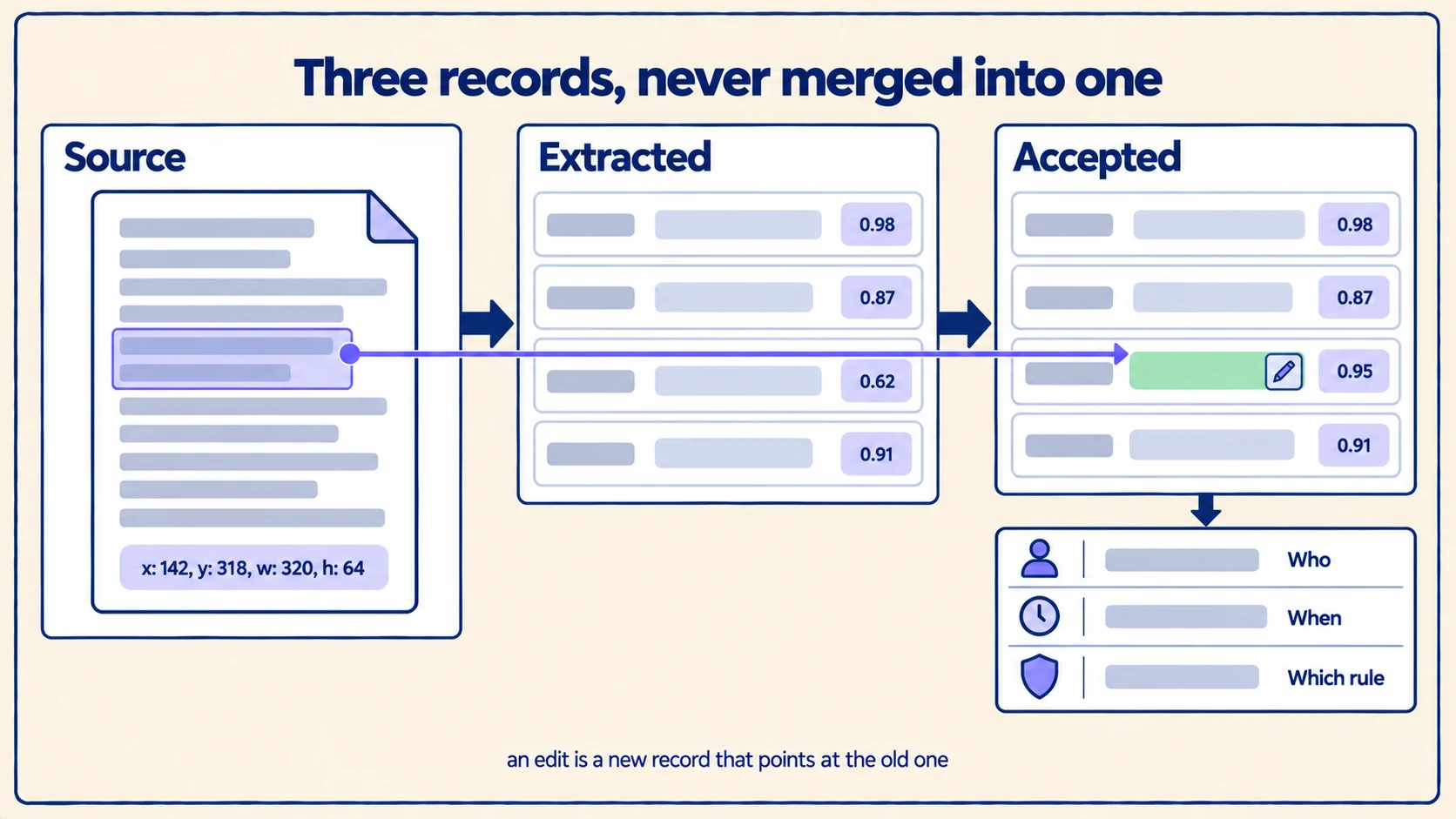
A fundamental architectural error in document processing systems is designing a database schema that overwrites the raw extracted text with normalized or reviewer-edited values. These are three fundamentally distinct operational objects:
- Source Document Substrate: The raw immutable binary file (PDF, TIFF, or JPEG) stored in write-once-read-many (WORM) compliant object storage.
- Model Extraction Snapshot: The raw, unadulterated prediction emitted by the layout or OCR model, capturing raw tokens, model confidence, and bounding polygons.
- Accepted Operational Record: The canonical business record resulting from data normalization, automated business validation, and human reviewer adjudication.
Overwriting raw extraction data with reviewer edits destroys the feedback loop needed to detect model drift. If a human reviewer corrects a misread date from "03/04/2026" to "2026-04-03", overwriting the raw extraction field gives the false impression that the automated model performed flawlessly, blinding engineering teams to recurring date-parsing errors.
Google Cloud's Document AI entity reference formalizes this separation, explicitly maintaining unnormalized surface text segments, character offset anchors, spatial bounding boxes, and normalized data objects within independent, non-conflicting schema structures.
An illustrative technical provenance ledger
To understand how provenance metadata must be structured in production, examine the synthetic equipment maintenance ledger below. It documents how a single inspection date moves through the extraction lifecycle. The data below is deliberately synthetic and illustrative; it does not represent customer data or benchmark claims.
| Ledger attribute | Operational value | Architectural purpose |
|---|---|---|
| Document Immutable ID | doc_sha256_e3b0c44298fc1c149afbf4c8996fb92427ae41e4649b934ca495991b7852b855 | Content-addressable storage hash guaranteeing file immutability. |
| Spatial Coordinate Anchor | Page: 3, BoundingBox: [ymin: 0.452, xmin: 0.128, ymax: 0.468, xmax: 0.285] | Normalized polygon enabling single-click visual viewport zoom for reviewers. |
| Raw Surface Text | "14 Septembre 2026" | Verbatim text string recognized by OCR, preserving localized French spelling. |
| Model Extraction Record | { "token": "14 Septembre 2026", "confidence": 0.948, "model": "layout-v4.2" } | Raw inference event capturing confidence and model versioning. |
| Normalized Entity | { "canonical_date": "2026-09-14T00:00:00Z", "schema_type": "ISO_DATE" } | Formatted output adhering to target ERP database contracts. |
| Transformation Lineage | TRANSFORM_FR_LOCALE_DATE_V1 (Applied regex: DD MMMM YYYY -> ISO) | Deterministic code version and rule ID responsible for the data conversion. |
| Reviewer Intervention | { "action": "VERIFIED_CORRECT", "reviewer_id": "usr_9481", "timestamp": "2026-09-18T10:14:00Z" } | Cryptographically signed human audit trail satisfying regulatory review standards. |
The normalized date (2026-09-14) is what populates the operational inventory table. However, when an engineer queries that inventory table, the underlying database record retains a foreign key pointer to the provenance ledger. If a disagreement arises regarding warranty coverage, the user interface can immediately display the original scanned PDF page with a luminous highlight box surrounding "14 Septembre 2026".
Pro Tip: Store bounding-box polygon vertices as normalized floats (0.0to1.0) relative to page width and height, rather than absolute pixel coordinates. When documents are re-rendered at different display resolutions on mobile devices or high-DPI desktop monitors, normalized coordinates scale effortlessly without requiring re-computation.
Preserve spatial coordinates through document transformations
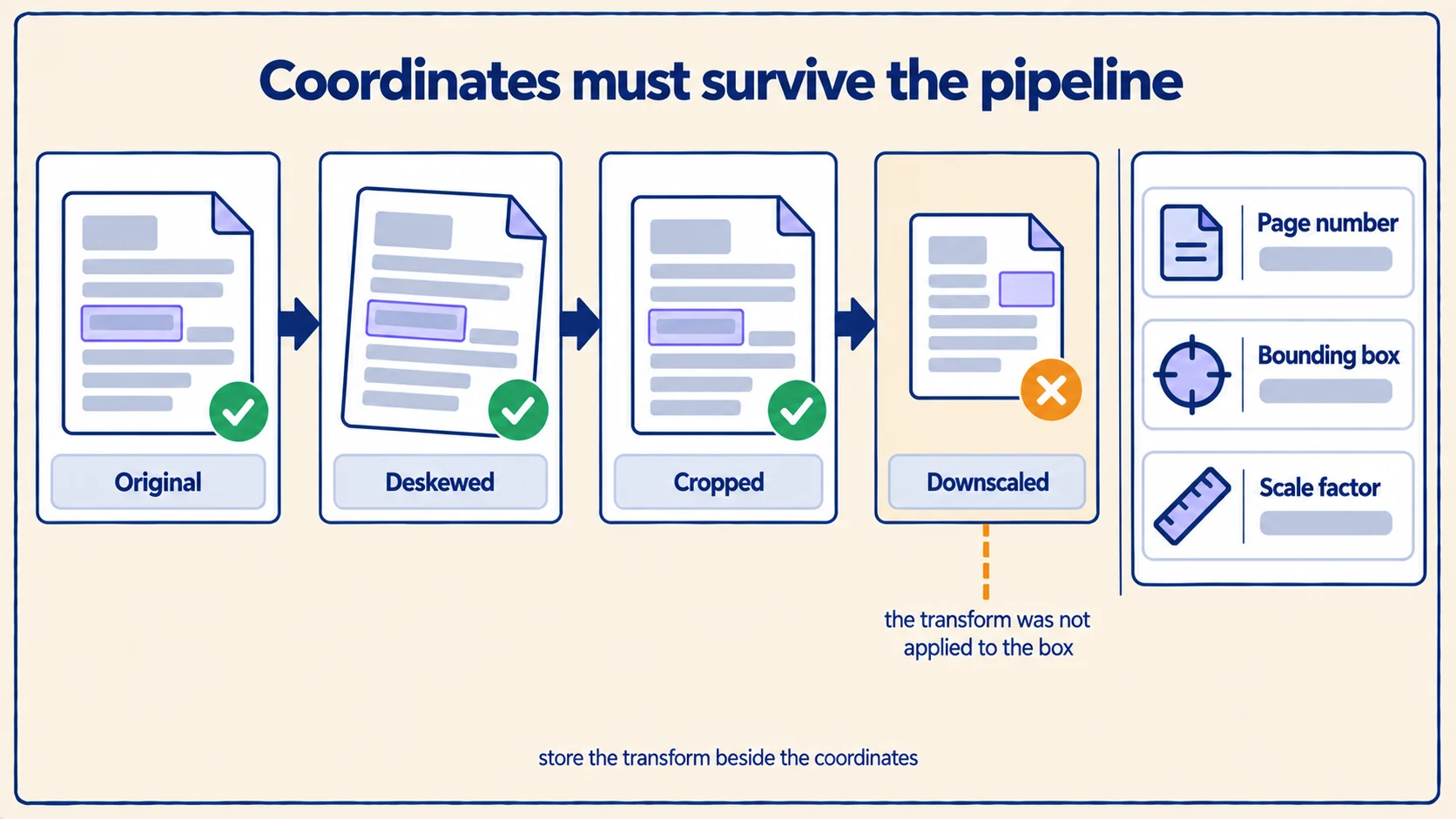
Document intake pipelines rarely process raw, pristine scans without intermediate physical alterations. Upstream workers routinely split multi-page bundles, de-skew misaligned scans, rotate upside-down pages, and crop margins.
When physical image transformations occur, coordinate tracking often breaks down:
- Page Splitting: If a 20-page bundle is split into three separate documents, coordinate systems must preserve both the relative page index within the split document (e.g., "Page 2 of Invoice B") and the absolute page index within the original upload (e.g., "Page 14 of Scan Batch 9").
- Rotation & De-skewing: If an image is rotated 90 degrees clockwise or de-skewed by 3.2 degrees, bounding box coordinate math must apply the inverse affine transformation matrix to map the bounding box accurately back to the raw source file.
- Tabular Geometry: In complex tables, a simple bounding box is insufficient; the provenance record must preserve the hierarchical row index, column header path, and merged cell relationships, as highlighted in Amazon Web Services' Textract table representation guide.
Using stable content-addressable identifiers (such as SHA-256 file hashes) guarantees that even if an intake clerk renames an uploaded file from scan_001.pdf to Acme_Vendor_Invoice_Final.pdf, all historical coordinate anchors remain valid and immutable.
Record transformations at the individual field level
Enterprise auditability demands field-level transformation granularity. In complex intake documents, different fields undergo radically different post-processing pipelines:
- Direct Transcript Copy: A serial number or SKU copied verbatim without alteration.
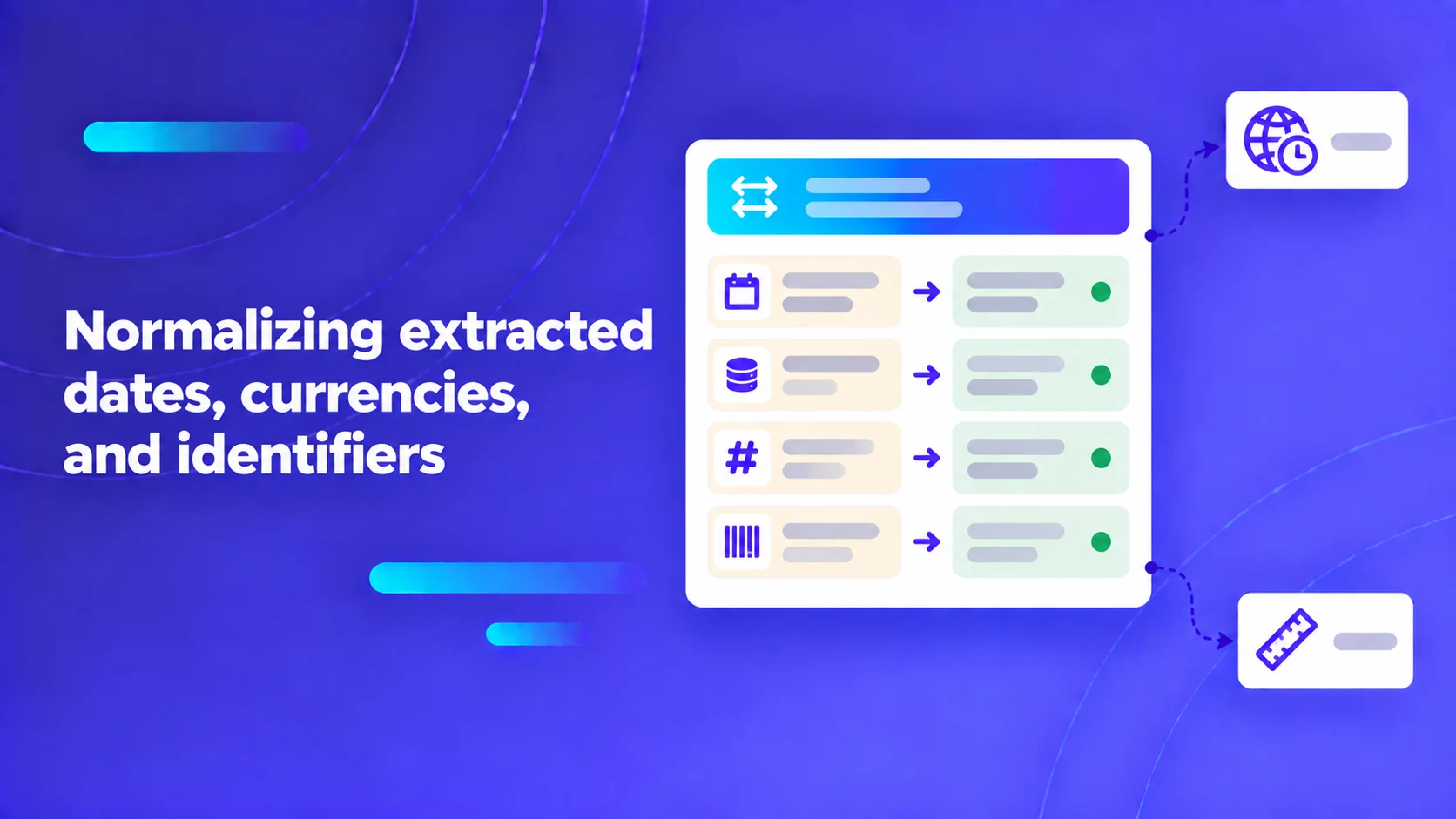
- Deterministic Normalization: A localized date or currency formatted according to published business rules, detailed in our guide to normalizing extracted dates, currencies, and identifiers.
- Synthetic Calculation / Derivation: An invoice subtotal calculated by summing individual line-item extractions. Provenance must link to the parent line items and record the mathematical formula used.
- Referential Augmentation: A vendor ID retrieved from an external SAP ERP database by querying the extracted tax number. The provenance log must capture the API endpoint, query timestamp, and foreign key.
- Human Reviewer Correction: A manual intervention where a human clerk altered an unreadable or misread value. The record must log the reviewer's employee ID, reason code, prior value, and new value.
Regulatory compliance playbooks: FDA, SOC 2, and Basel III
Maintaining rigorous source provenance is not merely an engineering best practice; it is a mandatory legal requirement across heavily regulated industries:
- Life Sciences (FDA 21 CFR Part 11): Clinical trial protocols and laboratory documentation require computer-generated, time-stamped audit trails that independently record the date and time of operator entries and actions that create, modify, or delete electronic records.
- Financial Services (Basel III & Sarbanes-Oxley): Financial institutions must demonstrate internal controls over financial reporting, proving that figures on balance sheets directly trace back to executed transaction slips and counterparty confirmations.
- Security & Trust (SOC 2 Type II): Audits require demonstrating data processing integrity, ensuring that data transformations are authorized, complete, and verifiable.
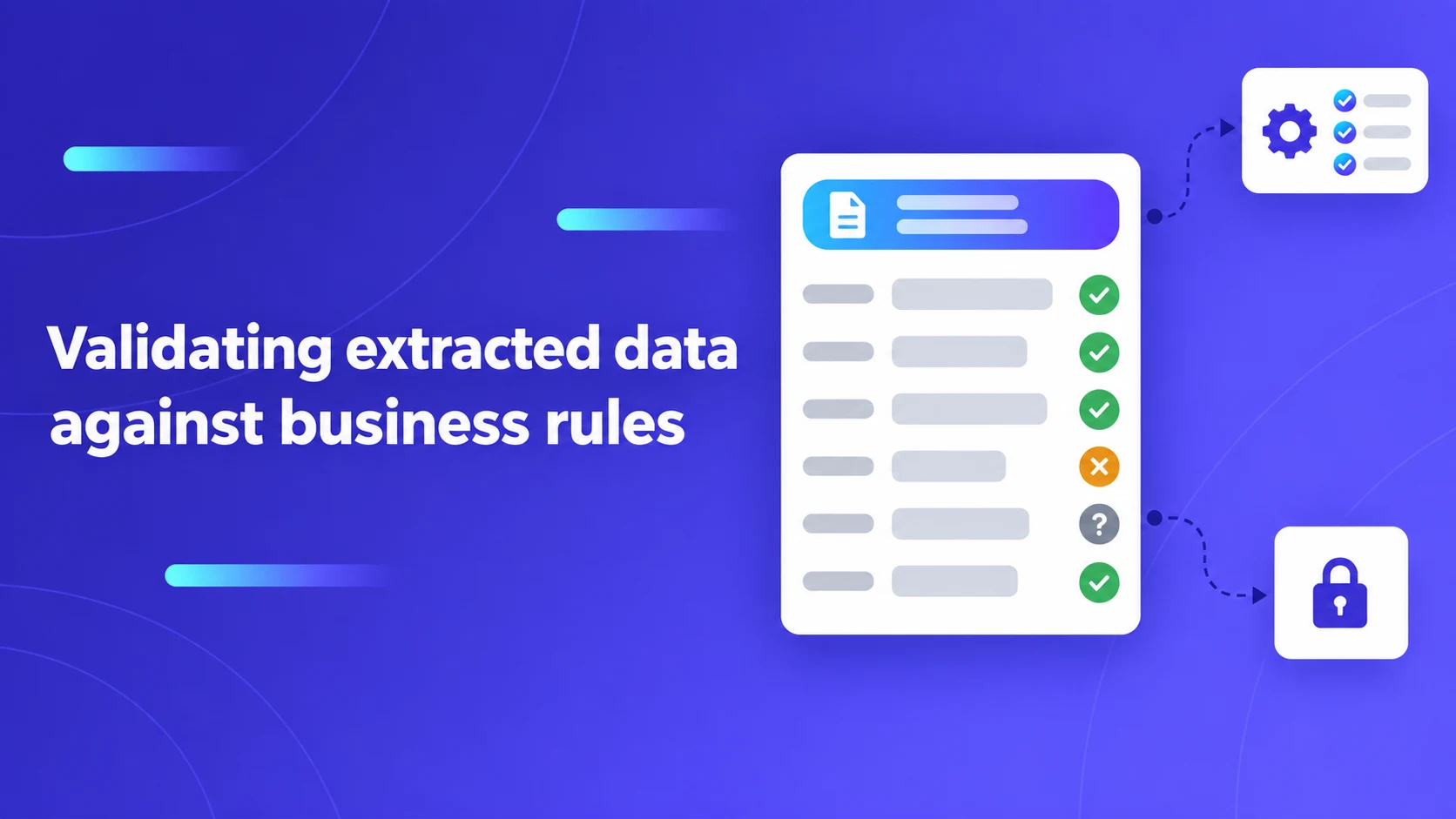
When integrated with automated business-rule validation checks, field-level provenance allows compliance teams to conduct continuous automated sampling—verifying that high-value transactions are supported by unambiguous documentary evidence.
Balance audit provenance with data access and retention policies
Retaining rich documentary evidence introduces data privacy and storage management challenges. In environments subject to GDPR or HIPAA, retaining full unredacted source scans indefinitely may violate data minimization principles.
To balance auditability with compliance:
- Granular Access Controls: Decouple operational record access from source document access. An operations specialist may be authorized to view extracted invoice totals in a reporting dashboard without having security clearance to download the original PDF containing sensitive bank account details.
- Automated PII Redaction: For archival records, apply automated redaction to sensitive personally identifiable information (PII) on the source scan before long-term storage, while preserving cryptographic hashes that prove the redaction occurred on the authentic original.
- Synchronized Lifecycle Policies: When a source document reaches its statutory retention expiration and must be purged, update the operational record to reflect that its underlying evidence was pruned under policy, avoiding dangling references.
For a complete architectural blueprint on architecting verifiable document intake pipelines, read our foundational AI document-processing guide. Learn how our high-security File store manages cryptographic document storage and how autonomous Agents maintain automated audit trails. Then, schedule an enterprise architecture demo to evaluate end-to-end provenance tracking on your organization's mission-critical document workflows.