AI document processing: a practical evaluation guide
Plan an AI document processing workflow with clear output requirements, representative test documents, source evidence, review rules and delivery checks.

Sarath Chandran
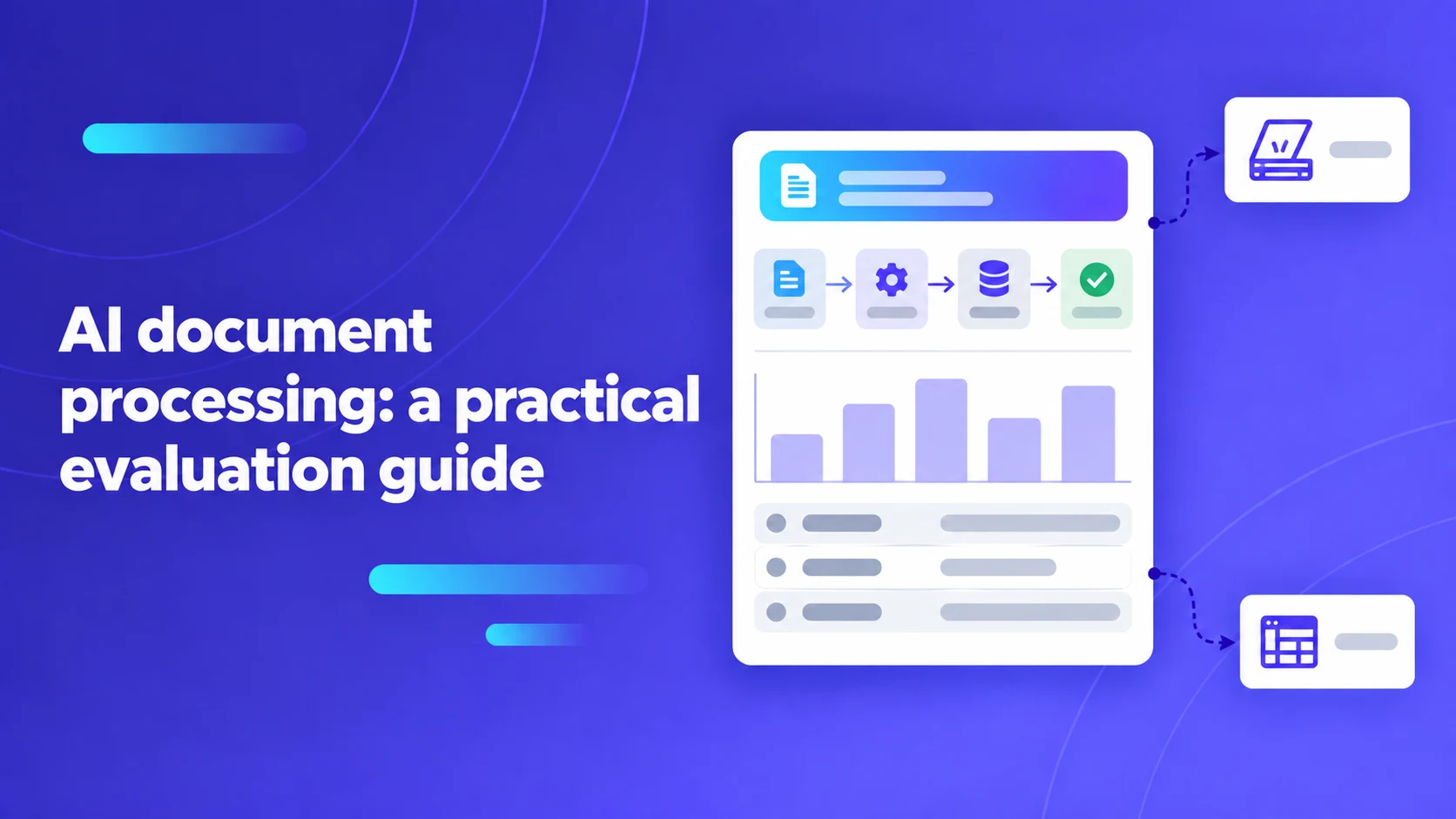
AI document processing turns unstructured files into verified, actionable business information that enterprise software and decision-makers can trust. A complete production-grade workflow does far more than read words on a page: it verifies file integrity, classifies incoming document types, splits bundled packets into discrete transactional instances, extracts tabular and entity-level fields, validates records against business invariants, routes ambiguous exceptions to human reviewers, and delivers immutable records to downstream core systems.
Modern enterprises process millions of complex documents annually—including commercial invoices, trade bills of lading, medical health records, insurance loss notices, mortgage applications, and regulatory filings. Historically, organizations attempted to automate these pipelines using rigid zonal OCR templates or brittle regular expressions. When a supplier shifted a logo by two inches or printed an invoice across two pages instead of one, legacy systems failed catastrophically. Today, intelligent document processing (IDP) harnesses multimodal foundation models, spatial vision transformers, and declarative rule engines. However, achieving 99%+ operational accuracy requires treating document processing not as a single model call, but as a disciplined multi-stage engineering pipeline.
Key Architecture Rule: Never treat AI document processing as an end-to-end "black box" model invocation. A resilient document processing platform must decouple ingestion, layout tokenization, packet splitting, field extraction, data normalization, business validation, human-in-the-loop review, and transactional delivery into observable, independently auditable stages.
Understand the seven stages of modern document processing pipelines
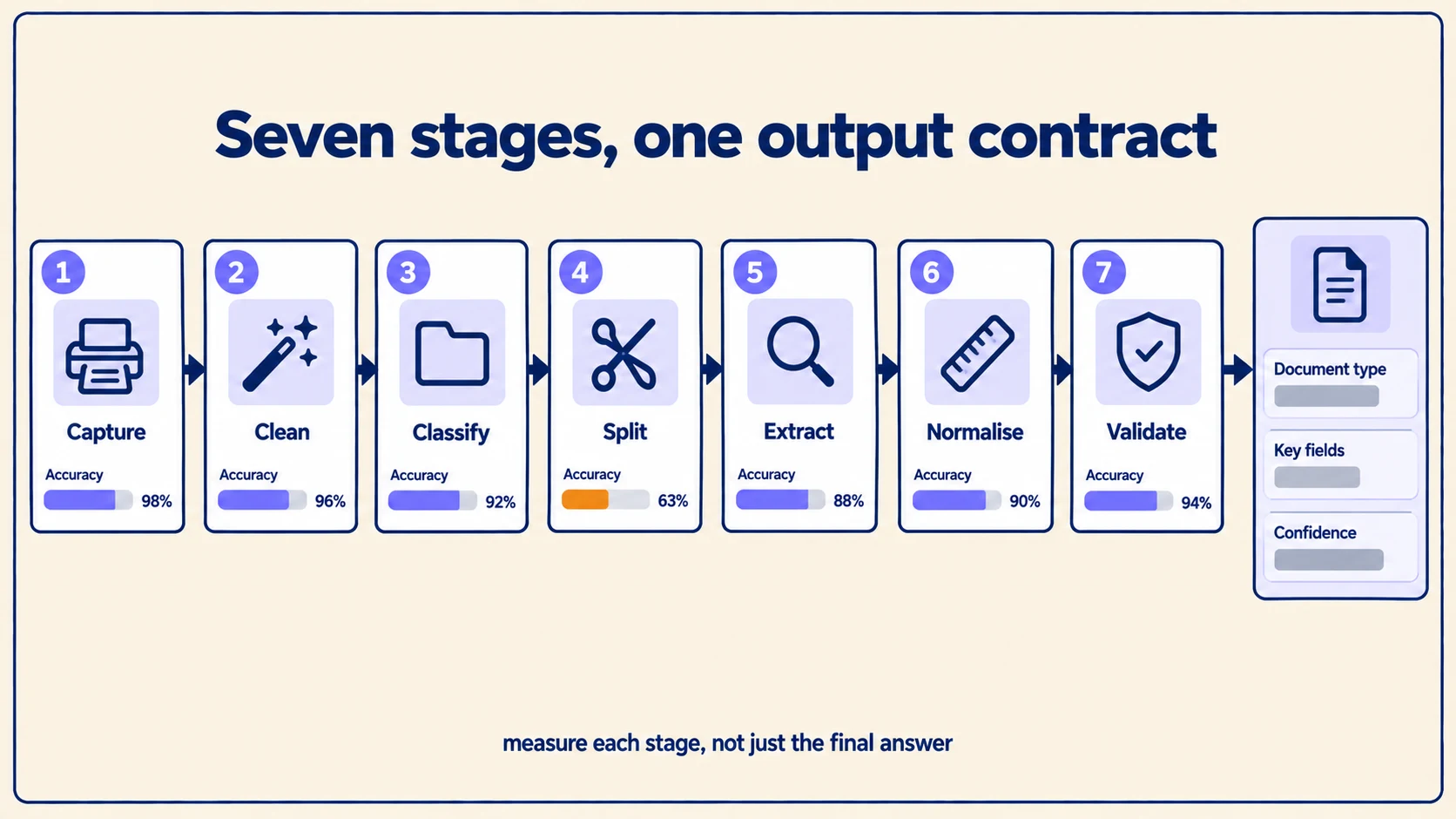
A production-grade document processing platform coordinates multiple specialized subsystem components. Conflating these responsibilities into an unsegmented pipeline makes root-cause error diagnosis impossible when processing failures occur.
The table below outlines the seven mandatory architectural stages of an enterprise document pipeline, their core objectives, and the specific telemetry evidence engineering teams must monitor.
| Pipeline stage | Core operational objective | Primary architectural question | Key telemetry & evidence to monitor |
|---|---|---|---|
| 1. Intake & Triage | Ingest raw binary streams; validate file integrity and scan resolution. | Did the authentic file arrive intact with sufficient optical legibility? | SHA-256 hash, MIME type, page count, DPI resolution, skew angle, blur score. |
| 2. Classification & Splitting | Identify document types and delimit multi-page transactional boundaries. | Which distinct business documents are present across the page sequence? | Document class probability, page boundary confidence, multi-document packet map. |
| 3. Layout & OCR Tokenization | Recognize glyphs, reading order, and tabular bounding-box structures. | Where do words, headers, paragraphs, and table grids physically reside? | Bounding polygons, reading order graphs, table cell adjacency matrices. |
| 4. Entity & Field Extraction | Map spatial tokens and semantic phrases to structured schema attributes. | Which specific document values satisfy the target schema fields? | Field-level model confidence, token provenance anchors, extraction latency. |
| 5. Normalization & Validation | Standardize data representations and enforce domain business invariants. | Are extracted values canonical, mathematically sound, and referentially valid? | Pre-normalization surface text, ISO standard outputs, business rule assertion results. |
| 6. Human-in-the-Loop Review | Route low-confidence predictions and validation exceptions to operators. | Which specific fields require human adjudication, and what did the reviewer decide? | Review queue latency, reviewer edit delta, disagreement rates, audit sign-off. |
| 7. Transactional Delivery | Atomically commit accepted records to enterprise systems of record. | Did the verified record reach ERP/database targets without duplicate writes? | Idempotency keys, webhook delivery receipts, retry queue status, DLQ count. |
Each stage exhibits distinct failure modes. An unreadable camera scan requires physical re-acquisition; an out-of-balance invoice requires financial dispute triage; a missing purchase order reference requires an ERP database lookup. Treating every pipeline failure as a generic "low confidence extraction" blinds operations teams to systemic workflow defects.
Microsoft's Document Intelligence model overview formalizes this division across reading models, layout analysis, classification classifiers, and structured extraction models. Similarly, Amazon Web Services details structured representation models for forms and tables in its Amazon Textract document analysis reference. Establishing these clear boundaries ensures that each operational failure is routed to the exact architectural component responsible for remediation.
Start with a high-value output contract and clear operational ownership
The most common reason enterprise document automation pilots fail is choosing vague, unmeasurable objectives—such as "use AI to parse all corporate PDFs." To succeed, start with a focused workflow possessing a named operational owner, recurring document volumes, high manual processing labor, and a strict downstream schema contract.
High-impact production candidate workflows include:
- Accounts Payable Invoicing: Ingesting supplier invoices, performing 3-way matching against purchase orders and receipts, and committing vouchers to SAP or Oracle ERP.
- Supply Chain Logistics: Ingesting multimodal bills of lading, packing slips, and customs declarations to update warehouse management systems.
- Commercial Lending & Underwriting: Parsing multi-year balance sheets, tax filings, and profit-and-loss statements to compute debt service coverage ratios.
- Healthcare & Claims Adjudication: Extracting patient encounter summaries, diagnostic codes, and fee schedules to accelerate prior authorization.
Prior to writing code or evaluating models, define the output schema contract in rigorous detail. For every target field, specify:
- Semantic Definition: An unambiguous business explanation of what the field represents (e.g., distinguishing an invoice issue date from an invoice payment due date).
- Canonical Data Type: The required structural primitive (e.g., string, ISO-8601 date, floating-point decimal, boolean).
- Nullability & Default Policy: Whether the field is strictly mandatory, optional, or conditionally required based on other fields.
- Source Grounding Requirements: Whether the field must map directly to a printed token bounding box, or whether it represents a calculated derivation.
Pro Tip: Define what constitutes an "acceptable abstention." If a document genuinely lacks a purchase order number, an extraction pipeline that emits null with high confidence has succeeded. An extraction engine that hallucinates an imaginary PO number from an unrelated serial code has committed a severe operational failure.A worked enterprise scenario: Industrial service certificates to asset inventory
To understand how end-to-end extraction architecture functions in practice, examine a concrete enterprise scenario: an industrial facilities management enterprise receiving equipment inspection certificates and attached maintenance schedules from third-party engineering contractors. The primary objective is parsing inspection records to update the enterprise asset management (EAM) database, ensuring high-voltage substations and pressure vessels maintain active operating permits.
The table below outlines the synthetic acceptance contract for this inspection pipeline. The values below are deliberately synthetic and illustrative; they do not represent proprietary customer data or benchmark claims.
| Field requirement | Expected extraction & normalization behavior | Business validation assertion | Exception handling & escalation route |
|---|---|---|---|
| Document Substrate | Ingest PDF; record immutable SHA-256 hash and verify page count. | Ensure file is not corrupt and scan DPI exceeds 200. | Route degraded files to automated contractor re-upload portal. |
| Asset Identifier | Extract alphanumeric serial number verbatim (e.g., "00492-X"). | Must match an active registered asset in the enterprise EAM database. | If unmapped, route to inventory master data steward for verification. |
| Inspection Date | Parse printed date; normalize into canonical UTC ISO format (YYYY-MM-DD). | Service date must be historical (Date <= CurrentDate). | If ambiguous (e.g., 04/05/2026), route to reviewer for jurisdiction check. |
| Safety Compliance Status | Extract certified inspector rating (PASS, CONDITIONAL, FAIL). | Value must belong to enumeration set ['PASS', 'CONDITIONAL', 'FAIL']. | If FAIL, trigger immediate high-priority safety alert to site operations. |
| Tabular Line-Item Schedule | Parse multi-page table of tested pressure valves and measured PSI tolerances. | Line items must associate with parent asset without row-splitting errors. | Route structural table anomalies to visual cell-editing queue. |
| Inspector Certification | Extract licensed engineer name and professional stamp ID. | Verify engineer license number against state licensing registry API. | If uncertified or expired, flag certificate for compliance officer review. |
In this workflow, an extraction of "14 September 2026" normalizes cleanly to "2026-09-14". However, if the page displays an ambiguous date string like "03/04/2026" without explicit locale formatting, the normalization engine must not guess. It must preserve the raw string, flag the field as unresolved, and present the reviewer with a high-resolution page crop showing surrounding text (such as an address indicating a UK or US facility) to settle the ambiguity.
Furthermore, when the multi-page inspection schedule lists 40 individual valves tested across three pages, the system must enforce table continuity rules. Individual valve records must inherit the parent certificate's asset identifier rather than generating orphaned rows in the database.
Select the appropriate extraction architecture for your document mix
Not all document processing tasks require the same computational architecture. Deploying an expensive multimodal frontier language model to extract five numbers from a standardized government tax form is wasteful; conversely, using a rigid coordinate-based template engine to parse unstructured legal contracts guarantees failure.
Modern architectures typically deploy a hybrid strategy combining three tiers:
1. Traditional Coordinate and Zonal OCR Engines
- Ideal For: Fixed, high-volume digital native forms where visual geometry never varies by even a millimeter (e.g., standardized IRS W-2 forms or state vehicle registrations).
- Strengths: Extremely fast inference (sub-100ms), low compute cost, deterministic field extraction.
- Weaknesses: Completely brittle. Fails entirely if an invoice has dynamic row counts, unexpected margins, or multi-page continuation.
2. Prebuilt Cloud Domain Models & Vision Transformers
- Ideal For: Common commercial document types with moderate layout variability but consistent semantic concepts (e.g., standard accounts payable invoices, receipts, passports, bills of lading).
- Strengths: Out-of-the-box support for complex key-value pairs, nested line-item tables, and multi-lingual character sets.
- Weaknesses: Constrained to vendor-defined schemas; extending the model to support bespoke proprietary engineering fields often requires custom fine-tuning.
3. Multimodal Large Language Models (LLMs) & Layout Foundation Models
- Ideal For: Highly unstructured, complex documents containing variable narrative prose, non-standard contractual clauses, handwritten marginalia, and novel layouts.
- Strengths: Superb contextual reasoning, zero-shot generalization to unseen document templates, and natural language interpretation of ambiguous terms.
- Weaknesses: Higher inference latency and compute cost; requires strict prompt grounding and post-processing validation to eliminate hallucination risks.
Key Architecture Rule: In high-volume enterprise pipelines, implement a tiered routing architecture. Route standard, high-confidence invoices through fast, specialized vision transformers, and escalate anomalous, unstructured, or failed documents to multimodal LLM reasoning agents for contextual extraction.
Build a comprehensive evaluation dataset that challenges pipeline boundaries
Demonstrations orchestrated on pristine, hand-picked digital PDFs inevitably create an illusion of operational readiness that shatters in production. To evaluate an intelligent document processing pipeline rigorously, construct an evaluation dataset that models the true variance of your enterprise intake streams.
Structure your evaluation suite across four dedicated challenge dimensions, referencing our deep-dive engineering guides:
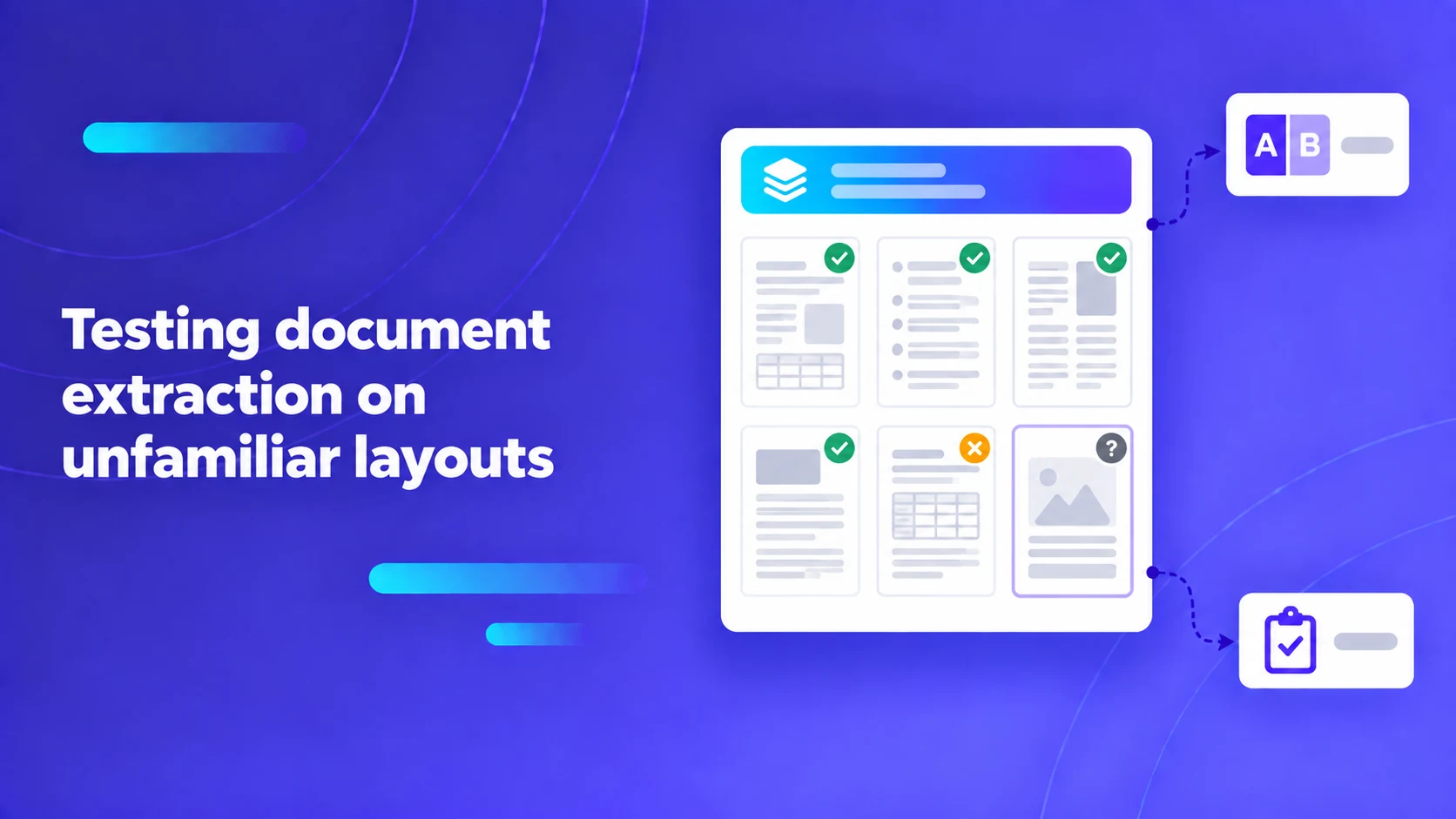
- Unseen Layout Generalization: Ensure your test suite contains layout families that were completely sequestered during development. Follow our methodology for testing unfamiliar layouts to measure zero-shot structural robustness.
- Open-World Classification & Triage: Test how the classifier behaves when presented with out-of-scope documents, corrupted files, or marketing brochures. Review our guide on document classification for unknown types to ensure your intake pipeline rejects invalid uploads gracefully.
- Multi-Document Packet Splitting: Ingest multi-page bundles containing several distinct forms, blank pages, and mixed attachments. Consult our framework for preventing document packet splitting errors to verify that instance boundaries remain intact.
- Optical Degradation & Scan Quality: Include real-world scans featuring skew, mobile camera glare, low contrast, and thermal receipt fading. Use our poor-scan-quality OCR triage method to establish image pre-processing standards, and apply our multilingual OCR evaluation framework when handling global character sets.
Amazon Web Services highlights input image standards in its Amazon Textract best practices documentation. Always retain pristine original files and record image pre-processing steps so that quality improvements remain fully reproducible across model upgrades.
Measure extraction errors at the level of business consequence
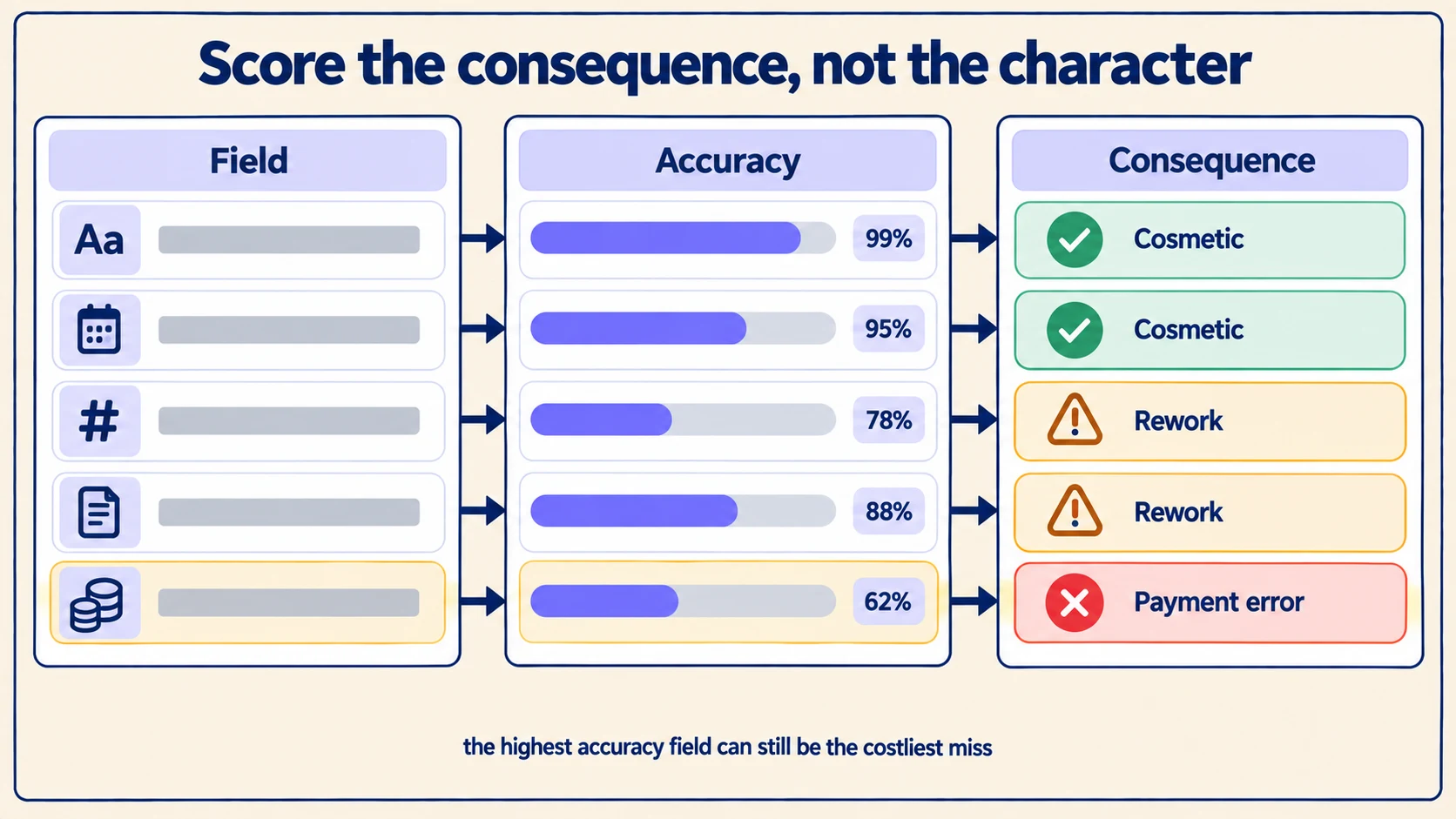
Evaluating document processing systems using naive aggregate accuracy metrics (such as average character error rate or top-line F1 scores) obscures dangerous operational vulnerabilities. An accounts payable pipeline that achieves 98% field accuracy across 50 fields can still boast a dismal 0% straight-through processing rate if the single field it consistently misreads is the total payment amount.
Structure your evaluation reporting across four actionable tiers:
- Field-Level Precision and Recall: Measuring exact-match and normalized accuracy for each target attribute independently.
- Complete Record Accuracy (Straight-Through Rate): The percentage of document instances where 100% of mandatory fields pass extraction and validation without human intervention.
- Abstention Fidelity: The system's ability to identify missing or unreadable fields accurately and emit a clean null, rather than hallucinating plausible text.
- Review Queue Escalation Burden: The volume of documents routed to human operators, categorized by root cause (e.g., low OCR certainty vs. business rule arithmetic mismatch).
Google Cloud's Document AI evaluation documentation outlines standardized protocols for computing precision-recall curves across extracted entity sets against ground-truth schemas.
Calibrate your field acceptance cutoffs using empirical precision calculations rather than arbitrary rules of thumb. Review our detailed playbook on document extraction confidence thresholds to balance straight-through automation velocity against manual verification overhead.
Keep data normalization, business validation, and source provenance unified
Extracting characters from a page is only the midpoint of the document lifecycle. Extracted strings must be converted into canonical enterprise types, validated against domain constraints, and linked immutably to their evidentiary origin.
Ensure your pipeline implements three coordinated safeguards:
1. Transparent Data Normalization
Never perform ad-hoc string manipulation inside extraction prompts. Pass raw surface strings into a deterministic normalization engine that applies explicit jurisdictional locale rules, accounting conventions, and check-digit validations. Consult our guide on normalizing extracted dates, currencies, and identifiers to prevent silent data corruption.
2. Multi-Tier Business Validation
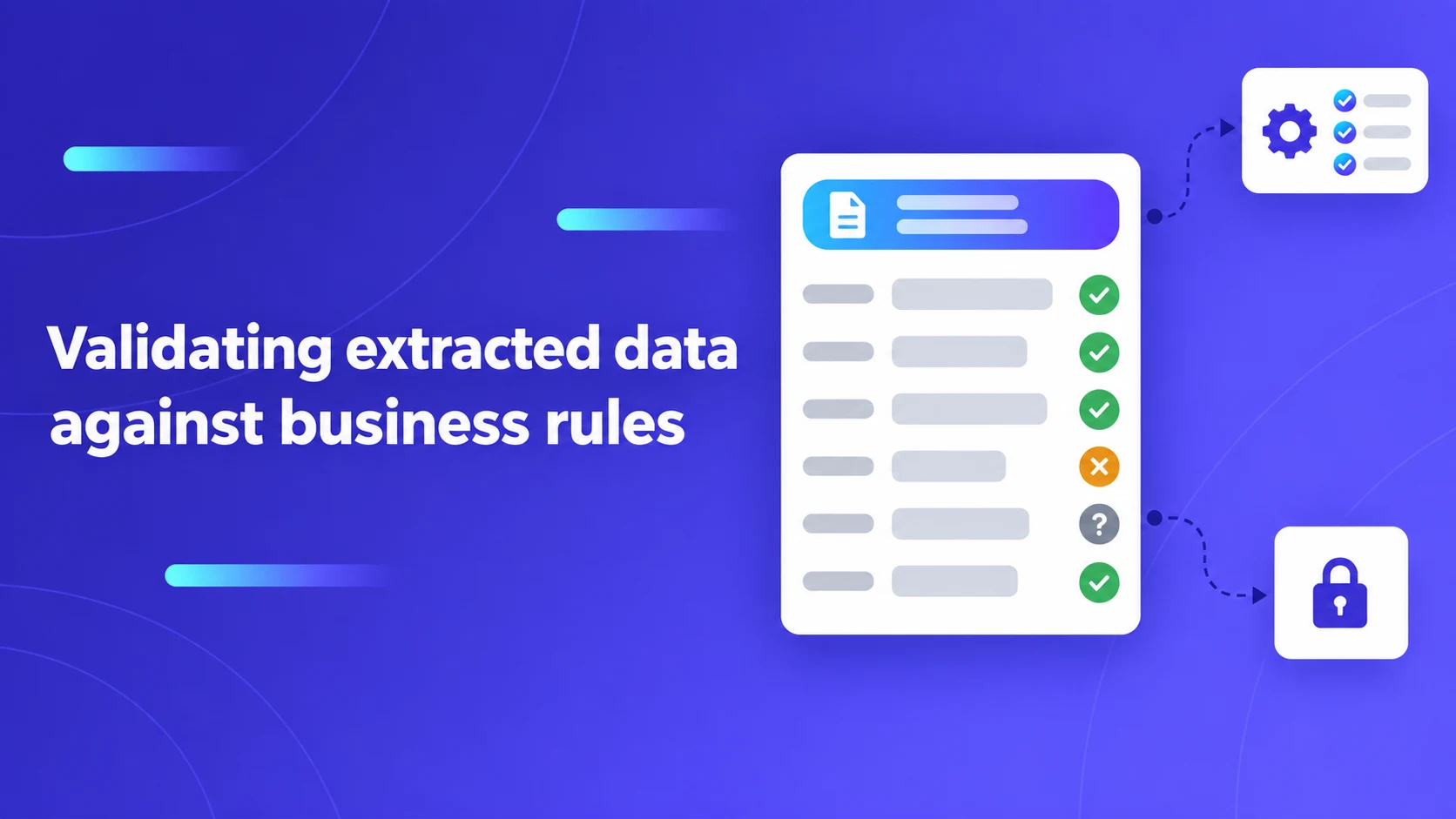
Validate extracted records against business invariants before committing data to databases. Check arithmetic totals, enforce cross-field dependencies, and execute referential lookups against ERP master data. Review our framework for document extraction business-rule validation to separate document data defects from OCR model failures.
3. Immutable Spatial Provenance
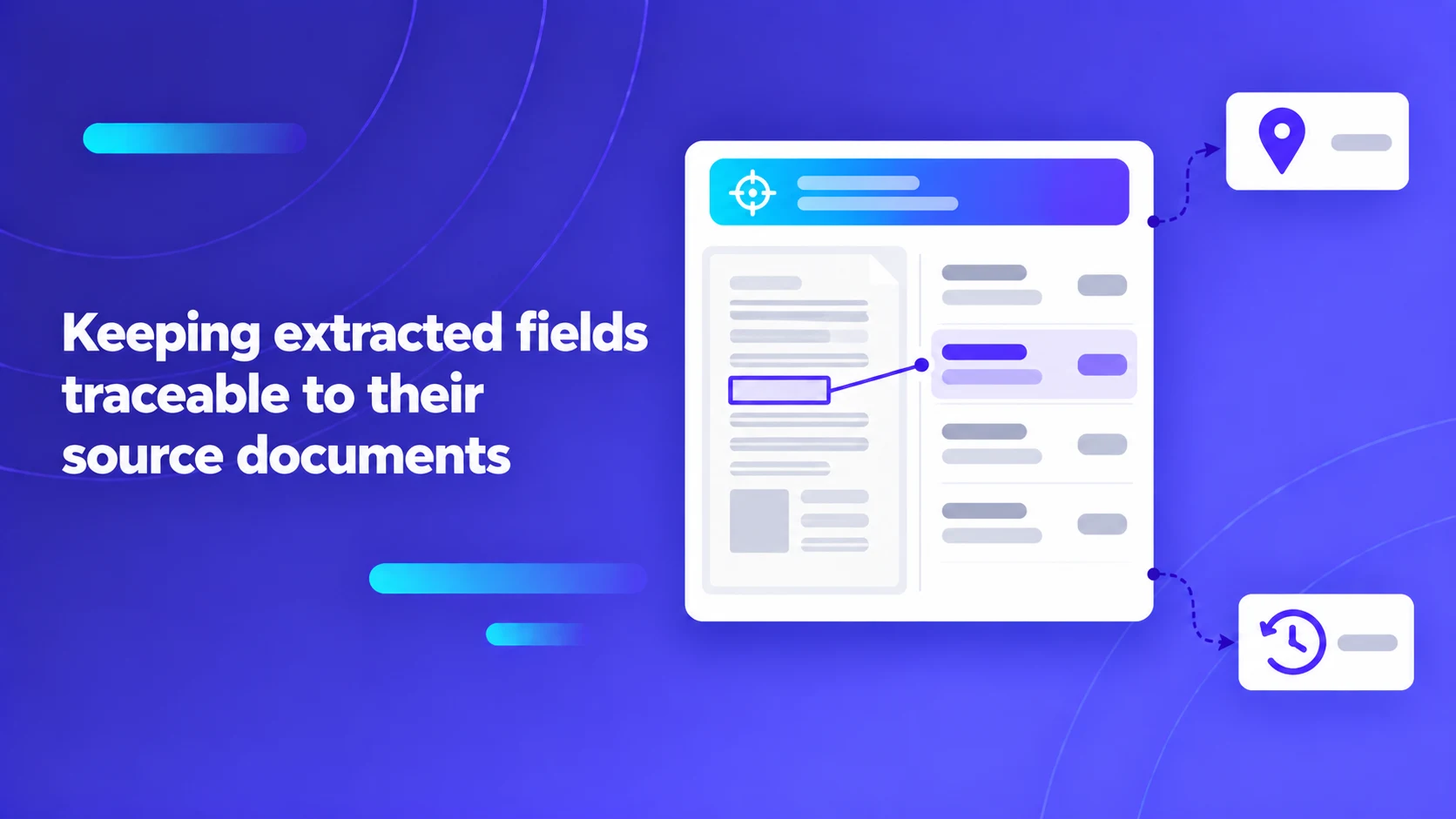
Every database record must retain cryptographic pointers back to the original PDF: file SHA-256 hash, zero-indexed page number, normalized bounding-box coordinates, and model inference metadata. Review our architecture for document extraction source provenance to ensure your records satisfy strict regulatory audit standards under FDA 21 CFR Part 11, SOC 2, and Sarbanes-Oxley.
Architect delivery, retry policies, and operational unit economics
An extraction pipeline that extracts records perfectly but fails to deliver them reliably to destination ERP systems creates administrative chaos. Design the delivery and persistence layer with enterprise-grade resilience:
- Idempotency Guarantees: Ensure every incoming document upload generates a deterministic, unique idempotency key based on its file content hash and transaction metadata. If an intake clerk uploads the same invoice three times, the system must recognize the duplicate, bind the events to the existing processing job, and prevent duplicate financial voucher creation.
- Transactional Delivery & Dead Letter Queues (DLQ): When committing extracted records to external APIs (such as Workday, SAP, or Salesforce), implement transactional delivery with exponential backoff retries. If the downstream ERP is undergoing maintenance, queue the payload in a durable Dead Letter Queue with automated alerting rather than dropping records silently.
- Total Cost of Ownership (TCO) & Unit Economics: Calculate processing costs across the entire lifecycle: image ingestion, OCR compute, model inference tokens, object storage, and human reviewer labor. A pipeline that advertises an attractive $0.01 per-page model fee can quickly become financially unsustainable if inaccurate extractions require $8.00 in human exception review per document.
An eight-point acceptance runbook for production pilot deployment
Prior to expanding an intelligent document processing pipeline to full production scale, execute a comprehensive pilot acceptance runbook across a representative sample of operational documents:
- Verify Binary Integrity: Confirm that files retain immutable SHA-256 hashes and that page boundary maps accurately delimit multi-page instances.
- Inspect Bounding-Box Spatial Anchors: Verify that every extracted entity highlights its exact physical source coordinates on the document viewport.
- Simulate Out-of-Scope Intrusions: Submit an unsupported document type and verify that the intake classifier routes it to the
Unknownqueue without hallucinating fields. - Test Deliberate Arithmetic Defects: Ingest a document with intentionally mismatched line items and verify that the business rule engine flags the discrepancy rather than rewriting values.
- Execute Human-in-the-Loop Adjudication: Route an ambiguous exception to a human reviewer, execute a correction, and verify that the audit ledger records the reviewer ID, previous value, new value, and timestamp.
- Simulate Downstream API Outages: Disconnect the destination ERP gateway, deliver an accepted record, and verify that the transaction safely buffers in a retry queue without data loss.
- Verify Idempotent Deduplication: Re-submit an identical file and confirm that the system prevents duplicate processing and flags the duplicate upload.
- Execute Model Regression Testing: Update a prompt or model version and re-run your complete held-out evaluation corpus, ensuring that overall record accuracy does not degrade.
By enforcing these eight verification gates, enterprise engineering teams can deploy automated document processing architectures with complete confidence in their accuracy, compliance, and operational resilience.
To explore how our platform accelerates intelligent document automation, discover the enterprise security architecture of our File store and the autonomous capabilities of our Agents. When you are ready to evaluate these capabilities on your organization's real-world document feeds, schedule an enterprise architecture demo to test custom extraction schemas, validation rules, and provenance tracking in a live deployment.