How to choose confidence thresholds for document extraction
Choose extraction review thresholds using labeled examples, field importance and the cost of errors instead of a universal confidence cutoff.

Sarath Chandran
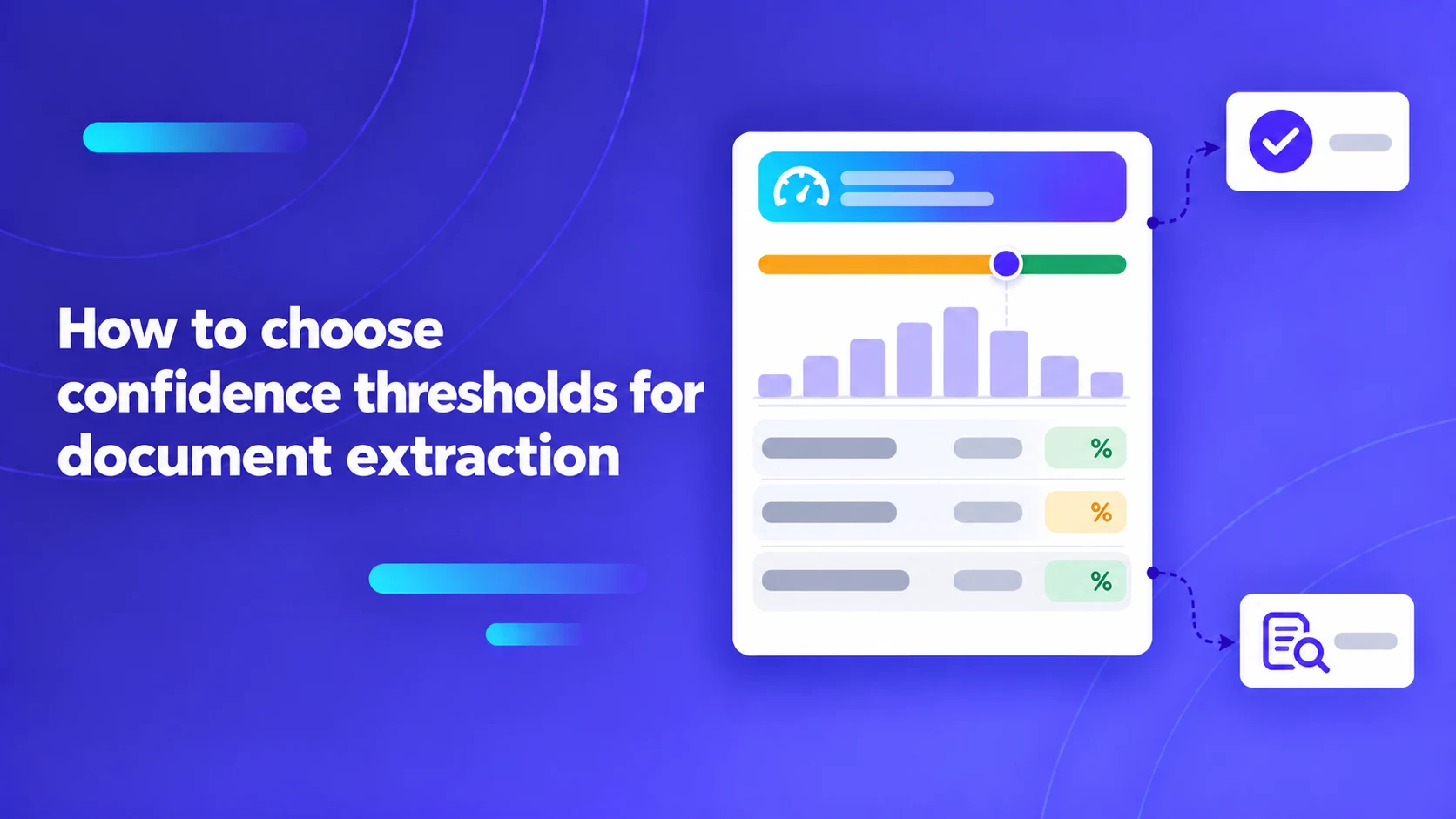
A confidence score is a signal to evaluate, not a universal permission to accept extracted data. Choosing a threshold means deciding how much uncertain work to send for review and which errors the process can tolerate. That decision depends on the field, the model, the documents and what happens after extraction.
In automated document processing pipelines, organizations frequently fall into the trap of adopting an arbitrary "90% confidence" rule across all extracted fields. A tracking reference, a line-item quantity, a vendor tax ID, and a free-text line description each carry radically different operational risks when misread. A single transposed digit in a payment routing number can misdirect thousands of dollars, whereas a minor typo in a delivery instruction field rarely causes downstream operational failure. Setting effective threshold policies requires understanding what each score measures, quantifying business failure costs, establishing structured verification stages, and measuring empirical precision on production workloads.
Key Architecture Rule: Never apply a single uniform confidence cutoff across all document fields. Confidence thresholds must be tuned at the field-level, tied directly to the operational risk and downstream cost of an unflagged extraction error.
Understand what the score describes
Modern intelligent document processing systems emit confidence scores at distinct layers of the pipeline. An OCR score evaluates glyph and token recognition accuracy; an entity score measures the probability that a character sequence represents a specific semantic type; a key-value pair score measures association between a label and its value; and a table score assesses cell boundary and structural alignment. Microsoft's confidence documentation distinguishes these levels and notes that not every field returns a score.
Check the output contract for the exact model and version being evaluated. Avoid averaging unrelated scores into a new synthetic number without establishing what that number means mathematically. A 99% confidence score on individual words does not guarantee that the entity extractor correctly assigned those words to the billing address rather than the shipping address. Furthermore, confidence numbers from different providers or model architectures cannot be directly compared; a 0.85 from a transformer-based vision-language model behaves differently from a 0.85 produced by a traditional convolutional OCR pipeline.
Keep source quality, extraction confidence, and business validation as separate, observable metrics:
- Source Quality: Evaluates scan resolution, contrast, skew, illumination artifacts, and compression noise.
- Model Confidence: Evaluates model probability distributions over tokens and structured fields.
- Business Rule Validation: Evaluates domain constraints such as mathematical totals, date ranges, and database entity matches.
Combining these three independent signals into a multi-factor routing decision provides resilient operational control; treating them as interchangeable numbers creates blind spots where invalid data slips into core enterprise systems.
Define correctness before selecting a cutoff
Before adjusting any threshold slider in a user interface, engineering and operations teams must document an unambiguous specification of what constitutes a "correct" extraction. Correctness criteria vary significantly by data type:
- Tracking and Reference Identifiers: Requires exact string matching after applying normalized whitespace and case-stripping transformations.
- Calendar Dates: Requires semantic equivalence (canonical ISO-8601 day, month, and year) rather than matching the printed format on the page.
- Monetary Amounts: Requires correct numerical value, currency symbol, and sign, matching the line-item arithmetic.
- Multi-line Descriptions: May permit minor OCR noise or formatting variance as long as the semantic meaning and SKU codes remain intact.
Record these rules in an evaluation dataset before reviewing model scores. Include negative test cases: missing fields, redacted text, stamps overlapping critical values, and plausible but incorrect values. If an identifier is genuinely absent from the source document, a system abstention (routing to exception handling or flagging as missing) is the only correct response; an invented or hallucinated identifier is a severe failure.
Operational Guardrail: Use separate, hold-out document sets to calibrate threshold policies and evaluate their runtime performance. Continuously adjusting thresholds against the same evaluation set overfits your policy to historical quirks rather than genuine document variability.
An illustrative threshold decision
Consider a shipping and logistics enterprise evaluating 200 extracted tracking references from international bill of lading documents. The figures below illustrate how shifting the acceptance threshold alters the operational tradeoff between straight-through processing and manual verification. The numbers below are deliberately synthetic and demonstrate the calculation only. They are not Exemplary AI results or recommended thresholds.
| Acceptance cutoff | Values accepted | Correct accepted values | Incorrect accepted values | Values sent to review | Accepted Precision | Review Burden |
|---|---|---|---|---|---|---|
| 0.70 | 180 | 170 | 10 | 20 | 94.4% | 10% |
| 0.85 | 150 | 147 | 3 | 50 | 98.0% | 25% |
| 0.95 | 100 | 99 | 1 | 100 | 99.0% | 50% |
At a 0.85 cutoff, 147 of the 150 accepted values are correct in this illustrative sample, yielding a 98.0% accepted-set precision. However, this calculation does not mean the entire workflow has achieved 98% operational accuracy. It reveals nothing about whether human reviewers accurately resolve the 50 flagged exceptions, whether critical records were omitted entirely, or whether the test sample reflects incoming layout changes.
Furthermore, increasing the cutoff from 0.85 to 0.95 reduces the accepted error count from 3 down to 1, but doubles the manual review volume from 50 to 100 documents. If human review teams have limited hourly bandwidth, that bottleneck can introduce severe processing latency into accounts payable or customs clearance workflows. Google's evaluation documentation describes how thresholds affect precision and recall tradeoffs across diverse extraction tasks.
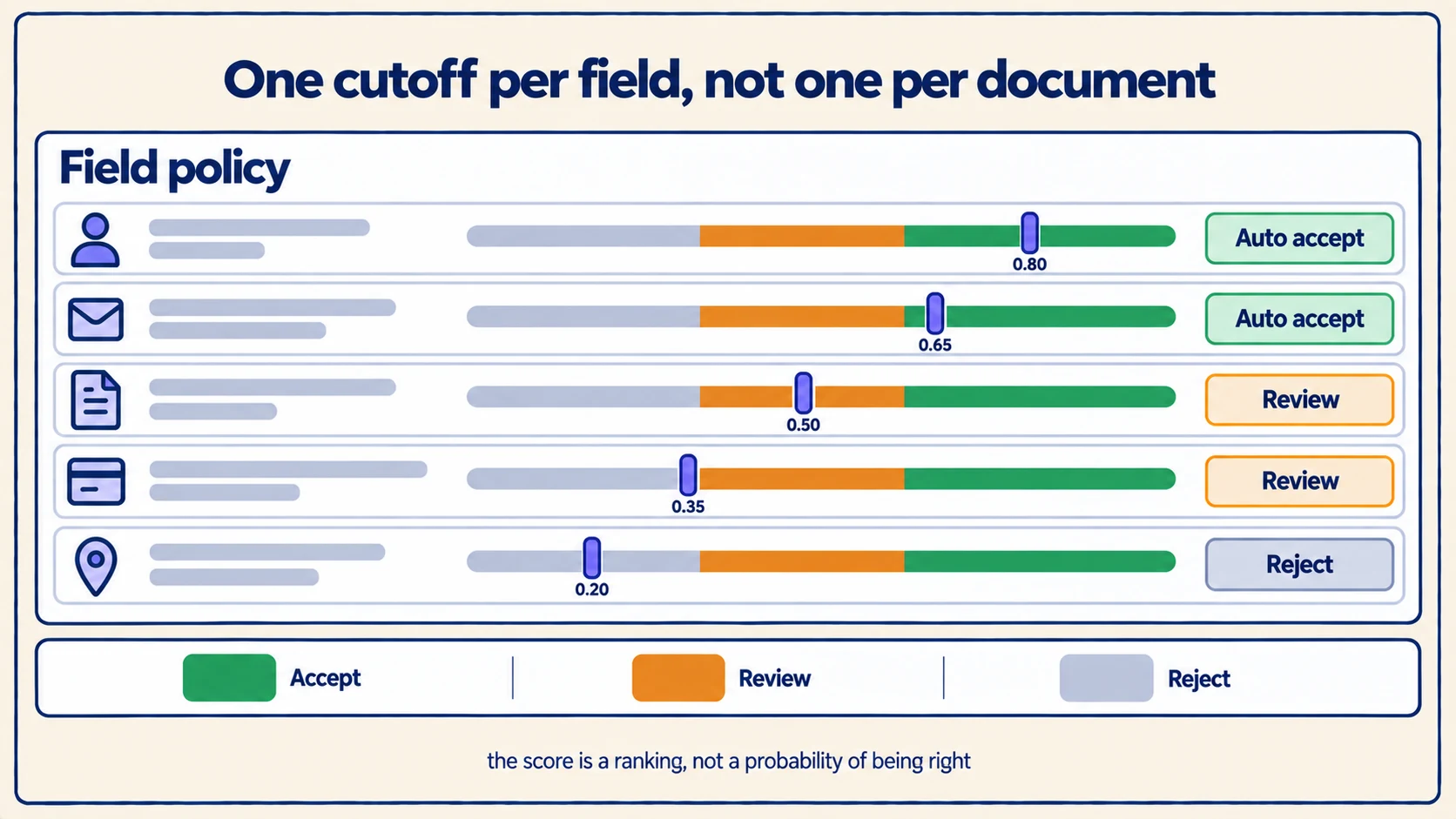
Choose field policies rather than one global rule
Field policies should be prioritized according to the business consequence of undetected errors. An unflagged error in an invoice line item directly impacts financial accounting, whereas an error in a vendor's telephone number is easily corrected during routine master data maintenance.
When configuring each field policy, specify:
- Comparison Semantics: The exact normalization and equivalence function used to score accuracy.
- Score Provenance: Whether the score originates from OCR character certainty, layout geometry, or entity classification.
- Automated Acceptance Bounds: The minimum statistical threshold required for straight-through processing.
- Prerequisite Business Rules: Auxiliary validations (such as checksum verification or database foreign-key lookups) that must pass regardless of confidence.
- Exception Routing: The specialized queue (e.g., tier-1 clerk, tier-2 compliance officer, or vendor outreach) assigned when a score falls below the cutoff.
Never inflate an extraction confidence score simply because an output string satisfies a regex format. A string of nine digits can match a tax identifier format perfectly while belonging to a completely different legal entity. Similarly, mathematical consistency across line items does not prove that the values originated from the target document. Complementary verification techniques, detailed in our guide to business-rule validation, must operate alongside confidence scoring rather than replacing it.
Pro Tip: Combine confidence scores with database validation lookups. If an extracted vendor name has moderate confidence (0.78) but matches an active vendor record in your ERP with an identical bank account number, the composite confidence for downstream straight-through processing is substantially higher than the raw OCR score suggests.
Test the policy under realistic operational variation
Threshold policies calibrated solely on pristine, digital-native PDFs will degrade rapidly when confronted with mobile camera captures, thermal receipt fades, skew angles, and low-contrast scans. Robust testing requires segmenting your evaluation suite across real-world dimensions:
- Ingestion Channel: Native PDF, high-speed flatbed scan, mobile capture, and multi-generation fax.
- Visual Artifacts: Salt-and-pepper noise, coffee cup rings, ink bleeds, skewed orientations, and folded creases.
- Language and Typography: Multilingual text, condensed proportional fonts, dot-matrix print, and handwritten annotations.
- Layout Variance: Legacy templates, localized regional variants, and previously unfamiliar layouts.
Document sample distributions rigorously. A test set consisting of 500 invoices from three major suppliers does not provide statistical confidence for a vendor ecosystem of 4,000 distinct suppliers. Maintain versioned test splits and evaluate threshold drift whenever model weights, upstream scanning hardware, or supplier contract templates change.
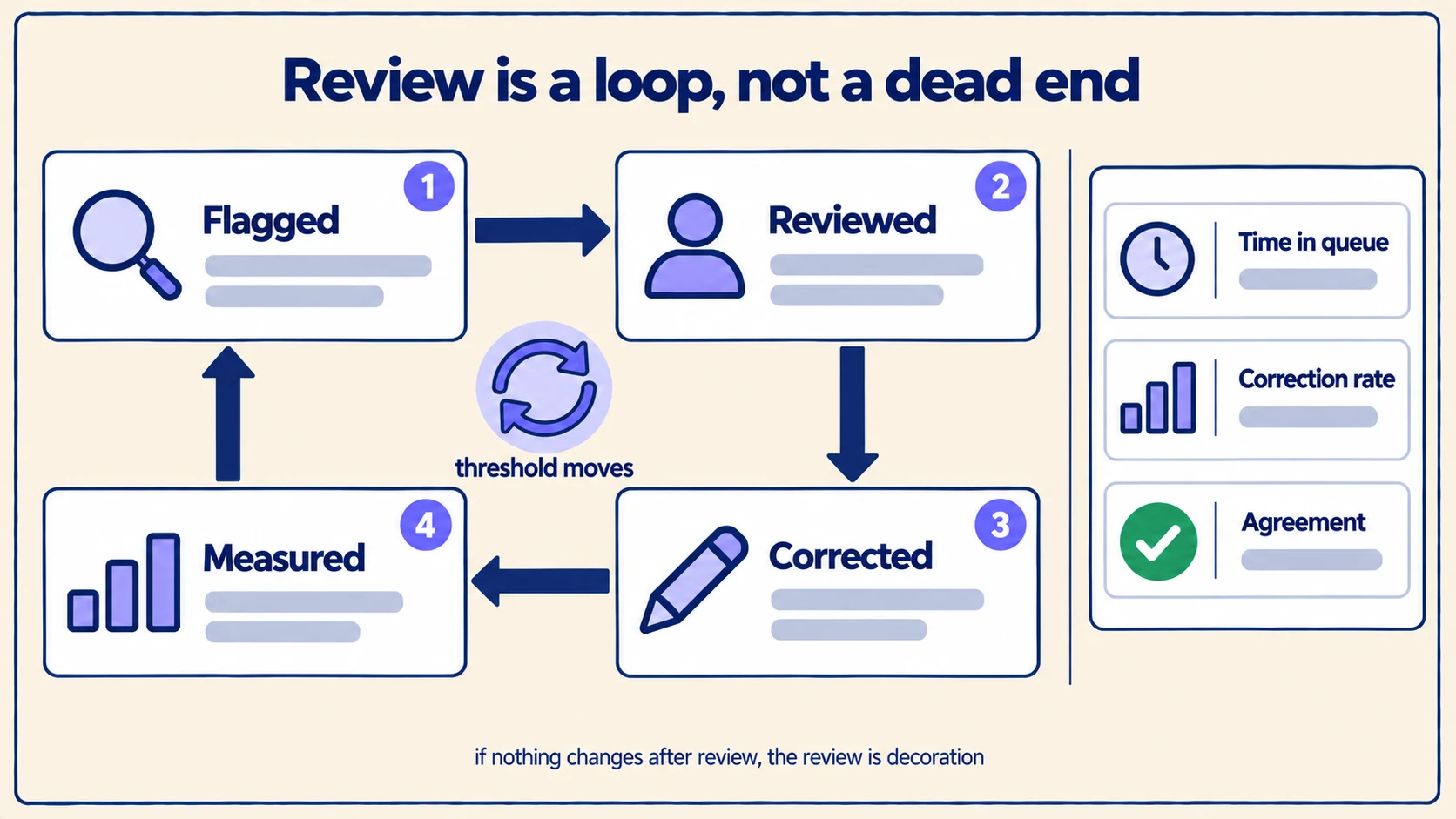
Make human review an observable, closed-loop outcome
Routing an extracted document to a human review queue is an active operational intervention that incurs latency and financial cost. Treat human-in-the-loop verification as an observable data product:
- Review Telemetry: Track time-to-review, reviewer disagreement rates, and field-level modification frequency.
- Error Taxonomy: Categorize reviewer interventions into OCR illegibility, model entity confusion, customer document omission, or reviewer error.
- Quality Auditing: Regularly sample and inspect automatically accepted documents (those scoring above the threshold) to measure false-negative rates that would otherwise go unnoticed.
- Feedback Loops: Feed verified reviewer corrections back into validation datasets to monitor model regression and refine field thresholds over time.
Ensure human verification interfaces present contextual provenance—highlighting the exact bounding box and page crop corresponding to the extracted field. For a comprehensive walkthrough of end-to-end processing pipelines, consult our foundational AI document-processing guide. Explore the security architecture of our File store and autonomous Agents, and schedule an enterprise architecture demo to evaluate confidence threshold calibration on your organization's document samples.