Testing document extraction on unfamiliar layouts
Design a held-out layout test with consistent annotations, field-level scoring and a reproducible record of errors.

Sarath Chandran
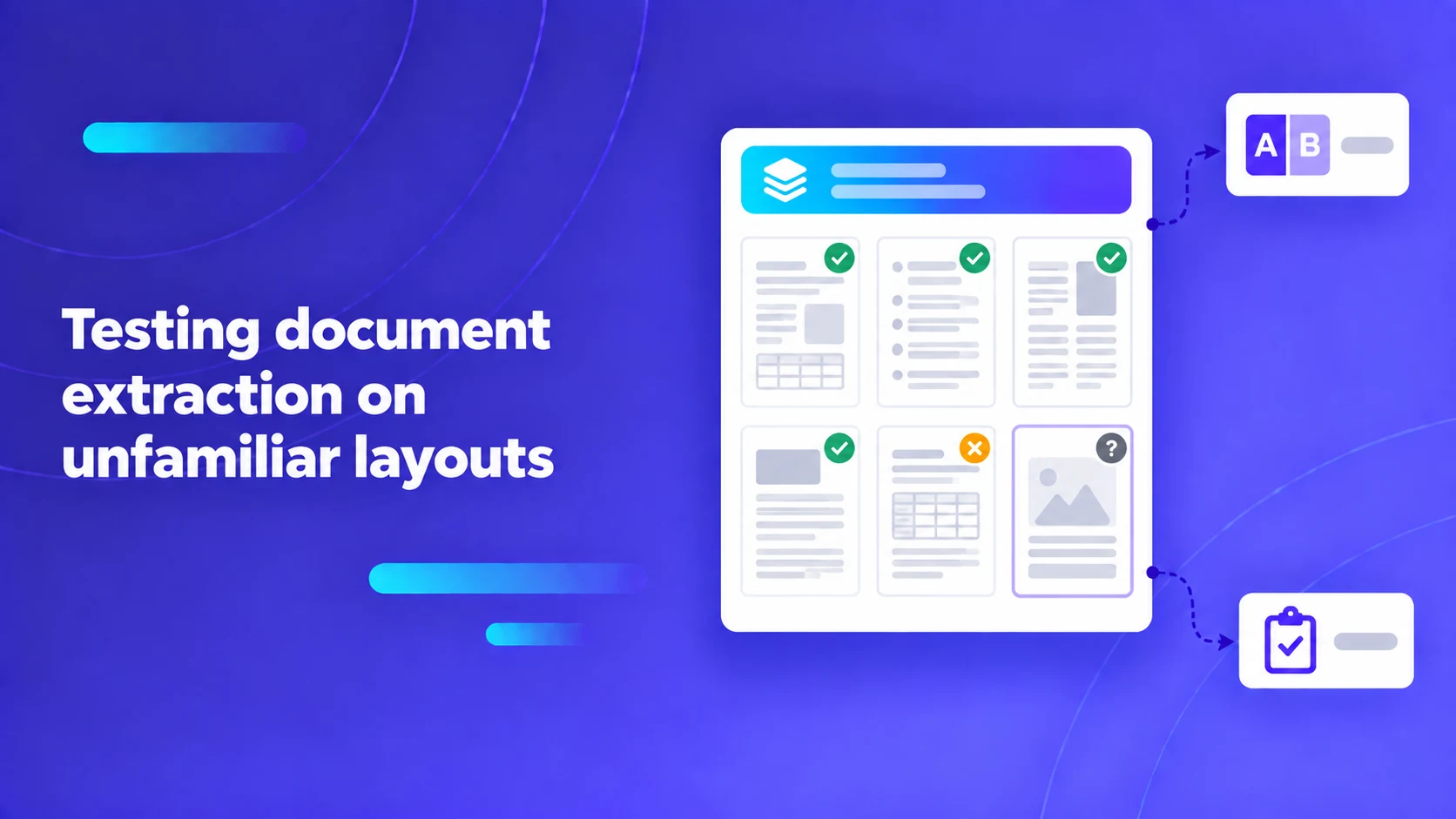
A document-processing demonstration becomes more informative when the system sees layouts that were not used to prepare it. Familiar templates can show that a configuration works for those templates. They do not establish how it behaves when a supplier changes a form, an attachment arrives as a scan or the same information appears in a different arrangement.
In enterprise software evaluations, vendor demonstrations frequently exhibit flawless 99% extraction accuracy because the demonstration models were fine-tuned or heavily prompt-engineered on the exact template layouts shown during the sales call. However, production environments are defined by layout entropy: suppliers update invoicing templates, hospitals revise intake questionnaires, regional branch offices modify header branding, and clients submit mobile camera photos of printed forms. When an intelligent document processing system encounters an unseen layout, its performance often plummets precipitously—an effect known as "generalization collapse." Testing unseen layouts is not an adversarial trick; it is the only rigorous method to measure whether an extraction engine comprehends semantic document structures or merely memorizes static coordinate bounding boxes.
Key Architecture Rule: Never evaluate an intelligent document processing pipeline using random train/test page splits. Always partition evaluation datasets at the layout-family level, ensuring that completely held-out template families never touch prompt design, few-shot prompt libraries, or model fine-tuning.
Define a layout family before dividing the evaluation corpus
Before partitioning documents into test splits, engineering teams must establish an objective definition of what constitutes a distinct "layout family." Simply splitting documents by file hash or upload date fails because an enterprise may receive 5,000 invoices that all share the exact same underlying ERP template.
A true layout family shares:
- Spatial Topology: The geometric arrangement of headers, line-item tables, signature blocks, and metadata sidebars.
- Lexical Vocabulary: The specific terminology used for field labels (e.g.,
"Invoice Total"vs."Balance Due"vs."Montant Total"). - Issuer / Generator Provenance: The underlying document generation software (e.g., SAP ERP export, QuickBooks template, Epic EHR report, or scanned paper form).
Two documents with different filenames, dates, and line items can be identical instances of the same layout family. Conversely, two documents originating from the same corporate vendor can feature completely different layouts if issued by different subsidiaries. Document your clustering criteria rigorously so that evaluation splits can be audited and reproduced by external compliance teams.
Microsoft's accuracy and confidence guidance for Document Intelligence highlights that model certainty fluctuates widely across differing document inputs, emphasizing the necessity of evaluating models across explicit structural variations rather than treating a file collection as a homogeneous population.
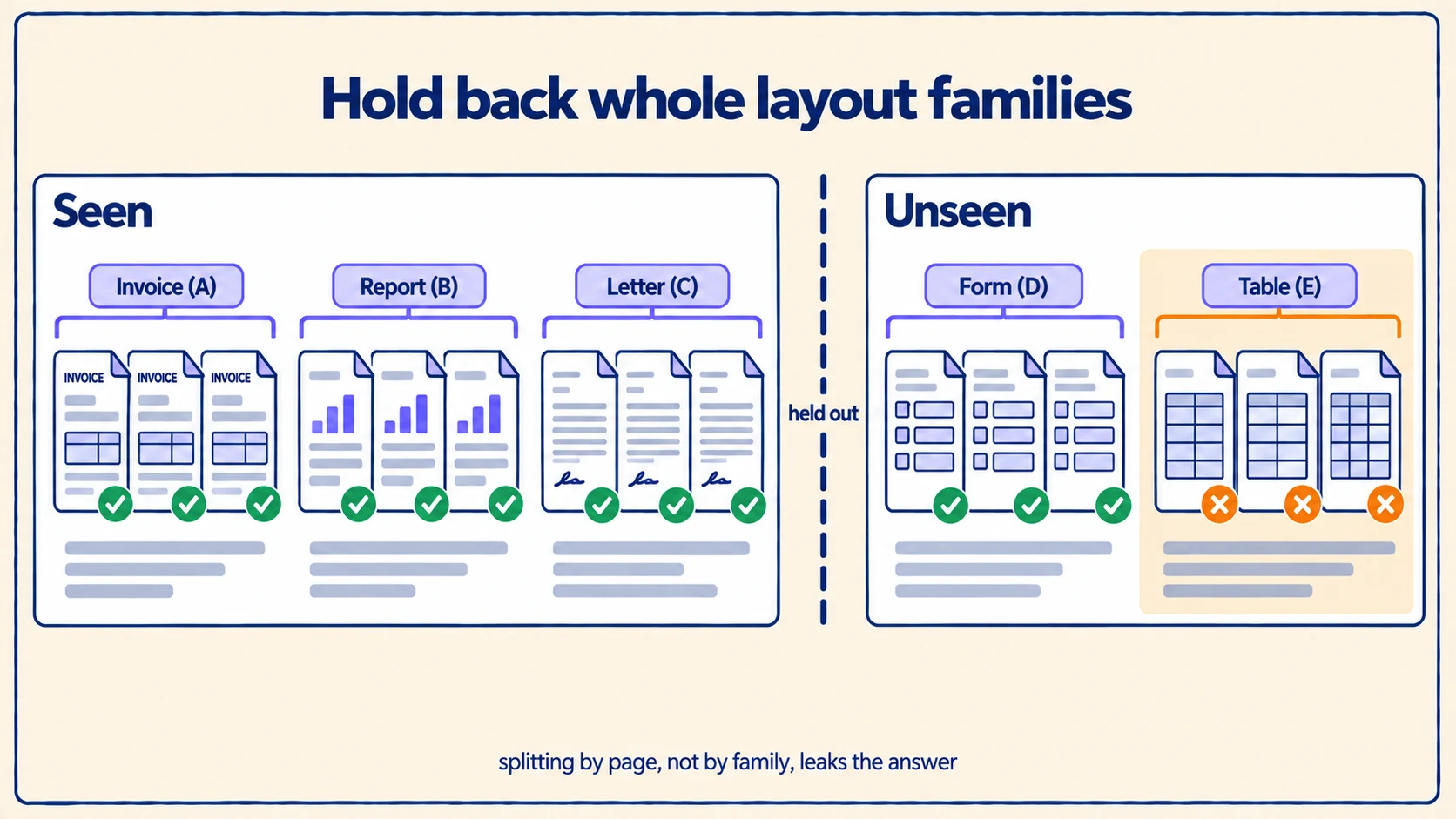
An illustrative held-out layout evaluation design
To measure generalization objectively, divide your candidate document corpus into strictly sequestered partitions. The table below illustrates a robust evaluation design for a commercial warranty platform evaluating equipment completion certificates across six distinct supplier layout families (A through F). The values below are deliberately synthetic and illustrative; they do not represent proprietary customer data or benchmark claims.
| Partition split | Included layout families | Permitted operational usage | Downstream risk if partition discipline is violated |
|---|---|---|---|
| Development & Tuning | Families A, B, and C | Prompt engineering, few-shot example selection, field mapping, coordinate tuning. | (Standard engineering sandbox for baseline system development). |
| Policy Calibration | Distinct instances of Families A, B, and C | Establishing field-level confidence thresholds and automated routing cutoffs. | Calibrating cutoffs on unseen data causes overfitting to specific anomalies. |
| Familiar-Layout Test | Unseen document instances of Families A, B, and C | Validating baseline model accuracy on known, trained document templates. | Measures regression on standard day-to-day enterprise workloads. |
| Unfamiliar-Layout Test (Held-Out) | Families D, E, and F (Zero overlap with Dev) | Assessing zero-shot generalization and structural robustness on novel layouts. | If Families D–F leak into prompts, zero-shot generalization claims are invalid. |
Maintain strict cryptographic isolation between partitions. If an engineer inspects a failure in Family D and adds an explicit few-shot example or regex override to fix it, Family D has been permanently contaminated and converted into development data. To make subsequent claims about unseen layout performance, the team must introduce an entirely new held-out family (e.g., Family G).
Pro Tip: Calculate the "Generalization Gap Ratio" by subtracting your held-out layout accuracy from your familiar layout accuracy. A pipeline scoring 98% on familiar layouts but 65% on unseen layouts exhibits severe overfitting and will generate high human-in-the-loop review costs in production.
Label expected target fields with semantic rigor
A common pitfall in unseen layout evaluations is ambiguous ground-truth annotation. When evaluating unseen layouts, human annotators must follow strict semantic guidelines:
- Disambiguate Competing Dates: In an unfamiliar layout, three dates may appear without clear labels. The annotation guidelines must specify whether the target field is the service completion date, the engineer's signature date, or the document generation timestamp.
- Handling Absent Fields: If a novel layout does not contain a field present in familiar layouts (e.g., omitting an explicit purchase order reference), the ground truth must record an explicit
null. Rewarding a model for extracting an invented or hallucinated PO number from an unrelated serial number is an architectural failure. - Exact-Match Normalization Rules: Define case-sensitivity, punctuation stripping, and whitespace rules prior to evaluation scoring.
Google Cloud's document processing evaluation documentation outlines standardized protocols for evaluating predicted entities against structured ground-truth annotations across diverse document classes.
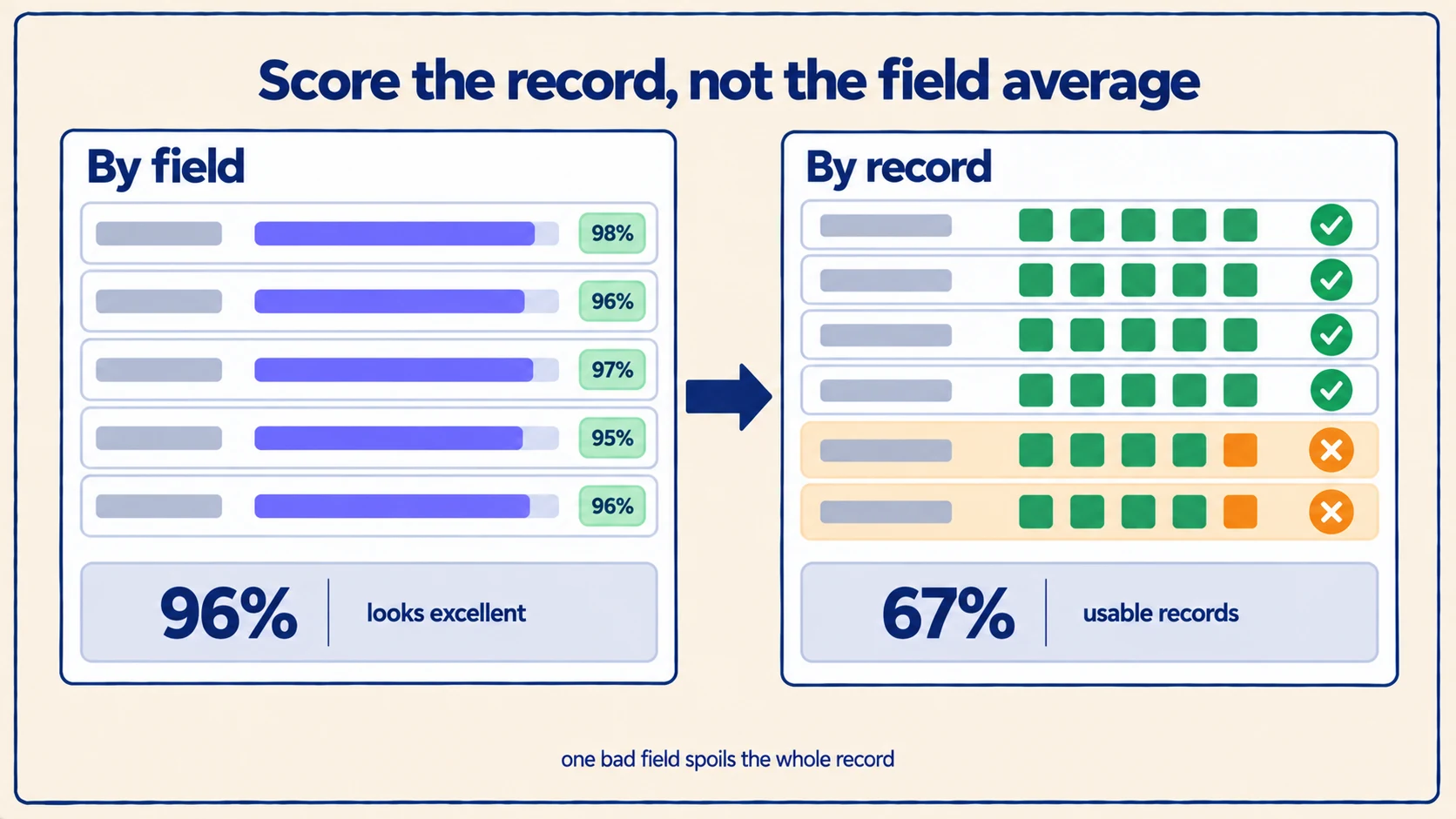
Score complete usable records, not isolated field averages
Aggregate field-matching percentages can be highly misleading. If an extractor scores 95% across an invoice because it correctly extracts 19 trivial fields (like phone numbers and addresses) while failing on the single invoice total field, the document is 100% useless for automated accounts payable straight-through processing.
Structure your evaluation metrics across four granular dimensions:
- Complete Record Accuracy: The proportion of documents where 100% of mandatory fields are extracted correctly without human intervention.
- Field-Level Generalization Decay: Identifying which specific fields degrade most when encountering novel layouts (e.g., line-item tables typically degrade faster than document headers).
- Abstention Precision: The system's ability to recognize when a field is missing on a novel form and gracefully abstain, rather than hallucinating plausible text.
- Review Queue Escalation Rate: The percentage of unfamiliar documents correctly flagged and routed to human review based on calibrated confidence-threshold policies.
Decide what "unseen" means before you claim generalisation
The word carries more weight than teams usually give it, and a held-out set that is unseen in the wrong sense measures nothing useful.
A layout can be unseen to the model but familiar to the pipeline, because a template-matching stage or a set of hand-written regional rules already recognises it. Conversely a layout can be genuinely novel and still trivial, because it is a clean single-column page with clearly labelled fields. Neither case tells you what you want to know.
Four increasingly demanding definitions, and what each actually supports:
| Definition of unseen | Held out from | Supports the claim |
|---|---|---|
| New document | The training sample, same template | Nothing about generalisation — this is regression testing |
| New layout family | Every stage, including rules and templates | The pipeline handles structural variation it was not tuned for |
| New vendor or issuer | Everything, including any issuer-specific handling | The pipeline handles a new supplier without configuration |
| New document type | Everything, including the classifier | The pipeline degrades safely rather than confidently mis-parsing |
Most teams evaluate at the first level and report the second. The gap is why extraction accuracy measured before go-live so often fails to survive the first month of real intake.
The fourth row is the one that protects you in production. A pipeline that meets an unfamiliar document type and returns low confidence has behaved correctly. One that confidently maps an unrecognised form onto the nearest familiar schema produces plausible, wrong, unreviewed records — the most expensive failure in document processing, because nothing about the output signals that anything went wrong.
Budget the held-out set against the decision it informs
A held-out set answers a question with a confidence interval attached, and the interval is usually much wider than teams assume. Fifty documents showing two failures does not establish a four per cent error rate; it is consistent with anything from roughly one to fourteen per cent. Deciding to automate a payment path on that basis is not an evidence-based decision.
Size the set against the consequence rather than against convenience:
- Start from the decision. Automating a low-value classification tolerates a wide interval. Automating a payment release does not.
- Count usable records, not fields. The unit that matters is whether the whole record was right, as the record-level scoring section above argues. A hundred documents is a hundred samples, not eight hundred.
- Stratify by layout family, then weight by volume. An equal number per family over-weights rare layouts; raw volume under-samples the long tail where failures concentrate. Hold enough of each family to detect a family-level failure, and weight the headline number by production mix.
- Keep a permanent frozen slice. A held-out set that is re-drawn each evaluation cannot show a trend, because every movement confounds a real change with a sampling change.
- Re-draw the rest periodically. Document populations drift as suppliers change systems. A set frozen for two years measures a population you no longer receive.
Pro Tip: Record which held-out documents were used in every evaluation run, and treat a document that has been reviewed by an engineer as contaminated. Once someone has read a failing case closely enough to fix it, that document measures the fix rather than the pipeline. Rotate it into the regression suite, where it belongs, and replace it in the held-out set.
Watch for silent degradation between evaluations
An evaluation is a measurement at a point in time, and nothing about passing it once keeps a pipeline correct. Between evaluations, three things change independently of your code: the documents arriving, the models behind the pipeline, and the configuration accumulated by well-meaning fixes.
Three production signals correlate well with extraction quality and cost nothing to emit, because the pipeline already computes them:
- Confidence distribution per layout family. A shift toward the threshold precedes a rise in error, and is visible days before the errors surface in a downstream complaint.
- Share of documents classified as unknown. A rise means the incoming population has moved, which is the earliest possible warning that the held-out set no longer represents reality.
- Human override rate in review. Reviewers correcting the same field repeatedly is direct evidence of a systematic fault, and it is the one signal that reflects business consequence rather than model confidence.
Each of these is available without labels, which is what makes them practical. Waiting for labelled ground truth to detect degradation means detecting it a quarter late. The related discipline of choosing confidence thresholds depends on the same distributions, and the two should be reviewed together rather than separately.
Perform root-cause triage before modifying configurations
When an unseen layout fails extraction, avoid making immediate ad-hoc prompt adjustments. Execute a systematic root-cause diagnosis:
- OCR & Legibility Breakdown: Did low scan quality, non-standard fonts, or complex background watermarks cause token recognition failure?
- Vocabulary & Synonym Mismatch: Did the novel layout use unfamiliar domain synonyms (e.g.,
"Remittance Identifier"instead of"Invoice Number")? - Spatial Topological Disruption: Did a multi-column layout confuse the model's reading-order heuristics, causing the extractor to link a label to a value in an adjacent column?
- Out-of-Scope Intrusion: Was the document an entirely unsupported document type that should have been intercepted by document classification controls?
Documenting failure causes in a structured triage ledger ensures that pipeline modifications address foundational generalization capabilities rather than creating brittle, overfitted point-fixes.
Turn every failure into a permanent regression case
A triage ledger records what went wrong. It does not stop the same thing going wrong again, and extraction pipelines are unusually prone to regression because a fix aimed at one layout family so often moves behaviour in another. A prompt clarified to disambiguate two date fields on a European invoice changes how every document with two date fields is read.
Close the loop mechanically:
- Promote the failing document into a regression suite with the corrected values as expected output. It is no longer a measurement sample — it has been read by an engineer and is contaminated — but it is an excellent guard.
- Run the regression suite on every pipeline change, including prompt edits and model version bumps, which are the changes teams most often ship without evaluation because they do not look like code.
- Re-measure on the untouched held-out set at a fixed cadence rather than after every fix, so the headline number stays a fair estimate rather than a target that has been optimised against.
- Record the model version and configuration hash with every result. Without it, a number from three months ago is not comparable to today's, and the trend line you are reading is an artefact.
The two suites answer different questions and should never be merged. The regression suite asks whether anything known to work has broken. The held-out set asks how well the pipeline handles documents nobody has looked at. Merging them produces a single number that quietly improves over time while telling you nothing, because every failure eventually becomes a case you have already fixed.
For a comprehensive blueprint on architecting resilient document extraction pipelines, consult our foundational AI document-processing guide. Learn how our enterprise File store securely isolates evaluation datasets and how autonomous Agents manage adaptive extraction workflows. Then, schedule an enterprise architecture demo to test your organization's most challenging unseen document templates in a live evaluation sandbox.