Document classification: handling unknown document types
Decide when document classification should select a known type, return an unknown result, or send an ambiguous record for review.

Sarath Chandran
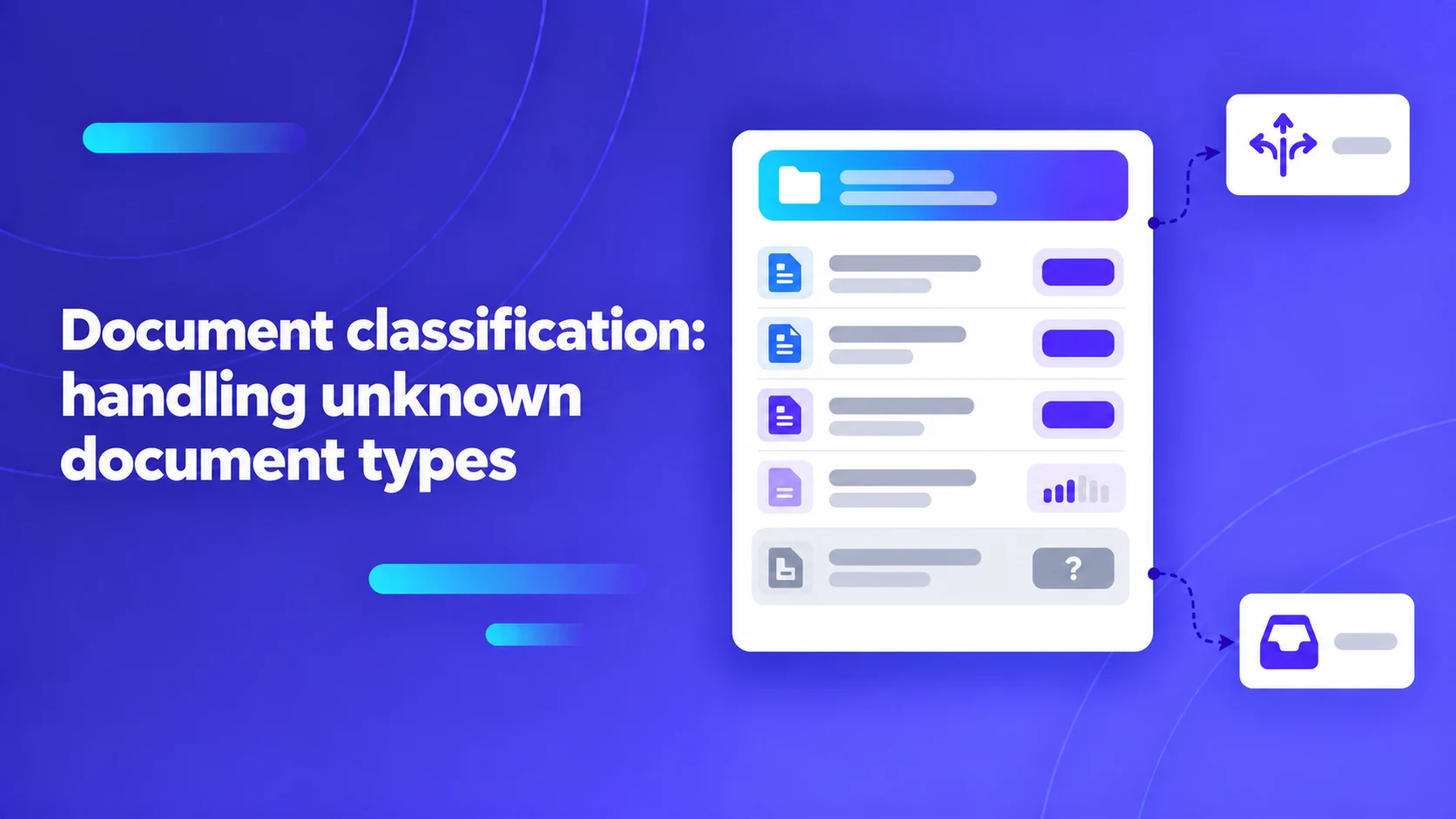
Document classification should be able to say that an incoming file does not fit a known type. Otherwise, a system can confidently send the wrong material into a specialized extraction process and return plausible fields from an unrelated document. The useful question is not simply “Which label wins?” It is “Is this document sufficiently understood to enter the next step?”
In production enterprise intake workflows—such as loan origination, insurance claims adjudication, and supplier onboarding—documents arrive from thousands of external parties without strict format controls. If an intelligent document processing pipeline operates under a "closed-world" assumption, its classifier is forced to assign one of a fixed set of pre-configured labels to every incoming file. Under this constraint, a real estate lease, an unsolicited sales catalog, or a blank cover sheet will inevitably be assigned to whatever trained class happens to receive the highest fractional softmax probability. The downstream extractor then hallucinates or forces unrelated text into structured fields, producing corrupted records that contaminate core databases.
Key Architecture Rule: Architect document intake classifiers for open-world operations. An explicit "Unknown / Abstain" decision route is not a system failure—it is a critical architectural safeguard that prevents out-of-distribution documents from triggering incorrect downstream automated actions.
Define categories by the decision they enable
Start with the work that follows classification. If certificates and application forms require different fields, rules or reviewers, distinguishing them can be useful. If two document labels both trigger exactly the same handling, maintaining separate classes may create work without improving the process.
Write a short operational specification for each class:
- Scope & Purpose: The exact transactional purpose and legal definition of the document type.
- Mandatory Structural Markers: Key textual phrases, layout structures, and graphical headers that verify the document's identity.
- Confusable Boundaries: Adjacent document types that share common vocabulary or visual styling but serve different business functions.
- Downstream Target: The specific extraction schema, automated validation rules, or review queues assigned upon classification.
A filename, an email subject line, or a visible enterprise logo can provide useful contextual hints, but should never serve as the sole justification for accepting a document. In production, customers frequently mislabel files when uploading, or reuse outdated templates with current branding.
Microsoft's custom-classification documentation highlights the necessity of handling inputs outside trained classes through confidence thresholding, negative sampling, and representative "other" classes. Incorporating out-of-distribution (OOD) detection into your classifier design from day one ensures that unexpected file types are handled gracefully rather than triggering pipeline crashes.
An illustrative application intake and failure taxonomy
Consider a commercial equipment leasing platform receiving registration packets from regional service partners. The platform expects three core document classes: an equipment registration form, an insurance liability certificate, and an equipment asset inventory schedule. The table below illustrates how incoming files should be routed based on operational requirements. The values below are deliberately synthetic and illustrative; they do not represent customer data or specific benchmark metrics.
| Incoming file artifact | Classified route | Operational rationale | Downstream failure if forced into a closed class |
|---|---|---|---|
| Completed registration form | class_registration | Contains canonical applicant entity fields and signature blocks. | (Normal operation: routes to registration extraction pipeline). |
| Insurance liability certificate | class_insurance | Features policy coverage bounds, underwriter stamps, and expiration dates. | (Normal operation: routes to compliance verification queue). |
| Equipment maintenance logbook | unknown_unsupported | Mentions equipment models and serials, but is an inspection history rather than an asset schedule. | If forced into class_equipment, maintenance timestamps will overwrite purchase dates. |
| Corrupted phone snapshot | unknown_unreadable | Low resolution, severe glare, and cut-off margins prevent reliable OCR. | If forced into any class, hallucinated values will slip into ERP master records. |
| Vendor marketing brochure | unknown_irrelevant | Unsolicited commercial overview containing no transactional data. | Wastes automated OCR credits and floods reviewer queues with junk records. |
| Merged registration & insurance PDF | packet_splitting_queue | Contains two distinct transactional documents bundled in a single file stream. | Single-class extraction extracts the first form and discards the second. |
Notice that an "unknown" outcome is not a monolithic wastebasket. The equipment maintenance log requires process engineering to evaluate whether a new intake class is warranted. The blurred phone photograph requires an immediate automated message to the partner requesting a legible scan. The multi-document PDF must be routed to a document packet splitting workflow.
Pro Tip: When deploying text-embedding or vision-embedding classifiers, establish an Out-of-Distribution (OOD) distance threshold. If the cosine similarity between an incoming document's embedding vector and the nearest class centroid exceeds your calibrated threshold, automatically route the document to the Unknown queue regardless of softmax probabilities.
Build a test set that includes near misses and negative controls
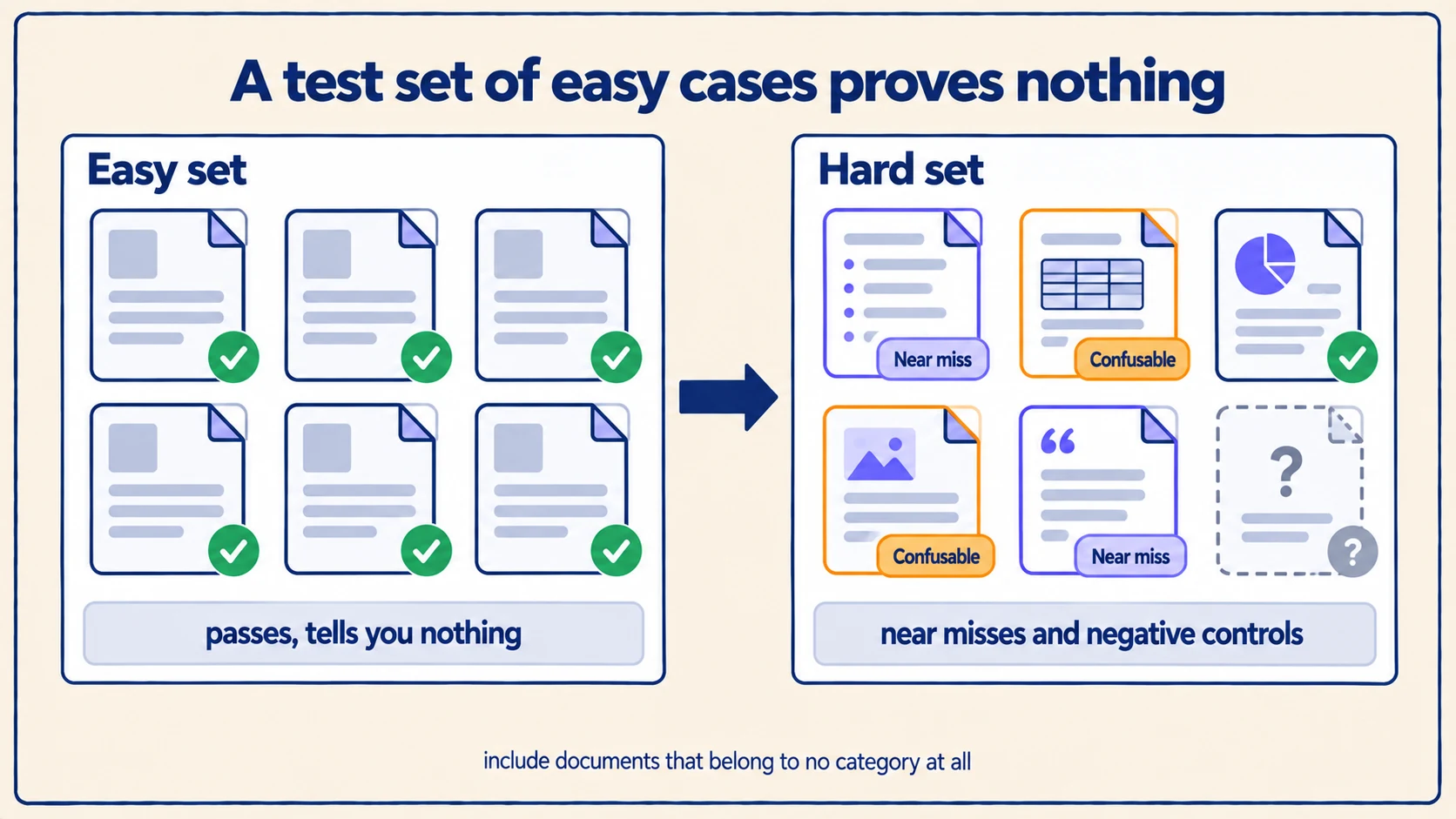
A classification evaluation suite that contains only clean, canonical examples of known classes cannot measure how the pipeline behaves in the presence of real-world noise. Construct an evaluation harness that deliberately challenges class boundaries:
- Near-Miss Samples: Documents that share significant vocabulary with valid classes (e.g., an insurance quote versus a binding insurance certificate).
- Format Variations: Outdated historical versions of current forms, regional state variants, and multi-lingual editions.
- Negative Controls: Completely irrelevant enterprise documents (invoices from office supply vendors, corporate newsletters, resumes, receipts).
- Physical Imperfections: Partial scans, missing pages, extreme skew angles, and documents with handwritten marginal notes.
Have domain experts label both the intended classification and the business consequence of misclassification before testing models. Where reviewers disagree on classification, the root issue is almost always an ambiguous business definition rather than a machine learning deficiency. When testing model behavior on unexpected document variations, follow our structured methodology for testing unfamiliar layouts.
Google's document classification evaluation documentation emphasizes constructing stratified test datasets and tracking class-level F1 scores, precision, and recall alongside confusion matrices.
Review routing confusion matrices, not aggregate accuracy
A single top-line metric like "98% classification accuracy" can conceal dangerous operational failures. An intake system that correctly classifies 9,000 standard registration forms but misclassifies 100 fraudulent or irrelevant attachments creates an unacceptable compliance risk.
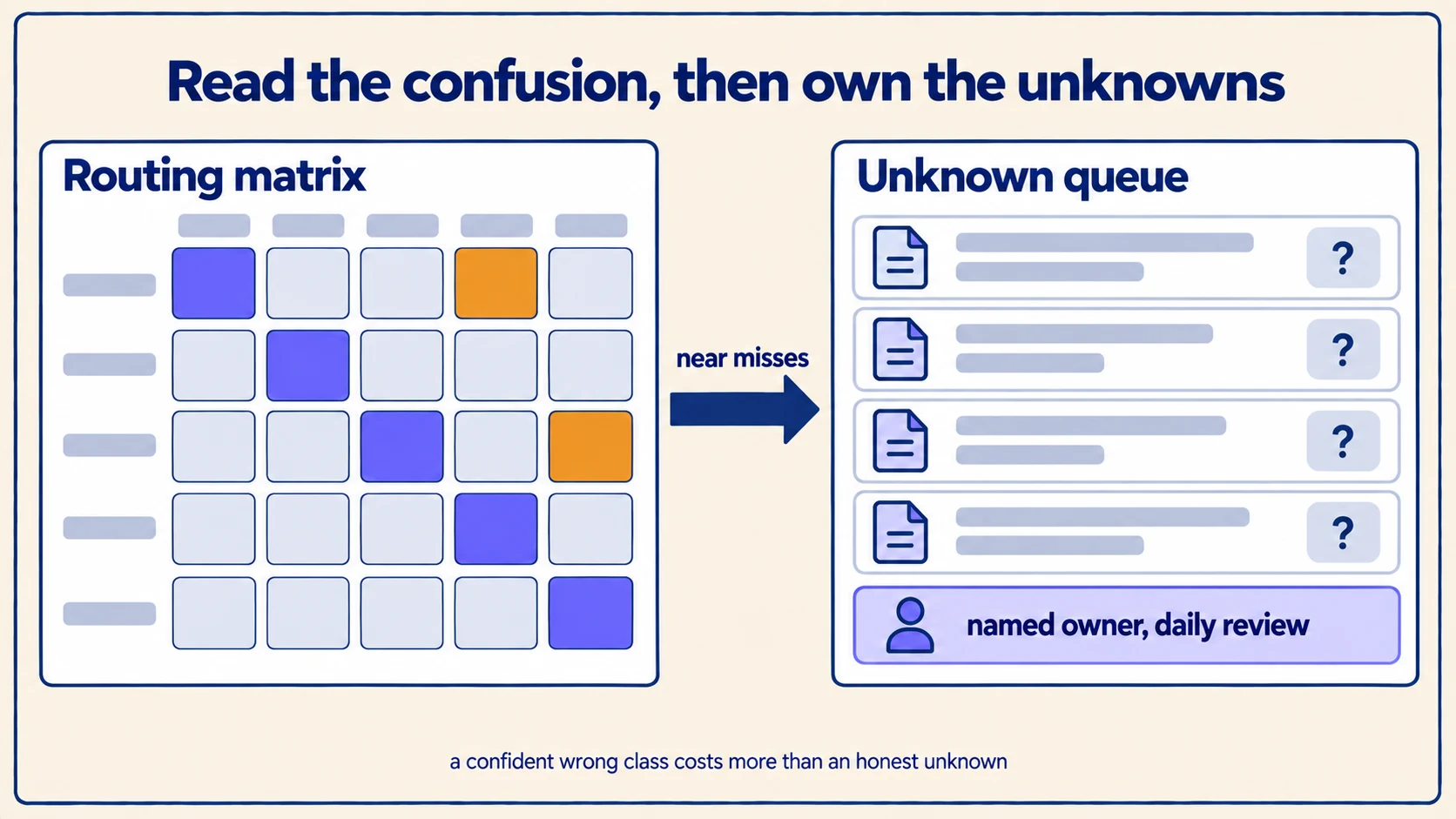
Construct a detailed confusion matrix that includes dedicated rows and columns for Unknown, Unreadable, and Out-of-Scope. When analyzing errors, evaluate the operational impact:
- False Acceptance (Type I Error): An irrelevant or unknown document is classified as a valid business form. The downstream extractor generates bogus records, creating silent data corruption in core databases.
- False Rejection (Type II Error): A valid document is routed to the
Unknownqueue. This creates human reviewer overhead, but completely preserves data integrity.
In enterprise architecture, False Acceptance is almost always orders of magnitude more damaging than False Rejection. Calibrate your classification confidence thresholds to prioritize precision over recall—favoring routing uncertain cases to review rather than risking automated misclassification.
Establish operational ownership for the unknown queue
An Unknown routing queue without operational ownership and strict service level agreements (SLAs) quickly becomes a black hole of stranded business transactions. Establish a rigorous operational runbook:
- Automated Reason Tagging: Automatically tag unknown documents with diagnostic indicators: low OCR confidence, embedding distance anomaly, missing mandatory anchor phrases, or multi-packet signature.
- Tiered Escalation Workflows: Direct unreadable scans to automated customer re-upload notifications; route novel or unclassified form variants to business analysts responsible for template curation.
- Taxonomy Drift Monitoring: Periodically cluster unknown documents using unsupervised semantic analysis. If hundreds of documents cluster tightly around a specific layout, this provides empirical justification to formalize a new document class.
- Auditable Security & Retention: Ensure unknown documents remain subject to standard corporate data retention and least-privilege access policies, rather than lingering indefinitely in temporary staging storage.
To design resilient, end-to-end document intake architectures, consult our comprehensive AI document-processing guide. Learn how our enterprise File store preserves document provenance and how our autonomous Agents manage complex intake pipelines. Then, schedule an enterprise architecture demo to evaluate open-world document classification on your organization's real-world document mix.