Human approval for AI agents: what reviewers need to see
Design action reviews that show the target, proposed change, authority, and consequences, then test edits, expiry, rejection, and execution results.

Sarath Chandran
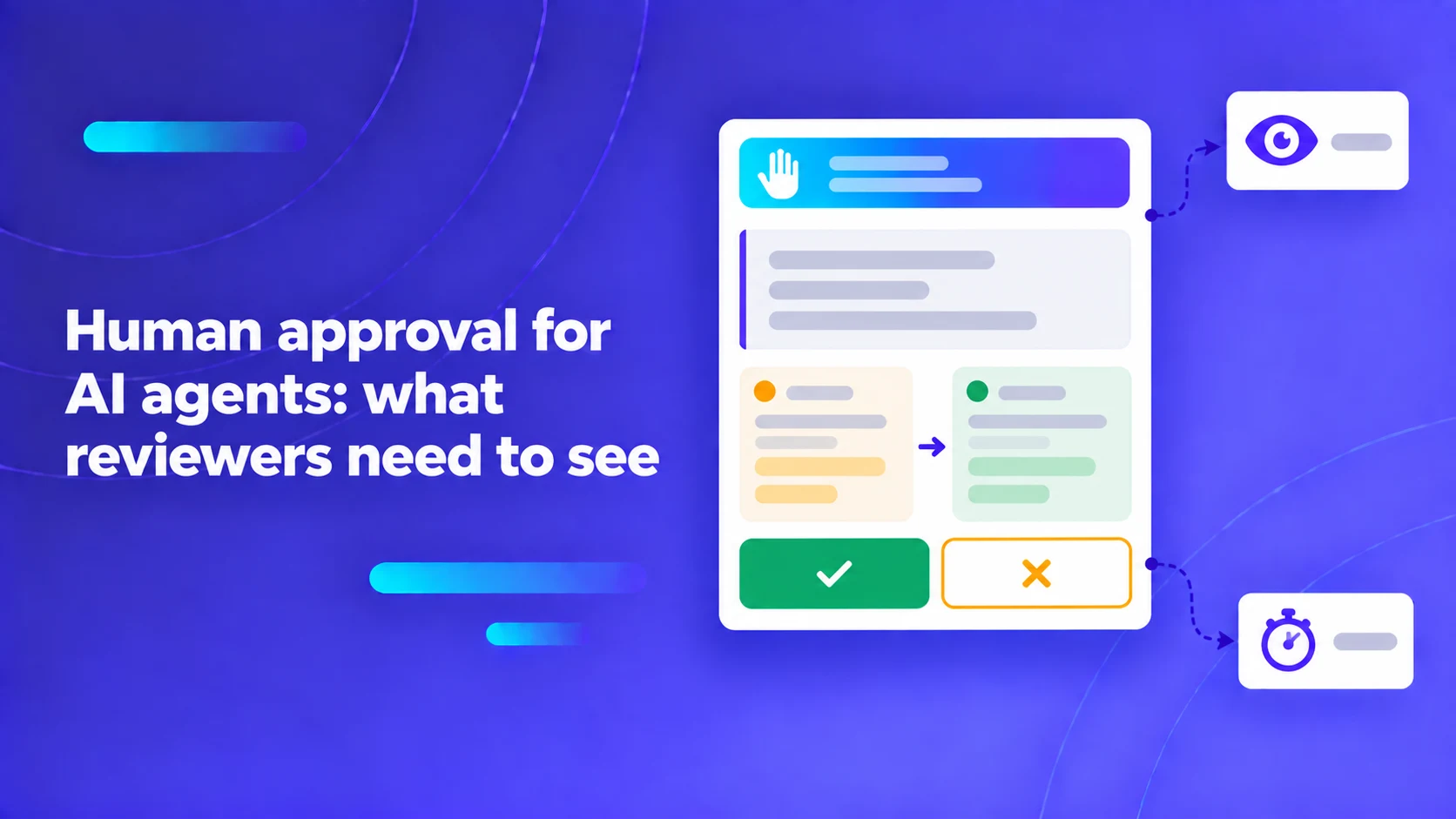
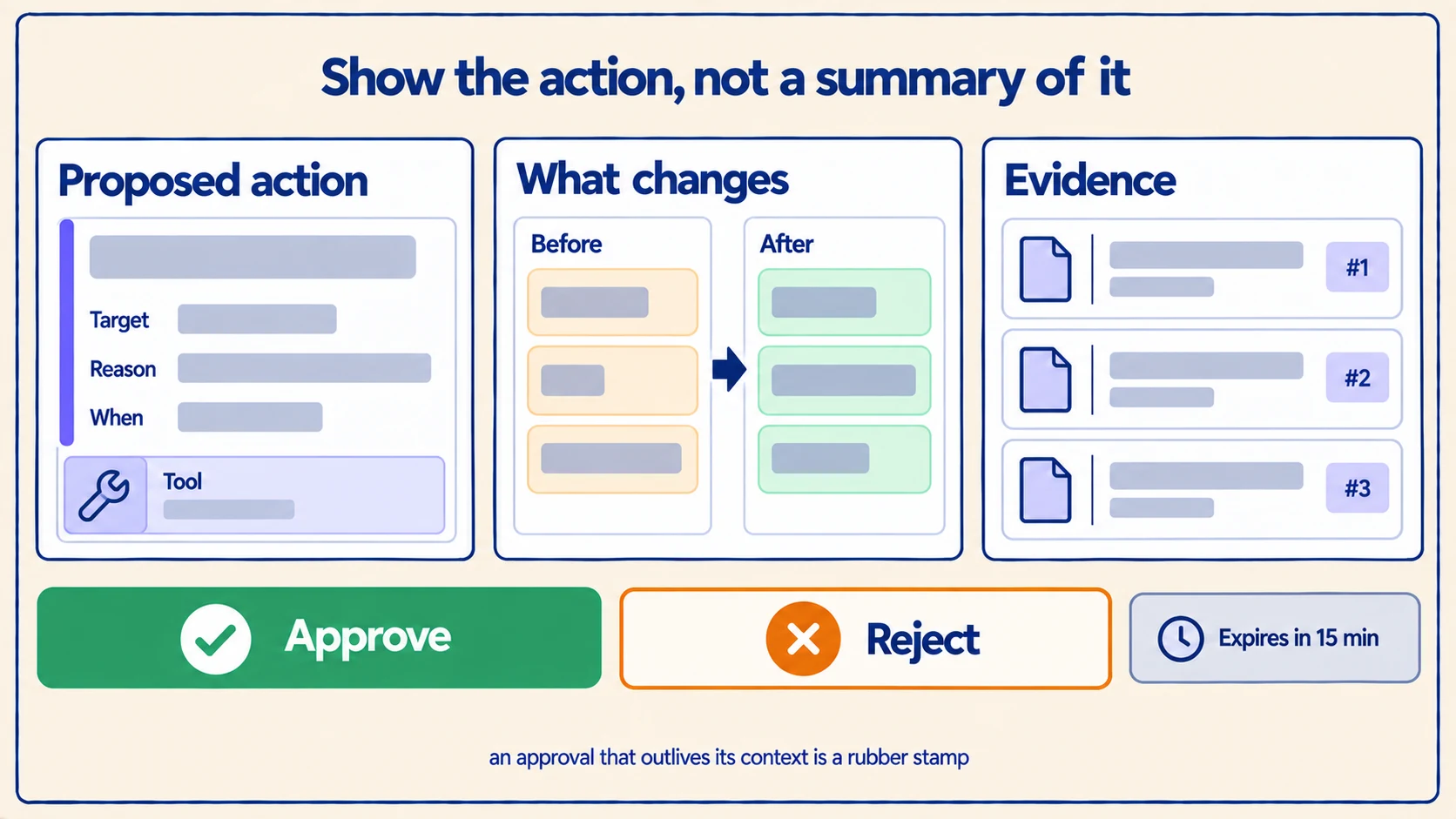
Human approval for AI agents is effective only when a human reviewer can inspect a concrete, fully resolved action payload before it executes against production systems. Meaningful oversight requires displaying the exact mutations to be performed, the target systems and identities involved, the supporting evidence cited by the agent, and the specific decision boundary being crossed. Presenting a generic prompt such as “The assistant wants to update records—do you wish to proceed?” forces operators to guess, inducing approval fatigue and transforming a critical safety control into a rubber-stamp liability.
Approval gates must operate on explicit, bounded scopes rather than blanket delegations. Permission to investigate an operational anomaly, permission to compile an incident briefing, and permission to execute a database state change represent fundamentally distinct authorization boundaries. A resilient autonomous agent architecture decouples draft synthesis from production execution, enforcing structured verification at each transitional checkpoint.
[!IMPORTANT] A human approval prompt does not compensate for weak system-level permissions. If an agent tool possesses write access to an entire enterprise database, requesting a human confirmation before running an unparameterized query introduces severe operational risk. Human oversight must always serve as a secondary defense layer layered on top of strictly scoped, role-based tool credentials and runtime parameter validations.
Put the proposed action in front of the reviewer
When an autonomous assistant prepares an external communication, database mutation, or financial transaction, the operator interface must surface the exact payload rather than a conversational summary. Summaries obscure subtle hallucinations, parameter discrepancies, and unauthorized scope expansions. The following synthetic evaluation matrix illustrates the minimum information requirements for a high-risk agent action review:
| Review field | Operational requirement | Example synthetic review payload | Triage verification check |
|---|---|---|---|
| Action Identifier | Canonical API operation or tool routine | crm.billing.issue_credit_memo | Verify that the routine matches the intended workflow step |
| Destination Target | Explicit resource URI or account identity | account_id: ACC-94812 (North American Logistics) | Check that the target ID corresponds to the active case record |
| Proposed Payload | Exact parameter diff and formatted body | amount_cents: 14500, reason_code: SLA_BREACH_Q3 | Confirm that amounts and reason codes match contractual rules |
| Acting Identity | Execution principal and delegated service role | svc-agent-crm-tier2 (on behalf of reviewer: j.doe) | Ensure execution credentials cannot escalate reviewer rights |
| Grounding Citations | Document identifiers supporting the decision | contracts/2026/NAL-MSA-v4.pdf (Clause 8.2, p. 19) | Inspect citation offsets to verify claim veracity |
| Rollback Capability | Automatic reversal or compensatory operation | crm.billing.void_credit_memo | Validate that the operation can be undone if errors appear |
| Review Options | Explicit decision actions for operator | Approve Exact, Edit Parameters, Reject with Note | Require positive selection; reject by default on timeout |
Showing only high-level natural language such as “Approve $145 refund” hides whether the underlying tool payload addresses the correct customer account or contains malformed currency codes. The reviewer must be positioned to identify subtle discrepancies, including misallocated accounts, unvetted attachments, or hallucinated contractual commitments.
In their technical guidance on autonomous architectures, the LangChain human-in-the-loop documentation demonstrates how interruptible execution graphs pause tool invocation steps to await human intervention, review, parameter modification, or outright abort signals. The architectural objective is to bind the human decision directly to the serialized execution state rather than an open-ended conversational context.
Decide which actions require a human gate
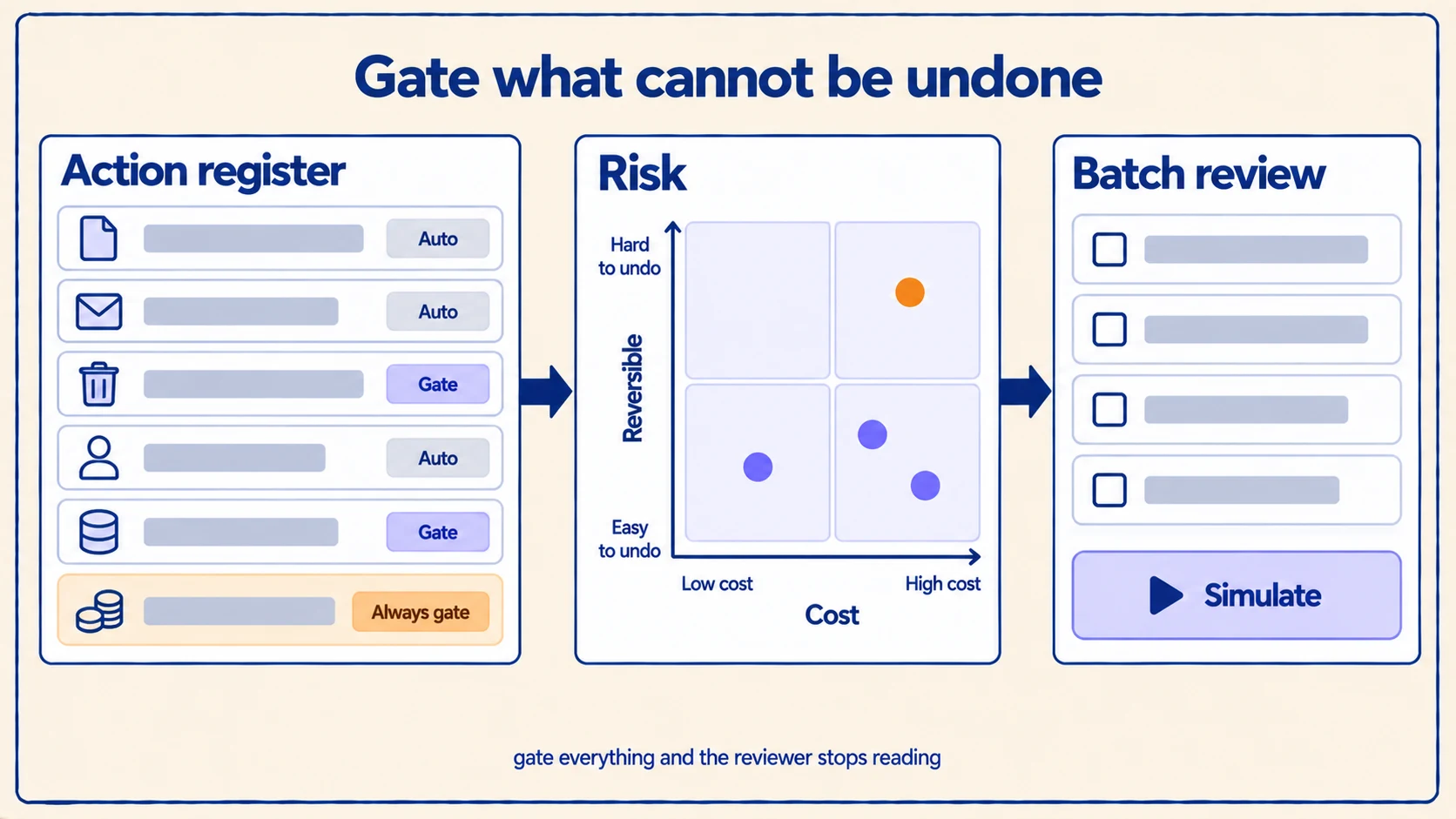
Implementing human confirmation for every benign agent action rapidly destroys user productivity and degrades vigilance. Organizations should establish an objective risk classification framework to determine which tool invocations must block for review and which may execute autonomously.
1Agent Intent Detected2 │3 ▼4[Risk Triage & Classification]5 │6 ├─────────────────────────────────────────┐7 ▼ ▼8[Tier 1: Read-Only / Private Drafts] [Tier 2: Reversible Internal Updates]9 │ │10 ▼ ▼11Autonomous Execution Permitted Soft Gate (Async Notification / Audit)12(Vector Search, Local Synthesis) (Draft Ticket Creation, Internal Note)13 │14 ┌─────────────────────────────────────────┘15 ▼16[Tier 3: Irreversible / External Mutations]17 │18 ▼19Hard Gate Required (Synchronous Pause)20(Customer Emails, Wire Transfers, DB Drops, IAM Revocations)21 │22 ├── Timeout / Invalidation ──► Abort & Abstain23 └── Approved ──► Ephemeral Execution Token Issued ──► ExecuteTo structure this classification, systems engineers should inventory all registered agent tools against four operational dimensions:
- Reversibility: Can the action be rolled back without external business impact? Reading a file or generating a private document draft is completely reversible. Sending an external email, firing a production webhook, or initiating a ledger debit is non-reversible or carries substantial compensatory costs.
- Blast Radius: How many records, systems, or users are affected by an erroneous execution? Updating a single support ticket tag has a low blast radius; mass-updating permissions across an organizational unit has an extreme blast radius.
- Data Sensitivity: Does the operation expose regulated, proprietary, or personal data to outside environments? Operations that transmit customer records across perimeter boundaries demand mandatory gates.
- Model Uncertainty: Does the underlying reasoning exhibit high entropy, contradictory source data, or edge-case classification scores? When confidence drops below defined thresholds, an otherwise automated action should fall back to human verification.
The OWASP Top 10 for LLM Applications guide on excessive agency emphasizes that human-in-the-loop controls must not serve as a singular safeguard against overprivileged models. Tool design must incorporate strict runtime parameter constraints, least-privilege API scopes, and downscoped execution contexts alongside human review.
Preventing approval reuse and state drift
A dangerous vulnerability in multi-turn agent systems occurs when an approval granted for a specific payload is repurposed across mutated state. Consider an autonomous agent assisting with quarterly supplier reviews:
- The agent compiles an email summarizing supplier performance and requests human approval to dispatch the notification to
contact-a@supplier.com. - The operator inspects the proposed draft and clicks Approve.
- While the execution payload sits in the task queue, a secondary background workflow finishes re-evaluating supplier metrics, prompting the agent to silently append
legal@supplier.comand replace an attached compliance scorecard with an unverified draft. - The orchestration runner executes the tool using the original approval token.
In this scenario, the executed action violates the human operator's intent. The approval covered an exact, static snapshot; the runtime execution dispatched a modified payload to unintended recipients.
1[Agent Proposed Payload: v1] ──► [Reviewer Approves] ──► Cryptographic Digest Generated: SHA256(v1)2 │3 ▼4[Model / Context Mutates Payload: v2] ────────► [Execution Dispatcher Compares Digest]5 │6 ▼7 SHA256(v2) != SHA256(v1)8 │9 ▼10 [EXECUTION HALTED: State Drift Error]To eliminate state drift vulnerabilities, production architectures should enforce the following operational guardrails:
[!TIP]
Bind every approval token to a cryptographic hash of the exact tool name, target endpoint, and serialized argument payload (SHA-256(action + target + args)). Before executing the downstream API call, the execution runner must re-compute the hash of the payload about to be sent. If the hashes differ by even a single byte, the runner must invalidate the token, halt execution, and alert the reviewer that the underlying proposal has drifted.Furthermore, all approval tokens must have a defined time-to-live (TTL). If an operator leaves an approval request open in their queue for four hours, upstream context (such as account status, market pricing, or inventory availability) may change dramatically. When an approval token exceeds its TTL, the system must automatically expire the request, discard the queued action, and require the agent to re-evaluate the task under fresh operational context.
Treating edits and rejections as structured feedback
When a human reviewer intervenes in an agent workflow, their response is rarely a binary yes-or-no switch. Real-world operational review produces three distinct branches:
1. Direct approval of the exact payload
The reviewer validates the serialized arguments without alteration. The system issues an ephemeral, single-use execution credential, invokes the downstream tool, and records the approving operator's identity in the audit trail.
2. Human-in-the-loop parameter editing
Frequently, an agent's proposal is conceptually correct but contains minor factual or stylistic flaws—for instance, an incorrect date format, an awkward phrase, or an omitted CC address. Forcing the reviewer to reject the action entirely and prompt the model again introduces frustration and non-deterministic behavior.
Instead, the review interface should enable operators to edit the arguments directly within the review modal. When an edit occurs, the execution record must capture both the original agent-generated proposal and the final human-adjusted payload. The workflow executes the edited version immediately, feeding the delta back into the context window as a structured correction so subsequent reasoning steps recognize the change.
3. Rejection with structured triage reasoning
If an operator rejects an action, the agent must not enter a repetitive loop where it rephrases the identical proposal and presents it again. The rejection event must return a machine-readable failure reason to the agent's orchestrator:
1{2 "approval_status": "rejected",3 "action_id": "act_8849204",4 "tool_name": "crm.billing.issue_credit_memo",5 "rejection_code": "INCORRECT_POLICY_CITATION",6 "reviewer_feedback": "Credit memo exceeds allowable Q3 threshold of $100 without manager co-sign. Re-evaluate using standard tier-1 concession.",7 "resubmission_allowed": true8}Receiving this structured feedback enables the agent to replan: it can adjust the credit memo amount, consult the appropriate policy documentation, or abstain from further automated action if human escalation is required.
Decoupling approval records from execution results
A pervasive architectural error is treating the status approved as synonymous with completed. Human authorization represents an intent; it does not guarantee that the downstream technical transaction succeeds.
Consider what occurs when an approved action fails during runtime:
- An approved database write fails due to an unexpected unique constraint violation.
- An approved external webhook times out due to third-party network degradation.
- An approved batch transaction executes partially, updating two out of five targeted records before failing.
If the audit log simply marks the task as “Approved by Jane Doe,” compliance auditors and incident response teams cannot determine whether the state change actually took place. As detailed in our analysis of partial agent failure handling, multi-step agent systems must maintain an unambiguous state machine:
1[Proposed] ──► [Pending Review] ──► [Approved] ──► [Execution Dispatched]2 │ │ │3 │ ├─► [Rejected] ├─► [Succeeded]4 │ │ │5 │ └─► [Expired / Timed Out] ├─► [Failed / Retried]6 │ │7 └─► [Abstained / Cancelled] └─► [Partially Completed]Every state transition must emit an immutable log event recording the timestamp, the acting principal (agent or human), the payload hash, and the downstream response code. This rigorous separation forms the foundation of a defensible action audit trail, ensuring full operational traceability under forensic inspection.
Preventing approval fatigue through batched review and simulation
Human-in-the-loop controls fail when reviewers become overwhelmed by low-value notifications. Approval fatigue causes operators to blindly click approval buttons without scrutinizing payloads, defeating the entire safety mechanism.
Engineering teams can mitigate approval fatigue through two primary mechanisms:
Pre-execution dry runs and visual simulation
Before requesting human sign-off, the agent orchestrator should execute a deterministic dry-run where possible. For SQL operations, this means running an EXPLAIN query or executing within an isolated transaction rollback to measure affected row counts. For document generation, it means rendering the final PDF or email markup in an inline visual sandbox. Presenting the reviewer with a visual representation of the final artifact drastically reduces cognitive overhead compared to raw JSON payloads.
Intelligent aggregation of low-risk sibling actions
When an agent processes multi-item tasks—such as reconciling forty vendor invoices against purchase orders—presenting forty individual confirmation modals guarantees approval fatigue. Instead, the orchestrator should group homogeneous, low-variance actions into a unified review queue. The interface highlights statistical outliers (such as invoices with unmatched line items or amounts exceeding standard standard deviations) while permitting batched sign-off for items that fully comply with deterministic validation rules.
Step-by-step verification checklist for approval gates
Before deploying an autonomous agent workflow with human approval controls into production, execute the following diagnostic test suite across a non-production staging environment:
- Unapproved Execution Prevention: Verify that when a human reviewer takes no action, the agent cannot bypass the gate via alternate tool pathways or direct API calls.
- Payload Tamper Resistance: Modify the underlying arguments in transit between approval issuance and tool dispatch. Confirm that the cryptographic verification catches the mismatch and aborts execution.
- Timeout and Abandonment Behavior: Allow an approval prompt to exceed its TTL window. Verify that the system transitions the state to
expired, abstains from execution, and gracefully informs the user. - Rejection Recovery Cycle: Reject an agent proposal with explicit feedback. Verify that the agent incorporates the feedback into its context window without repeating the rejected tool call.
- Privilege Boundary Enforcement: Attempt to approve a high-risk financial transaction using an operator account that lacks financial signing authority. Verify that the approval interface enforces enterprise IAM role validation before accepting the decision.
- Network Failure Resilience: Simulate a network disconnection during execution dispatch after approval is granted. Confirm that the system records the transaction as
unresolvedrather than reporting false success.
Operational governance and continuous monitoring
Human approval workflows should not remain static. As autonomous models improve and organizational confidence grows, teams should continuously analyze review metrics to calibrate approval boundaries:
- Reviewer Response Latency: High latency indicates that approval gates are blocking critical business workflows, signaling the need for better notification routing or asynchronous handoffs.
- Intervention and Edit Rates: A tool that experiences zero human rejections or edits across thousands of invocations is a prime candidate for demotion to autonomous background execution with retroactive auditing. Conversely, a tool with high edit rates indicates that the agent's prompts, grounding data, or parameter schemas need refinement.
- Rejection Reason Distribution: Aggregating operator feedback categories highlights recurring systemic issues—such as out-of-date documentation, flawed policy documents, or ambiguous user instructions.
To establish comprehensive evaluation criteria for your organization's autonomous workflows, consult our enterprise knowledge assistant evaluation guide. To explore how our platform implements robust human-in-the-loop guardrails, audit logging, and role-based access control, explore Exemplary AI Agents, review our governance architecture at Management, and book a personalized enterprise demo.