Updating self-hosted AI: what to test before changing versions
Plan version compatibility, representative task checks, migration rehearsals, and rollback decisions before updating a self-hosted AI deployment.

Sarath Chandran
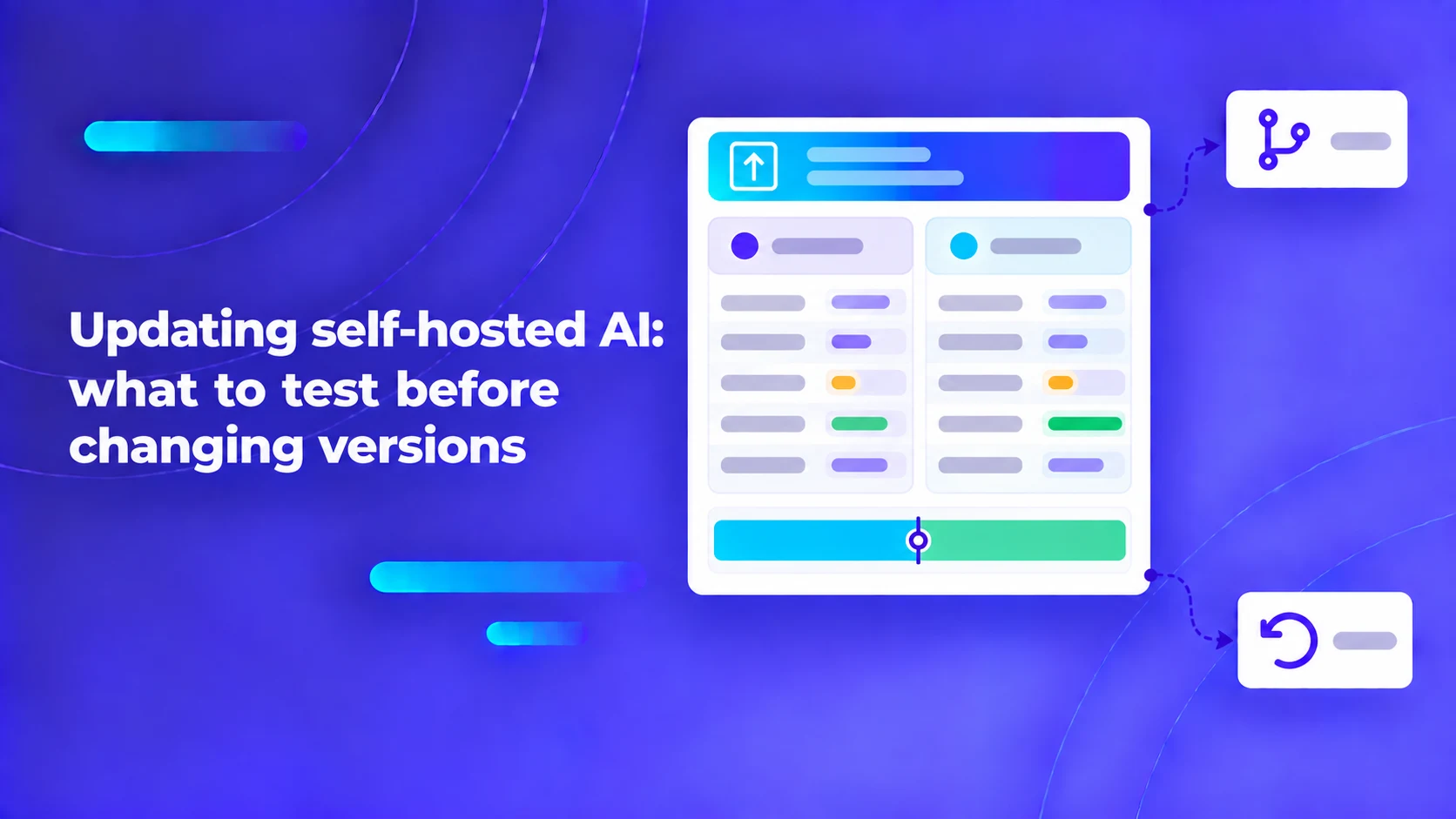
A self-hosted AI update can change more than the application version. Model behavior, serving compatibility, document parsing, tool interfaces, and stored data may all be affected. The safest decision comes from testing the proposed combination and its recovery path before production changes.
In conventional enterprise software engineering, updating a web service or microservice involves standard regression suites, database schema migrations, and canary deployments. In self-hosted generative AI platforms, updates introduce non-deterministic behavioral shifts that defy traditional unit tests. Upgrading an underlying LLM weight checkpoint from version 1.0 to 1.1 might fix a reasoning bug while silently breaking delicate few-shot prompt templates, altering JSON schema compliance, or causing system prompts to become overly conversational. Even more catastrophically, upgrading an embedding model invalidates every existing vector in your vector database—requiring complete re-indexing before the application can function.
Key Architecture Rule: Never treat an AI platform update as a simple container image bump. An update to an enterprise AI stack must be evaluated across three decoupled planes: Infrastructure & Runtime Compatibility (CUDA, drivers, memory), Transactional State & Schemas (databases, vector indices), and Semantic Model Behavior (prompt fidelity, tool calling, grounding accuracy).
The catastrophic hidden hazards of AI platform updates
Platform engineering teams frequently encounter severe regressions when deploying updates that appeared minor in vendor release notes:
- Embedding Space Invalidation: If an update changes the text embedding model (e.g., from
bge-large-en-v1.0tov1.5), the mathematical geometry of the high-dimensional vector space changes entirely. Running a similarity search between a new query vector and legacy document vectors yields total gibberish. An embedding model update requires an atomic rebuild of the entire vector database or dual-index staging. - Tokenizer Vocabulary Shifts: Even minor model weight updates can alter special tokens (
<|im_start|>,<|eot_id|>). If your orchestration layer passes hardcoded special token markers that the new tokenizer rejects or misinterprets, prompt boundaries collapse, triggering prompt injection vulnerabilities or runaway generation loops. - Structured Tool Calling Schema Drift: Upstream model updates frequently alter how models invoke function tools. A model that reliably emitted valid RFC-8259 JSON for autonomous agent tools may suddenly begin wrapping JSON in conversational pleasantries or markdown backticks, crashing downstream API parsers.
- CUDA Driver & Kernel Incompatibilities: Updating the model serving engine (e.g., vLLM or TensorRT-LLM) often requires newer CUDA runtime libraries that conflict with the physical bare-metal host GPU drivers, halting cluster initialization.
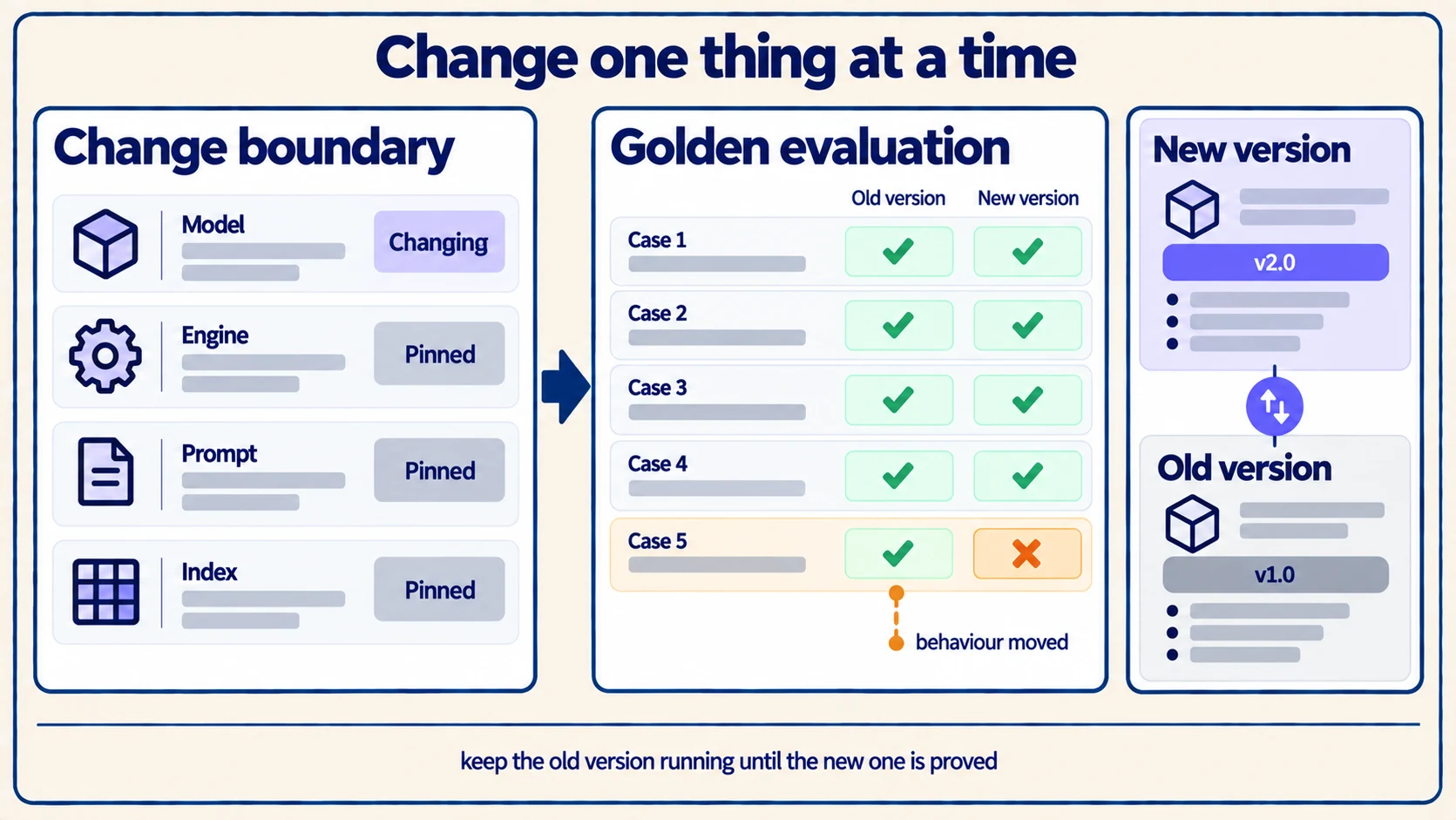
Establish an immutable change boundary matrix
Before scheduling any maintenance window or updating staging environments, platform engineers must document the exact delta across all six tiers of the AI platform stack. The table below illustrates an enterprise compatibility matrix. The values below are deliberately synthetic and illustrative; they do not represent proprietary product releases or vendor benchmarks.
| Subsystem tier | Baseline production state | Candidate update state | Mandatory pre-flight verification requirement |
|---|---|---|---|
| Application Middleware | Release v2.4.1 (Digest sha256:4a1..) | Release v2.5.0 (Digest sha256:8f9..) | Dry-run database migrations against production schema snapshot. |
| Foundational LLM | Model Llama-3-70B-v1.0 (FP16) | Model Llama-3-70B-v1.1 (FP8) | Run 500-sample semantic evaluation harness; score schema adherence. |
| Serving Runtime Engine | vLLM 0.4.2 (CUDA 12.1) | vLLM 0.5.1 (CUDA 12.4) | Verify physical host NVIDIA driver compatibility (>= 535.104). |
| Text Embedding Model | BAAI bge-base-en-v1.5 | BAAI bge-base-en-v1.5 (Unchanged) | Confirm vector index requires no re-indexing or migration. |
| Document OCR Engine | PaddleOCR v2.6 | Custom Vision Transformer v1.0 | Benchmark CER/WER and layout accuracy across 100 sample PDFs. |
| Relational Schema | PostgreSQL Schema rev_48 | PostgreSQL Schema rev_49 | Verify rollback downgrade migration script executes cleanly. |
Documenting this change boundary prevents the classic operational mistake of bundling five major version jumps into a single release, which makes attributing failures impossible when errors occur.
Establish a golden semantic evaluation baseline
Before installing a candidate release in staging, engineering teams must establish an empirical performance baseline on the current, active production environment. Traditional software tests assert binary booleans (assert result == expected); generative AI requires probabilistic semantic evaluation.
Construct a Golden Evaluation Suite comprising 100 to 500 curated enterprise queries that reflect real-world user workflows:
- Direct Factual Grounding (RAG): Questions with known reference documents where the model must cite exact clauses.
- Strict JSON Schema Emission: Prompts demanding complex structured extractions, validating that outputs strictly conform to JSON Schema definitions without syntax errors.
- Negative & Adversarial Controls: Prompts where source context is missing, verifying that the candidate model abstains gracefully rather than hallucinating answers.
- Tool Invocations: Agent prompts requiring multi-step tool calls, verifying that tool names and parameter dictionaries match API contracts.
Dify's storage and migration architecture reference emphasizes the vital relationship between application migrations, database integrity, and storage volumes during self-hosted updates.
Evaluate the candidate model against this golden suite using automated evaluation harnesses (e.g., LLM-as-a-judge scoring, ROUGE/BERTScore, and strict JSON parsers). A candidate model that achieves a higher MMLU academic benchmark but degrades your enterprise JSON extraction accuracy from 99% to 92% is an unacceptable regression that must be blocked.
Pro Tip: In continuous integration (CI/CD) pipelines, configure automated assertion gates: if a candidate model update causes more than 1% regression on your golden JSON schema validation suite or increases latency by more than 15%, automatically fail the build and halt deployment.
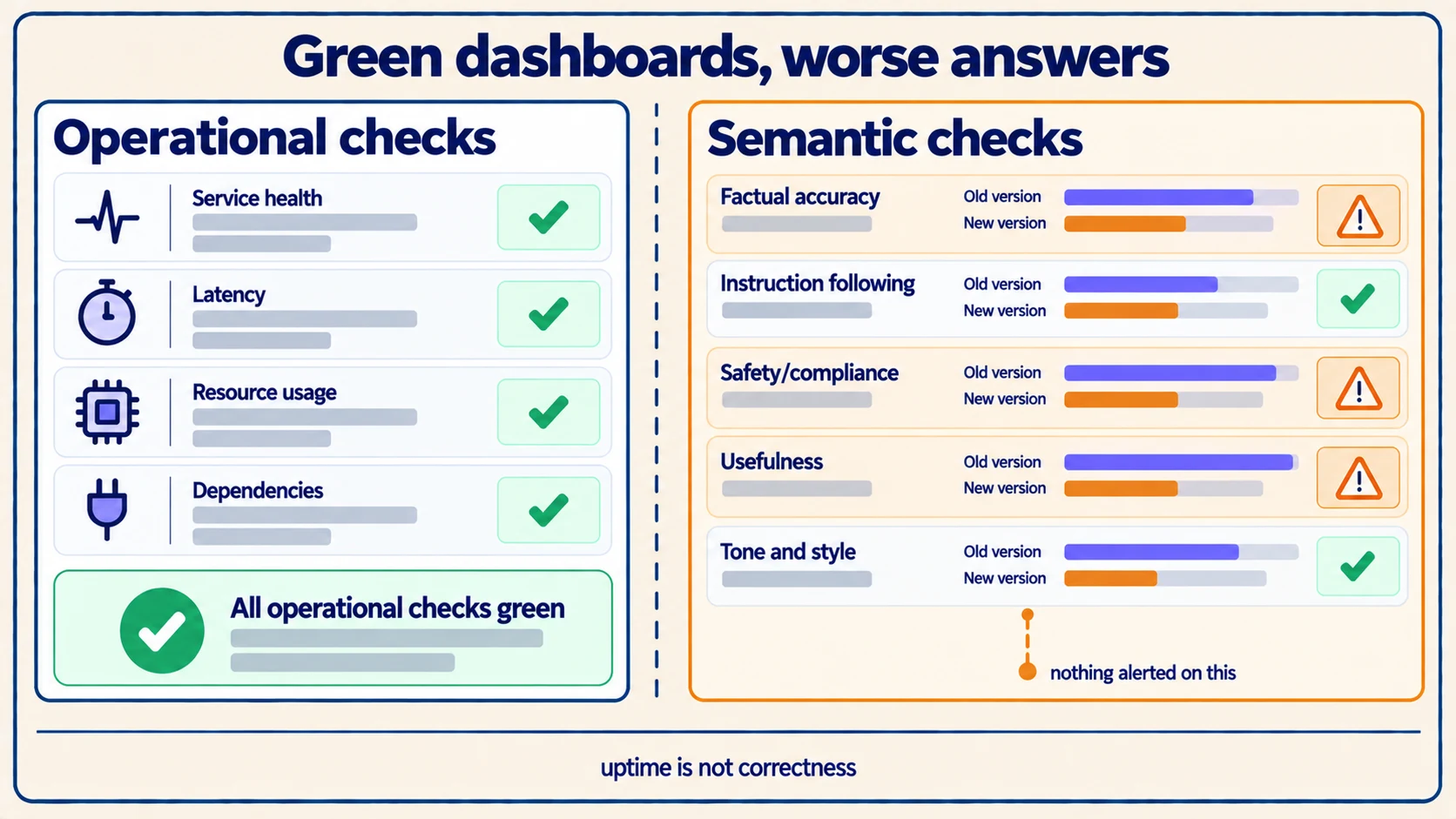
Separate behavioral evaluation from operational stability checks
An updated platform release can produce brilliant natural language answers while harboring critical infrastructure defects. Similarly, a container can boot with flawless health checks while producing broken, hallucinated responses.
To ensure stability, test operations and behavior across two isolated verification tracks:
The table below outlines the specific verification questions and required evidence across both operational tracks.
| Verification track | Primary diagnostic question | Required empirical evidence |
|---|---|---|
| 1. Operational Stability | Does the platform boot, allocate VRAM, and scale reliably? | Container startup logs, GPU VRAM allocation graphs, zero OOM errors. |
| 2. Interface Adherence | Do existing client SDKs and API gateways connect without errors? | HTTP 200 responses, streaming SSE protocol compliance, valid headers. |
| 3. Throughput & Latency | Does the candidate release satisfy agreed SLO percentiles? | P95 TTFT, Inter-Token Latency, tokens-per-second load curves. |
| 4. Semantic Fidelity | Does the model answer questions accurately without regression? | Golden dataset evaluation score, hallucination rate, citation accuracy. |
| 5. Disaster Recovery | Can the platform be rolled back to the previous release cleanly? | Demonstrated clean rollback drill executing within 15 minutes. |
The NVIDIA benchmarking metrics reference provides standardized definitions for measuring latency distributions under load, ensuring that performance comparisons between software versions remain mathematically sound.
Architect for zero-downtime blue/green rollbacks
A common disaster in self-hosted operations is assuming that rolling back an update simply requires running docker-compose down and docker-compose up with the old image tag.
If an application update applied database schema migrations that altered table columns, deleted foreign keys, or changed vector dimensionality, rolling back the container image leaves an old application connected to an incompatible database, resulting in immediate catastrophic downtime.
To ensure painless rollbacks:
- Enforce Backward-Compatible Migrations: All database migrations must follow the Expand/Contract pattern. New database columns must be additive and nullable. The old application version must be capable of running against the newly migrated schema without errors.
- Deploy Blue/Green Serving Replicas: Maintain the "Blue" (current) model serving cluster online while deploying the "Green" (candidate) cluster in parallel.
- Execute Canary Traffic Shifting: Route 5% of internal non-critical user traffic to the Green cluster. Monitor error rates, token latency, and user feedback for 24 hours.
- Instantaneous Cutover & Rollback: Shift 100% of ingress traffic to Green via load balancer routing. Keep the Blue cluster fully warmed in VRAM for at least 48 hours. If an unforeseen defect emerges, cut traffic back to Blue instantaneously with zero data loss.
Review our companion guide on private AI backup and recovery to ensure that cold disaster recovery snapshots are taken immediately prior to initiating any production update.
Rehearse updates in air-gapped and disconnected enclaves
In sovereign, air-gapped facilities, software updates cannot be pulled dynamically from Docker Hub or Hugging Face during maintenance. Update packages must be staged, transferred via physical media, and validated offline.
Key air-gapped update protocols:
- Package Transitive Dependencies: Ensure the update bundle includes updated base OS packages, container layers, Python wheels, and model weights.
- Banish Hidden Caches: Verify the update on a clean staging node with zero local cache directories to guarantee that missing assets do not cause silent failures.
- Audit Outbound Probes: Monitor system logs to verify that newly introduced libraries do not attempt outbound network calls or license checks, as detailed in our guide on air-gapped AI operating requirements.
To explore how our platform architecture supports seamless lifecycle upgrades, review ExemplaryAI’s sovereign deployment options and schedule an enterprise architecture demo to evaluate automated update testing and canary deployment workflows.