Air-gapped AI deployment: requirements beyond installation
Plan the model artifacts, software dependencies, transfer process, updates, and recovery checks an air-gapped AI service needs after installation.

Sarath Chandran
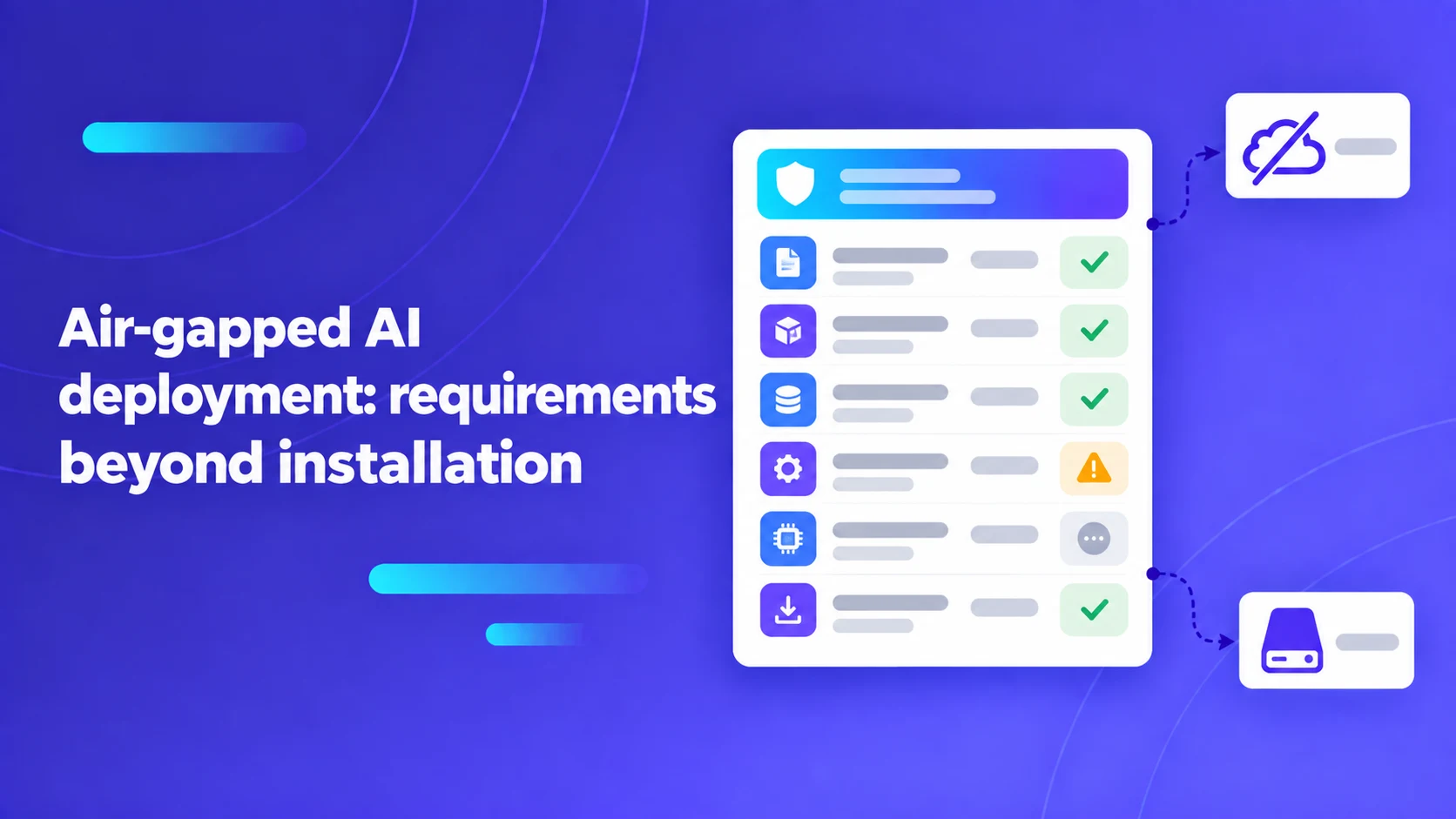
An air-gapped AI deployment needs a complete operating process, not just a model that runs locally. The service must start, process its intended inputs, recover after failure, and receive controlled updates without reaching public services. A successful installation proves only one part of that lifecycle.
In defense agencies, national intelligence facilities, semiconductor research labs, critical power utilities, and core banking infrastructure, data security policies mandate complete physical and cryptographic isolation. These enclaves cannot tolerate outbound telemetry, cloud-based API inference calls, or external package registry lookups. However, deploying modern generative AI systems into an air-gapped environment introduces immense operational friction. Modern AI frameworks are engineered under the assumption of ubiquitous, high-speed internet access—frequently attempting to download missing tokenizer files, query cloud license servers, check remote certificate revocation lists, or stream pre-trained weights on demand. When these systems are booted inside a strictly severed network, invisible dependencies trigger cascading startup failures, memory segmentation faults, or silent performance degradation.
Key Architecture Rule: An air-gapped deployment is an operational ecosystem, not a static software installation. Every software binary, container image, model weight shard, tokenizer configuration, Python dependency, and cryptographic certificate must be inventoried, signed, and validated prior to physical ingestion into the enclave.
Define what "offline" and "air-gapped" mean for your operational perimeter
Before architecting infrastructure or purchasing hardware, systems architects must establish an unambiguous definition of the operational boundary. In enterprise marketing, terms like "on-premises," "private cloud," and "air-gapped" are frequently used interchangeably, yet they represent fundamentally distinct security postures.
The National Institute of Standards and Technology (NIST) formally defines an air gap as a physical separation across a strictly enforced boundary, where data can only traverse via controlled, audited manual media transfers or hardware-enforced unidirectional optical data diodes, as outlined in the NIST Computer Security Resource Center glossary. Merely placing a cloud firewall rule that blocks outbound port 443 on a standard virtual machine does not constitute an air gap; that is a restricted network partition vulnerable to misconfiguration or side-channel leakage.
Organizations must document three distinct operating boundaries:
- Strict Physical Air Gap: No physical or wireless network connection exists between the enclave and any external network. Software and data enter exclusively via encrypted, physically transported media (e.g., optical discs or hardware-encrypted storage) subjected to multi-stage malware scanning stations.
- Unidirectional Hardware Data Diode: Optical hardware allows data to flow strictly into the enclave via a single physical fiber-optic strand (transmit-only to receive-only). No electrical or optical return path exists, mathematically eliminating the possibility of data exfiltration.
- Restricted Egress Enclave: The environment resides on an internal enterprise corporate network with strictly controlled, authenticated forward proxies and zero direct internet routing.
Document whether your air-gap requirements govern normal runtime inference, maintenance updates, automated disaster recovery, or all three operational phases. If an AI platform requires an external internet connection during initial cluster setup or license activation, that platform is not air-gap compatible.
For foundational architectural planning, review our comprehensive private AI deployment planning guide to select the appropriate boundary model before provisioning physical servers.
Build a comprehensive artifact inventory before initiating media transfer
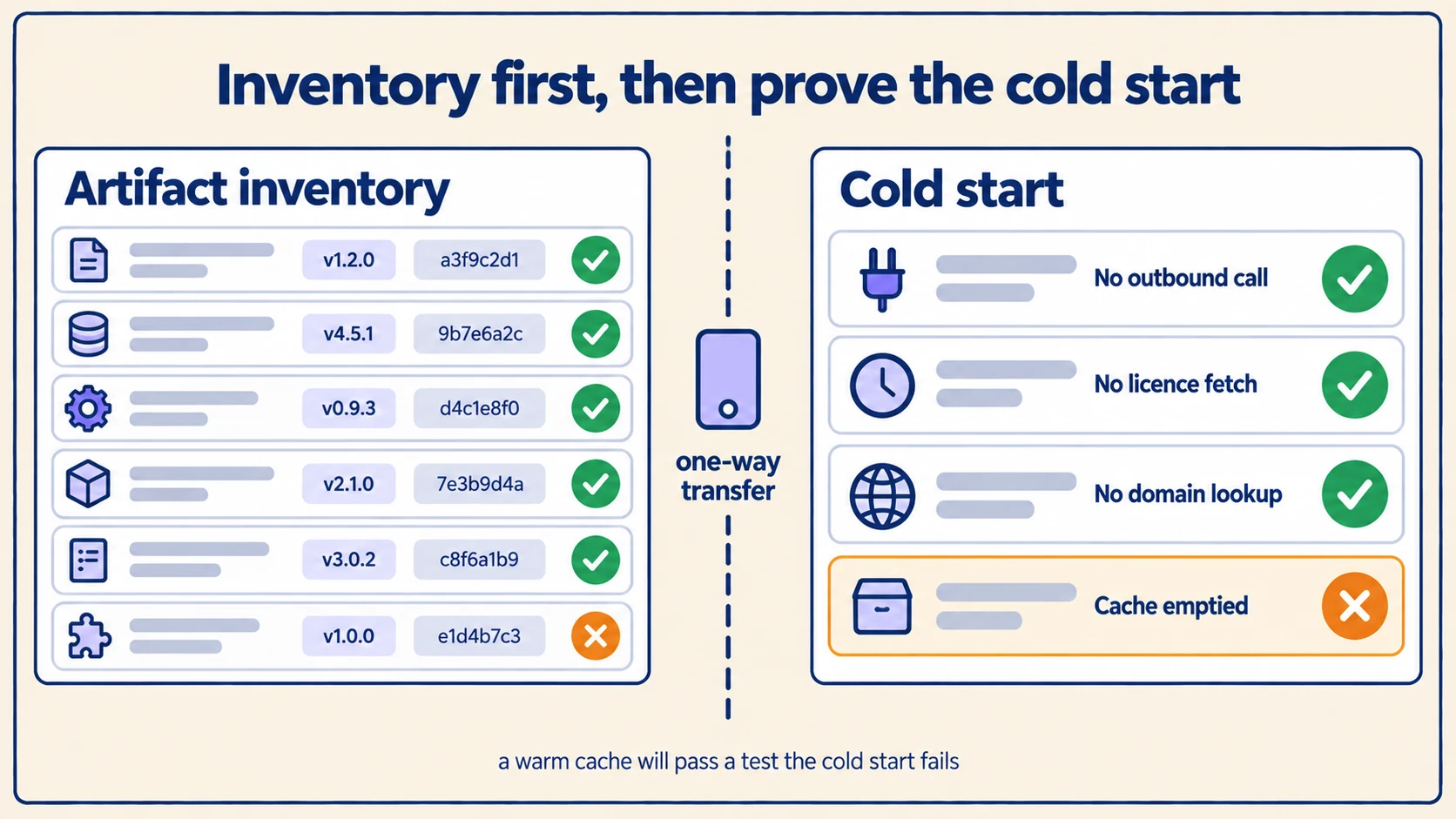
Deploying an AI platform across an air gap requires creating a self-contained, cryptographically signed software release bundle. NVIDIA’s air-gap deployment documentation for NIM microservices establishes the critical operational methodology of separating bundle staging in an internet-connected DMZ from runtime execution inside the disconnected enclave.
The table below outlines the six mandatory artifact tiers that must be captured in the deployment manifest. The values below are deliberately synthetic and illustrative; they do not represent proprietary vendor configurations or benchmark claims.
| Artifact tier | Specific components to package | Verification evidence & integrity requirements | Downstream failure if omitted from bundle |
|---|---|---|---|
| 1. Model Weight Assets | SafeTensors model shards, quantized weights, vocabulary files, generation configs. | SHA-256 cryptographic checksums, Cosign digital signatures, license notices. | Inference server crashes on startup looking for missing config.json or tokenizer. |
| 2. Serving Runtimes | vLLM, TensorRT-LLM, or Triton container images; CUDA runtime libraries. | Pinned image digests (sha256:...); matching NVIDIA host driver versions. | CUDA driver-runtime mismatch halts GPU kernel compilation and allocation. |
| 3. Ingestion & Document Engines | Optical character recognition (OCR) models, layout parsers, language packs. | Offline language dictionaries, font files, and pre-compiled binary utilities. | Document processing fails on multilingual PDFs due to missing localized OCR glyphs. |
| 4. Application Infrastructure | Vector databases (Milvus/Qdrant), relational DBs (PostgreSQL), Redis caches. | OCI container archives, database schema migration scripts, Helm charts. | Database migration scripts fail attempting to pull public base images at runtime. |
| 5. Enclave Network Services | Local DNS zones, internal PKI root authorities, localized NTP time servers. | Internal IP bindings, mTLS x509 certificates, localized CRL bundles. | System components crash due to clock skew or TLS certificate validation failure. |
| 6. Diagnostic & Telemetry Tools | Prometheus exporters, Grafana dashboards, vector logging agents, packet capture. | Offline monitoring agents, diagnostic runbooks, local backup clients. | Platform operations teams have zero visibility into GPU thermal throttling or VRAM leaks. |
Every software artifact must be pinned to an immutable cryptographic digest rather than a mutable tag like :latest. Ensure software license terms explicitly permit offline redistribution and private deployment within air-gapped facilities.
Pro Tip: Never rely on dynamic package managers (pip,npm,apt) inside an air-gapped staging script. Package managers must be pointed to localized on-premises mirror registries (such as Harbor or Sonatype Nexus) pre-populated with verified wheel files, or container base images must be built with all dependencies completely pre-baked.
Execute cold-start verification and cache banishment testing
A common operational failure occurs when an application functions smoothly on a staging machine because the developer’s local workstation already has hundreds of gigabytes of hidden cached assets in ~/.cache/huggingface or /root/.npm. When the container is transferred to a clean, bare-metal server inside the air-gapped facility, the application immediately crashes because a critical auxiliary configuration was missing from the deployment bundle.
Hugging Face’s offline mode documentation highlights that offline operation relies strictly on pre-cached local files, requiring explicit configuration flags (HF_HUB_OFFLINE=1 and TRANSFORMERS_OFFLINE=1) to prevent libraries from initiating outbound network calls.
To verify true offline readiness prior to production handover, execute the Cold-Start Banishment Protocol:
- Provision a Clean-Room Node: Provision a freshly formatted physical server with bare-metal operating system installation and verified hardware drivers. Ensure all user directories and temporary cache directories are completely empty.
- Sever All Network Interfaces: Disconnect all physical ethernet cables, disable wireless interfaces in the BIOS, and enforce strict loopback firewall rules (
iptables -P OUTPUT DROP). - Load Assets from Sealed Media: Ingest the cryptographically verified release bundle via authorized removable media or internal secure transport.
- Boot from Cold State: Execute the container launch orchestration. Monitor system logs for socket timeout exceptions or connection refusal warnings.
- Execute Synthetic Workload Test: Run a suite of diverse test inferences: natural language reasoning prompts, complex multi-page PDF extractions, code generation tasks, and vector similarity searches.
- Trigger Complete Host Reboot: Reboot the physical server, verify that system services recover automatically on boot, and re-execute the test suite without attaching any external media.
If any component hangs, times out, or attempts to resolve a public domain name, the test fails. The engineering team must trace the offending process, vendor the missing asset into the local bundle, and restart the cold-start protocol from scratch.
Day-2 operations: Secure sneaker-net updates and rollback engineering
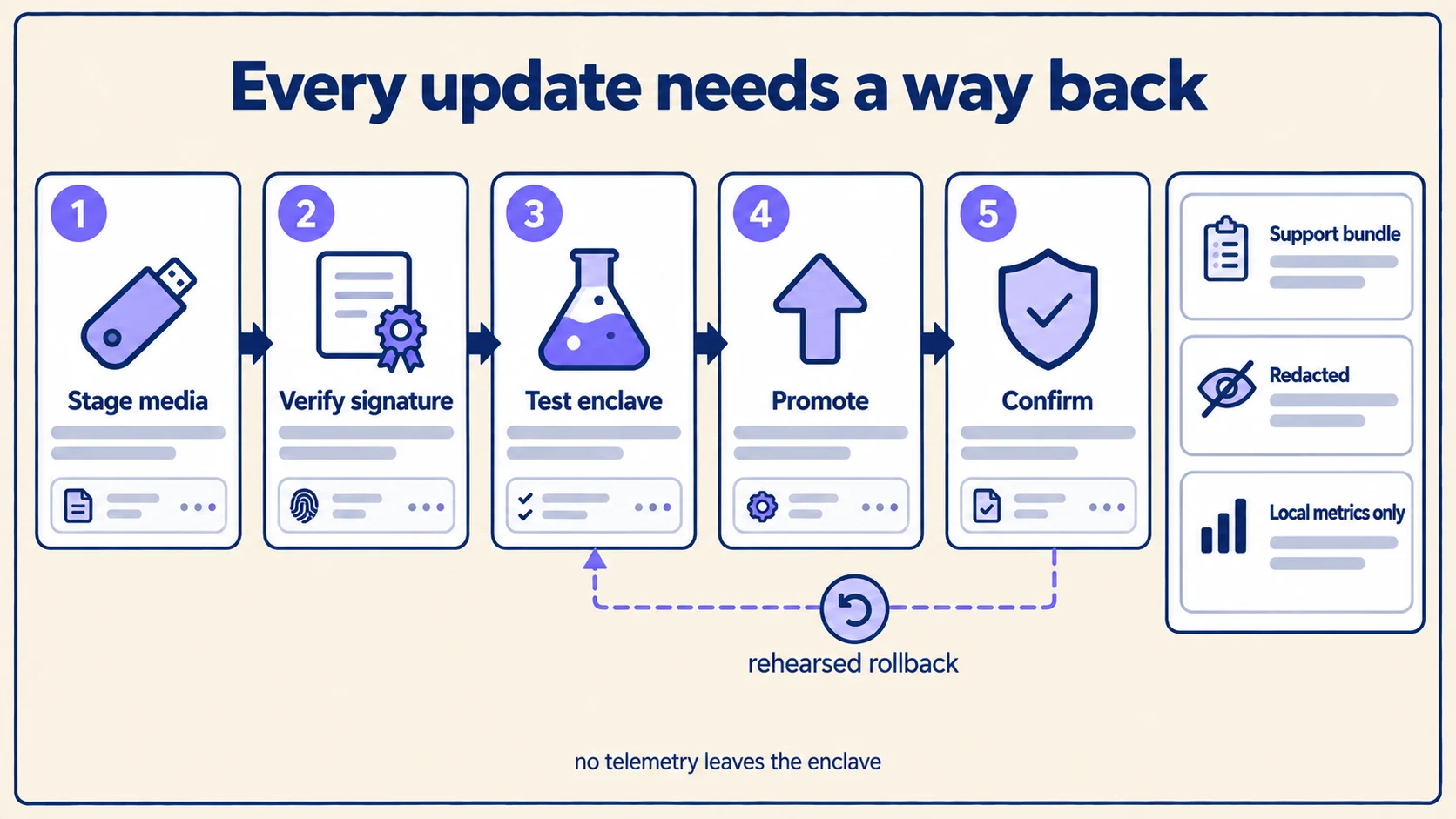
An air-gapped AI platform cannot remain static indefinitely. Security vulnerabilities in base operating systems must be patched, proprietary business documents must be indexed into vector databases, and refined model weights must be introduced. However, updates must be managed as formal, auditable release events.
Establish a disciplined Day-2 lifecycle runbook:
- Cryptographic Staging & Antivirus Scanning: All incoming update media must pass through an automated "kiosk" station outside the enclave. The kiosk verifies digital signatures, computes file hashes against approved manifests, and runs multiple independent commercial antivirus engines.
- Atomic Rollback Architecture: Air-gapped environments do not have the luxury of rapid cloud rollbacks. When deploying updates to an internal Kubernetes or Docker Swarm cluster, maintain blue/green deployment architectures. Keep the previous working model serving container and vector database index fully staged on disk until the new release passes comprehensive regression tests.
- Database Schema Migration Resilience: If an update introduces database migrations, ensure backward-compatible schema changes or automated downgrade scripts. Reverting a model container is trivial; reverting a corrupted relational database schema without external backups is an operational disaster.
Consult our detailed self-hosted AI update testing checklist to rehearse update cadences and rollback procedures prior to executing live changes in air-gapped production.
Localized monitoring, diagnostics, and support bundle redaction
When an AI system operates inside an air-gapped facility, standard vendor support workflows—such as screen-sharing sessions, automated error reporting, or direct SSH bastion access—are legally and physically prohibited. All observability, diagnostics, and incident remediation must be handled internally.
To ensure operational maintainability:
- Self-Contained Metrics Stacks: Deploy localized Prometheus and Grafana instances within the enclave. Monitor GPU core utilization, VRAM consumption, token throughput latency, queue depth, and host temperatures.
- Automated Redaction for Diagnostic Bundles: When an unresolvable platform defect requires vendor engineering analysis, operators must export a diagnostic bundle. The platform must provide an automated diagnostic export tool that sanitizes all sensitive business data: stripping document text, redacting prompt tokens, scrubbing IP addresses, and retaining only low-level system stack traces and error codes.
- Explicit Operator Runbooks: Deliver clear, human-readable troubleshooting runbooks. If a GPU worker crashes with an out-of-memory (OOM) error, the documentation must provide exact CLI commands to adjust tensor parallelism or reduce context window sizes without requiring external internet searches.
Review our technical guide on AI agent integrations without internet access to audit how autonomous tools interface with internal network resources inside disconnected enclaves.
The ten-point air-gapped handover certification checklist
Prior to formally accepting an air-gapped AI deployment into production, enterprise platform and cybersecurity officers must verify and sign off on ten operational criteria:
- Zero-Egress Network Verification: Packet capture tooling confirms zero outbound network packets when all firewalls are dropped and physical network lines are disconnected.
- Cryptographic Manifest Verification: All container images, model weights, and scripts match their pre-computed SHA-256 digests and Cosign signatures.
- Cold Boot Autonomous Recovery: The complete application stack boots cleanly and processes tasks from a cold reboot without human intervention or external media attachment.
- Local Identity Resolution: User and service account authentication functions over internal PKI and local directories without external OAuth dependencies.
- Full Modality Execution: Document processing, vector embedding generation, LLM inference, and agent tool calling all execute successfully using local models.
- Hardware Driver Stability: GPU driver versions, CUDA libraries, and container runtimes match certified hardware compatibility matrices without deprecated calls.
- Local Observability Operational: Real-time dashboards display GPU health, memory utilization, and inference latency on internal monitoring consoles.
- Automated Diagnostic Sanitization: Test diagnostic export scripts successfully generate support bundles with zero sensitive business PII or prompt text leakage.
- Validated Rollback Playbook: Operators successfully execute a simulated rollback from a blue deployment to a green deployment within ten minutes.
- Trained On-Site Personnel: Facility operations personnel successfully execute routine administrative tasks using exclusively offline documentation.
By enforcing these rigorous standards, enterprise organizations can harness cutting-edge generative AI capabilities while maintaining ironclad data sovereignty and uncompromising physical security.
To learn how our platform supports sovereign enterprise infrastructure, explore ExemplaryAI's sovereign deployment options and high-security File store. When you are ready to evaluate air-gapped capabilities against your agency's compliance frameworks, schedule an enterprise architecture briefing to discuss custom deployment manifests, data diode integration, and offline evaluation protocols.