Private AI deployment planning: on-premises, private cloud and air-gapped
Plan a private AI deployment around data boundaries, workloads, infrastructure ownership, integrations, updates, recovery, and evidence of production readiness.

Sarath Chandran
Private AI deployment planning should produce a clear boundary, a supported architecture, and an operating agreement. Before selecting infrastructure, establish where data may be processed, which services may be contacted, and who will run the system after installation.
In an era governed by stringent data sovereignty mandates, trade secret protections, and rigorous compliance regimes—including the EU AI Act, HIPAA, FedRAMP High, ITAR, and regional sovereign cloud directives—enterprises cannot afford to treat AI deployment as an ad-hoc experiment. Deploying large language models, autonomous agents, and document intelligence systems within enterprise perimeters requires far more than spinning up a GPU virtual machine and pulling an open-weight model from a public repository. A successful private AI deployment represents an end-to-end operational architecture: it establishes cryptographic boundary controls, provisions scalable GPU compute fabrics, isolates internal networks, formalizes data retention lifecycles, and enforces disciplined Day-2 maintenance runbooks.
Key Architecture Rule: Private AI is an operational commitment across software, data, infrastructure, and governance. Never select hardware or model weights before defining the exact data classification boundaries, operational ownership responsibilities, and catastrophic disaster recovery targets.
1. Define the cryptographic and operational boundary in plain language
In commercial technology marketing, the phrase "Private AI" is applied loosely to everything from virtual private clouds to dedicated on-premises supercomputers. Hewlett Packard Enterprise's overview of private AI architectures highlights how private deployments span a spectrum from dedicated edge infrastructure to managed sovereign clouds. A defensible enterprise deployment plan cannot rely on marketing slogans; it demands explicit boundary definitions.
Document exactly where each category of enterprise data resides, where it is transformed, and where it terminates:
- Raw Evidentiary Substrates: Physical documents, audio recordings, video transcripts, and relational records.
- Derived Ephemeral Artifacts: OCR tokens, layout bounding boxes, and intermediate image crops.
- High-Dimensional Embeddings: Vector representations stored in dense indices.
- Prompt Payloads & Context: System instructions, retrieved RAG context snippets, and conversational histories.
- Generated Model Outputs: Completed responses, structured JSON entities, and code artifacts.
- Operational Diagnostic Telemetry: System logs, Prometheus metrics, GPU traces, and error dumps.
- Cryptographic Secrets & Identity: API keys, database credentials, mTLS certificates, and OAuth bearer tokens.
A robust boundary policy establishes an explicit whitelist of permitted internal services, documents authorized network transit protocols, and legally prohibits unvetted outbound connections. Distinguish normal steady-state operations from initial installation and maintenance workflows; an architecture that allows temporary external package downloads during staging must be completely sealed during production runtime.
2. Compare deployment arrangements across the responsibility spectrum
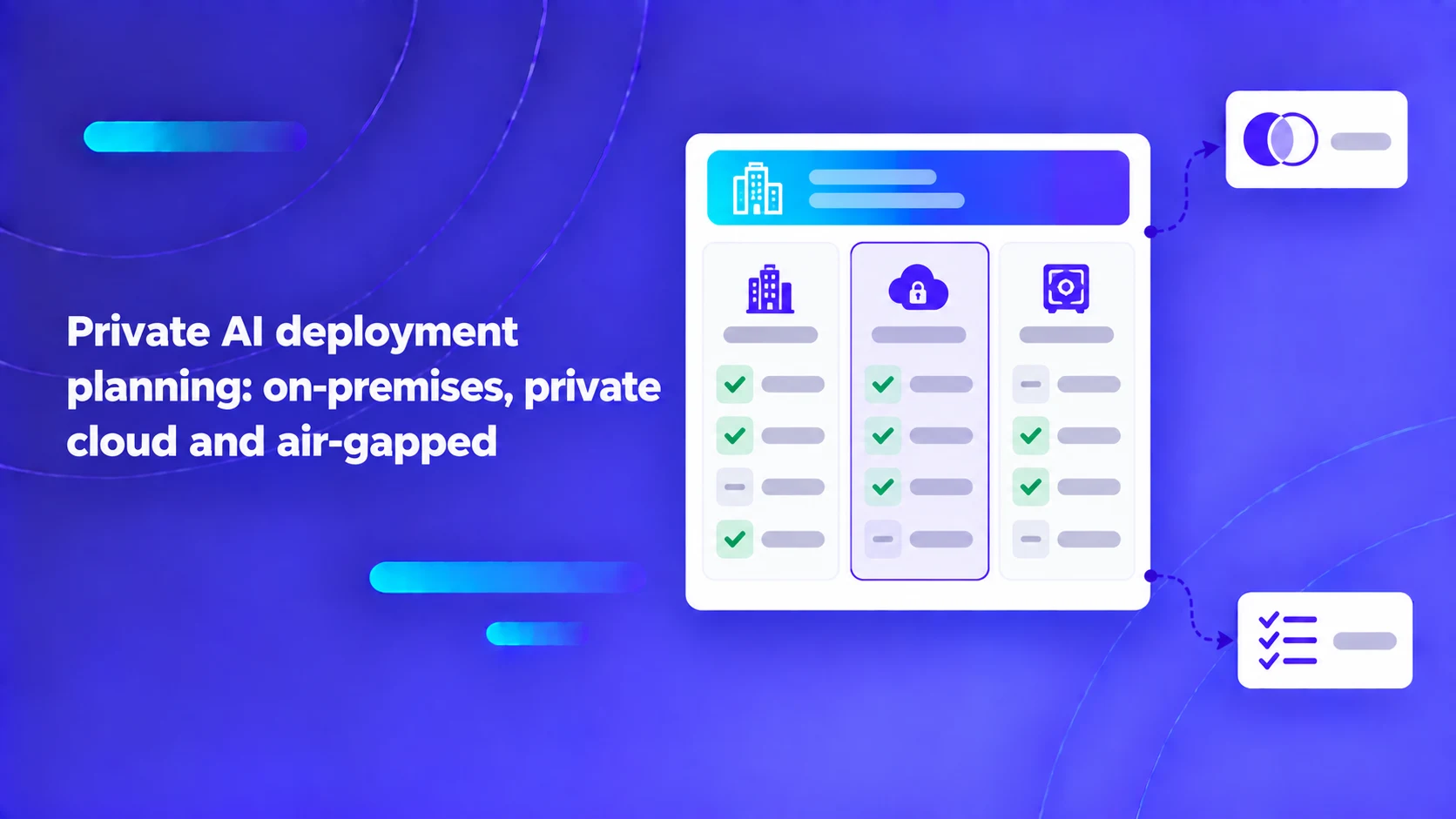
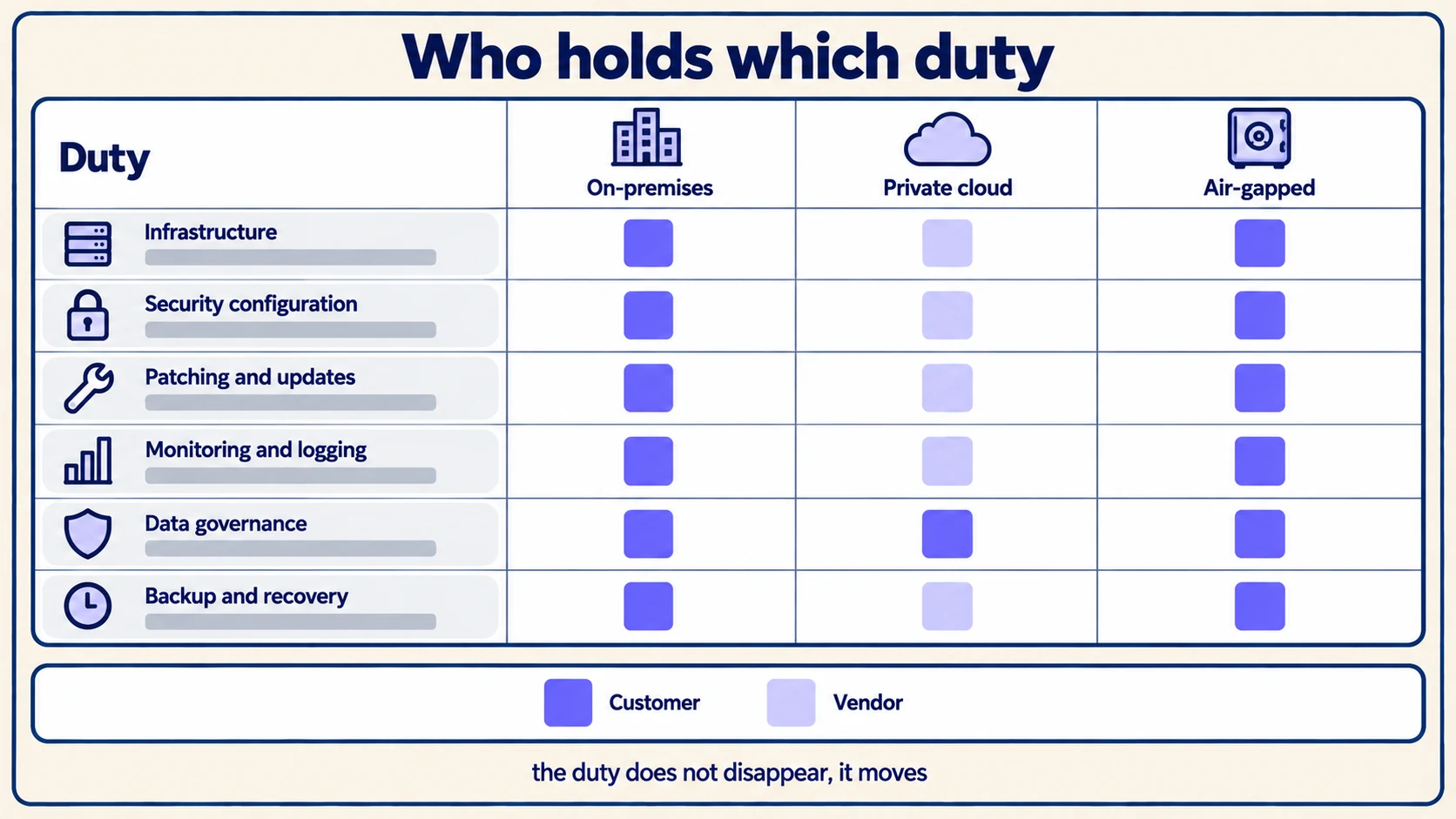
Organizations must evaluate four primary deployment topologies, evaluating the operational tradeoffs between administrative burden and regulatory isolation. The table below details these four architectural models. The descriptions below are general planning frameworks; they do not represent proprietary product configurations.
| Deployment topology | Physical & logical infrastructure ownership | Network egress posture | Core operational responsibilities |
|---|---|---|---|
| 1. Dedicated On-Premises | Physical servers located within customer-owned enterprise datacenters. | Fully customer-managed; can be completely disconnected or air-gapped. | Customer manages physical hardware, power, cooling, hypervisors, and OS patches. |
| 2. Sovereign Private Cloud | Dedicated, single-tenant cloud infrastructure (e.g., AWS Dedicated Hosts, Azure Sovereign). | Isolated virtual private cloud (VPC) with customer-controlled gateways. | Cloud provider maintains hardware and hypervisors; customer manages software and models. |
| 3. Air-Gapped Sovereign Enclave | Physically isolated bare-metal hardware with zero internet or corporate WAN connectivity. | Strictly prohibited: Physical media transfer or unidirectional optical data diodes. | Customer manages complete offline lifecycle, manual artifact ingestion, and cold updates. |
| 4. Hybrid Zero-Retention Gateway | On-premises orchestration calling external models with cryptographically enforced Zero Data Retention (ZDR). | Authenticated egress via secure proxy; strict ephemeral processing contracts. | Enterprise manages application tier; cloud model provider processes inference without logging. |
The NIST Definition of Cloud Computing (SP 800-145) formalizes that a private cloud must be provisioned for exclusive use by a single organization comprising multiple consumers. Simply provisioning a multi-tenant SaaS workspace with tenant-level logical partitioning does not constitute private cloud infrastructure under federal standards.
Furthermore, the NIST Computer Security Resource Center glossary establishes that an air gap requires physical separation across a defined perimeter. Blocking outbound HTTP traffic via basic firewall rules represents a restricted network partition, not true physical air-gap isolation.
Review our dedicated technical analysis on on-premises AI outbound data flows to trace how outbound connections traverse network perimeters.
3. Prioritize high-value workflows before provisioning hardware
The most frequent cause of enterprise AI pilot stall is purchasing multi-million-dollar GPU clusters before defining the specific business tasks the hardware must execute. Sizing an AI deployment based on total employee headcount inevitably results in severely under-utilized or hopelessly bottlenecked systems.
Begin with a tightly bounded high-value workflow characterized by:
- Identified Business Sponsor: An executive owner with defined operational KPIs (e.g., reducing contract review cycle time by 60%).
- Standardized Input Corpus: A curated, accessible repository of domain-specific documents or structured databases.
- Strict Downstream Schema: An unambiguous output destination (e.g., populating claims records in Guidewire or vendor vouchers in SAP).
- Quantified Error Tolerance: Explicit business definitions of acceptable abstention versus catastrophic hallucination.
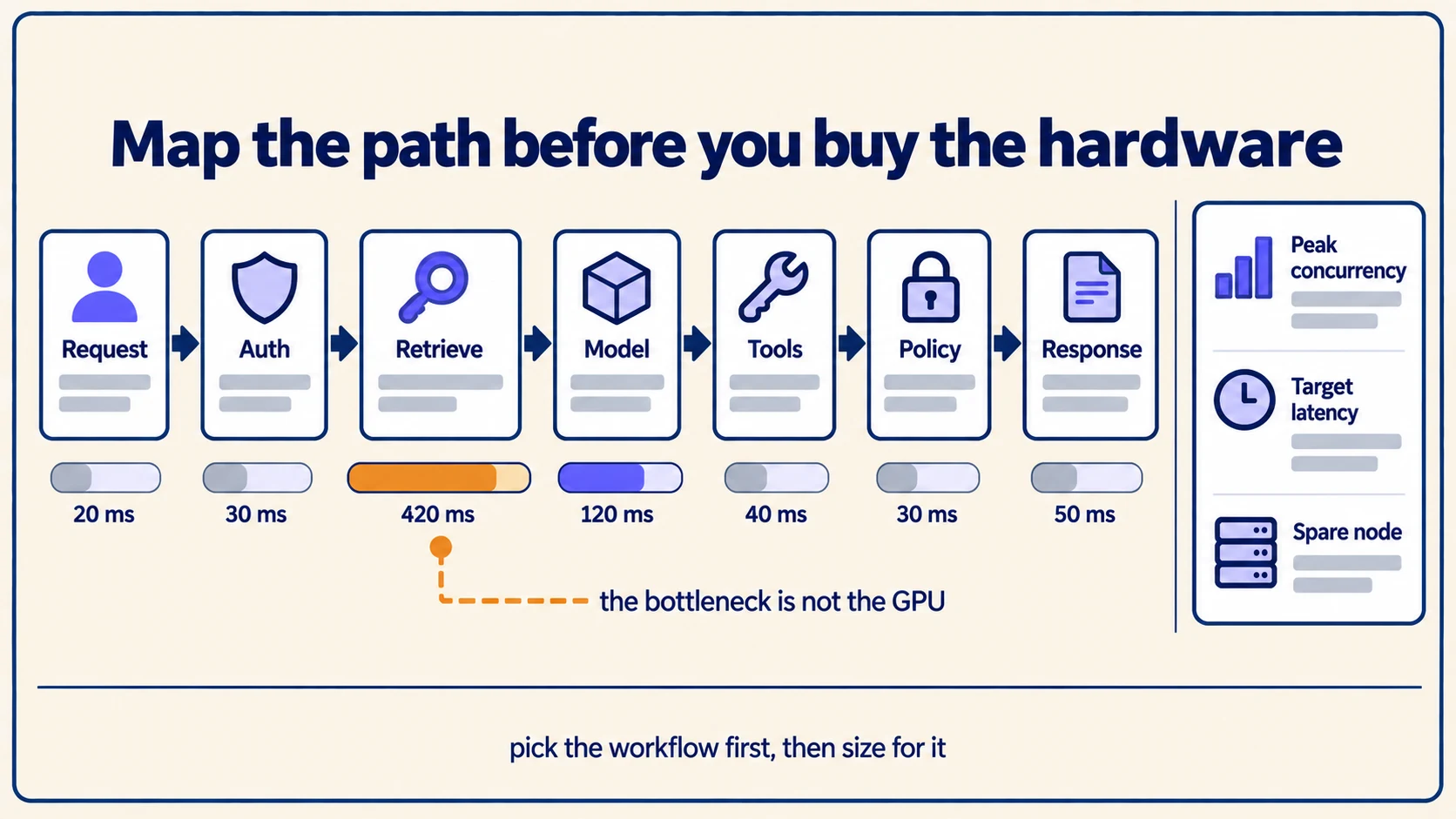
Profile the computational characteristics of the selected workflow: input prompt token length, expected output completion size, peak concurrent transaction arrivals, and maximum acceptable latency percentiles. Use our Model Hub to explore open-weight model architectures, and apply our rigorous benchmarking methodology for on-premises AI workload sizing to translate task requirements into concrete GPU memory bandwidth allocations.
4. Map the complete end-to-end transaction service path
An AI deployment is a distributed ecosystem. Drawing a high-level box labeled "AI Engine" obscures the complex network hops where latency, security vulnerabilities, and single points of failure originate.
A complete architectural service map must trace:
- Client Ingress Tier: Load balancers, API gateways, and web clients managing streaming Server-Sent Events (SSE) connections.
- Identity & Access Management (IAM): Enterprise identity providers (LDAP, Active Directory, Keycloak) issuing localized JSON Web Tokens (JWT) or Kerberos tickets.
- Orchestration & Agentic Middleware: Application pods executing business logic, prompt formatting, and autonomous tool calling.
- Retrieval & Context Tier: Vector databases (Milvus, Qdrant, pgvector) and hybrid lexical search engines (Elasticsearch).
- Model Inference Tier: Local GPU serving engines (vLLM, TensorRT-LLM, Triton) managing continuous batching and PagedAttention memory.
- Persistent Systems of Record: Relational databases, enterprise ERPs, and object storage arrays.
Inspect the boundaries between these tiers. Verify whether communication occurs over private subnets, whether internal traffic is encrypted via mutual TLS (mTLS), and whether any microservice contains hidden dependencies on public external endpoints.
5. Establish a formal shared responsibility matrix
Operational failures frequently occur not from software defects, but from organizational ambiguity—where platform engineering assumes the cybersecurity team manages certificate renewal, while the cybersecurity team assumes the application team handles it.
The matrix below defines a practical enterprise responsibility allocation. The roles below are illustrative and must be adapted to your organization's operating charter.
| Operational domain | Primary internal owner | Handover evidence & operational deliverables |
|---|---|---|
| Physical Hardware & Datacenter | Enterprise Facilities / Data Center Operations | Rack power density certification, liquid cooling telemetry, hardware warranty SLAs. |
| Network Fabric & Perimeter Security | Enterprise Network Security / SecOps | Firewall ingress/egress policies, DNS zone delegation, proxy routing rules. |
| Host Operating System & GPU Drivers | Platform Engineering / SRE | Pinned Linux kernel releases, NVIDIA CUDA driver certification, container runtimes. |
| Model Lifecycle & Serving Runtimes | MLOps / AI Platform Team | Serving engine optimization, quantization benchmarks, model weight verification. |
| Data Pipelines & Ingestion (RAG) | Data Engineering Team | Vector index synchronization, document chunking parsers, ETL data freshness monitoring. |
| Application Logic & Agentic Tooling | Application Development Team | Tool schema manifests, business validation logic, user experience interfaces. |
| Disaster Recovery & Business Continuity | Enterprise Continuity Officer / SRE | Point-in-time backup snapshots, tested RTO/RPO runbooks, clean-room recovery drills. |
Ensure clear escalation handoffs: define who receives alerts when GPU VRAM exceeds 95%, who approves model weight upgrades, and who possesses authorization to initiate an emergency cluster rollback.
6. Audit tool integrations and air-gapped dependencies
Autonomous agents deliver immense business value by interfacing with external enterprise tools: querying databases, updating Jira tickets, generating pull requests, and triggering robotic process automation (RPA) workflows. However, in private and air-gapped environments, integration connectors represent high-risk data leakage vectors.
Key integration validation rules:
- Inspect Connector Transport: Ensure connectors communicate via localized protocols (such as Model Context Protocol / MCP over local sockets) rather than invoking remote cloud-hosted tool endpoints.
- Audit Authentication Lifecycles: Verify that connectors authenticate using localized service accounts or internal mTLS certificates, avoiding public OAuth redirects that fail in disconnected networks.
- Review Data Currency & Sync Latency: If live integrations are replaced with periodic database snapshots, clearly document data staleness thresholds to prevent agents from acting on obsolete business state.
Consult our detailed architectural evaluation of AI agent integrations without internet access to audit tool compatibility in disconnected enclaves.
For strictly isolated environments, package all model weights, container images, tokenizers, and language packs into an immutable manifest, following the rigorous guidelines in our air-gapped AI operating requirements.
7. Plan the complete Day-2 operational lifecycle
A private AI deployment plan must account for the months and years following initial installation. Generative AI systems require continuous operational stewardship:
Lifecycle Upgrades and Regression Testing
Updating foundational models, serving engines, or vector databases introduces severe behavioral drift. A model update can alter prompt adherence, break JSON schema emission, or invalidate high-dimensional embedding spaces. Rehearse updates in an isolated staging environment using automated golden evaluation datasets, as detailed in our guide on self-hosted AI update testing.
Operational Monitoring and Telemetry
Traditional server monitoring is fundamentally inadequate for generative AI. Implement comprehensive observability tracking the Golden Signals of AI: Time to First Token (TTFT), Inter-Token Latency (ITL), KV cache block utilization, queue saturation depth, and vector query latency. Follow the Prometheus instrumentation standards detailed in our guide to self-hosted AI monitoring, and use our diagnostic playbook for self-hosted LLM performance troubleshooting to remediate bottlenecks.
High Availability and Disaster Recovery
Decouple service continuity from data protection. High availability keeps the platform online during hardware component failures through N+1 GPU replica clustering, load balancing, and Pod Disruption Budgets, as outlined in our guide to private AI high availability. Conversely, disaster recovery protects persistent state against catastrophic data center loss through synchronized point-in-time backups across relational databases, document object stores, and vector indexes, detailed in our guide to private AI backup and recovery.
8. Construct a fully burdened Total Cost of Ownership model
Avoid the dangerous trap of comparing bare server hardware costs against cloud per-token API rates. A defensible business case must evaluate the fully loaded Total Cost of Ownership (TCO) across compute capital depreciation, power consumption, PUE cooling overhead, enterprise software licenses, and dedicated engineering labor.
Review our comprehensive private AI total cost of ownership worksheet to analyze unit economics, model multi-scenario sensitivity variations, and identify the GPU utilization threshold where on-premises infrastructure achieves superior ROI over public cloud APIs.
9. Enforce an eight-stage readiness verification gate
Prior to authorizing a private AI deployment for production workloads, platform teams must require formal sign-off across eight sequential verification gates. The table below outlines the required empirical proof for each gate.
| Verification gate | Core architectural assertion | Mandatory empirical evidence required |
|---|---|---|
| Gate 1: Boundary Verification | Zero unauthorized data egress across the defined perimeter. | Packet capture telemetry (tcpdump/eBPF) confirming zero external IP calls. |
| Gate 2: Workload Baseline | Representative business tasks satisfy accuracy acceptance criteria. | 100-sample golden evaluation suite passing with >= 98% schema compliance. |
| Gate 3: Capacity & Latency | System satisfies agreed SLO percentiles under peak concurrent load. | Measured P95 TTFT < 1,000ms and sustained token throughput under load test. |
| Gate 4: Dependency Readiness | Stack boots completely from clean-room state without external fetches. | Cold-start verification test passing with empty local caches on sealed media. |
| Gate 5: Operational Observability | Monitoring dashboards and alerting rules are operational. | Prometheus exporters reporting GPU VRAM, KV cache, and latency metrics. |
| Gate 6: Change & Rollback | Upgrades and rollbacks execute without data loss or prolonged downtime. | Demonstrated blue/green cutover and clean rollback completed within 15 minutes. |
| Gate 7: Disaster Recovery | Full platform state can be restored from cold backup archives. | Successful clean-room restoration validating RTO < 4h and RPO < 15m. |
| Gate 8: Operational Handover | Platform operations team can execute runbooks independently. | Successful execution of routine administrative tasks by non-vendor engineers. |
A gate is never satisfied merely because a vendor promises support or because an architecture diagram looks clean. If an empirical test fails, the gate must remain open until the engineering team resolves the bottleneck or records a formal risk acceptance sign-off.
10. Bring a structured deployment brief to your architecture review
An actionable deployment brief consolidates business objectives, technical boundaries, hardware sizing, operational responsibilities, and financial models into an integrated roadmap:
- Executive Summary: Targeted enterprise workflows, operational KPIs, and data sovereignty regulatory drivers.
- Cryptographic Boundary Map: Permitted networks, data classifications, and egress firewall rules.
- Hardware & Capacity Plan: Sizing calculations for GPU compute, KV cache memory, storage tiers, and high-availability redundancy.
- Integration Inventory: List of internal databases, document repositories, and tools accessed by autonomous agents.
- Operational Charter: Shared responsibility matrix, monitoring dashboards, backup cadences, and update testing protocols.
To evaluate how our sovereign platform accelerates private deployments, discover ExemplaryAI’s sovereign deployment options, explore leading models in our Model Hub, and review pre-built enterprise integrations. When you are ready to review your deployment brief with our systems engineering team, schedule an enterprise architecture briefing to evaluate secure on-premises, private cloud, and air-gapped configurations tailored to your organization's exact compliance requirements.